
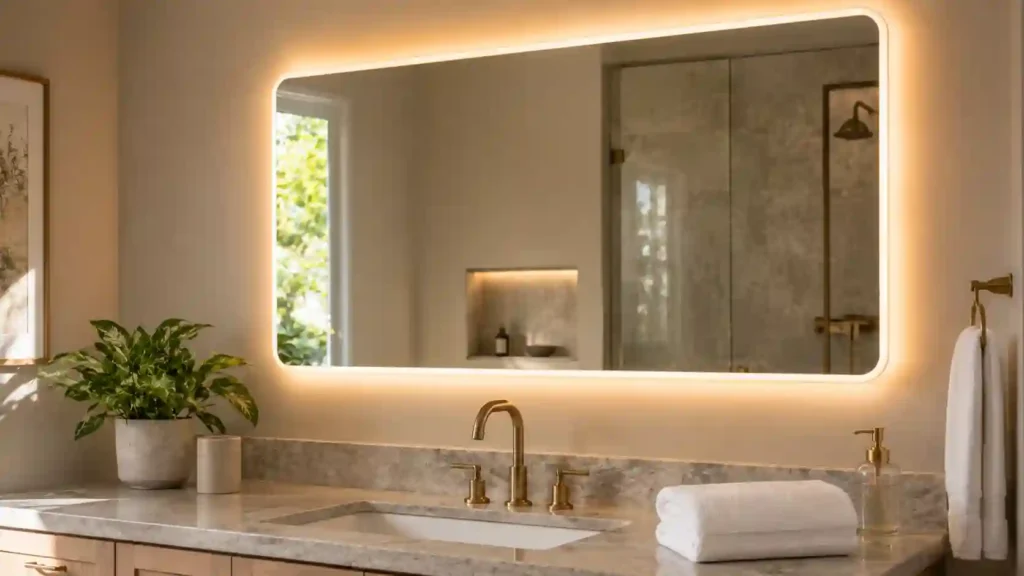
I hung a bathroom mirror at exactly the wrong height once measured from the floor instead of from the vanity, which sounds like a minor distinction until you’re six months in and still ducking slightly every morning to see your own face properly. Took me an embarrassingly long time to admit the mirror was wrong rather than just adjusting my own posture around it. That’s the thing about a mirror on bathroom walls it’s one of the few design decisions in a home that you interact with every single day, multiple times, often half-asleep. Getting it wrong is a daily friction point. Getting it right is something you stop noticing entirely, which is exactly the point.
Most people researching mirror on bathroom options focus entirely on style shape, frame, finish and treat size and placement as an afterthought. That ordering is backwards, and it’s the single most common mistake I see in bathroom renovations.
Mirror on Bathroom Walls – Why Size and Placement Matter More Than Style:
The Measurements That Actually Determine Daily Usability:
Before any mirror on bathroom wall choice involving shape or frame matters, the size and mirror height need to be correct. The widely agreed standard places the mirror centre height between 57 to 65 inches from the floor, which aligns with average adult eye level for most households. For households with notably tall or short primary users, that range shifts single-user bathrooms can tailor mirror height directly to that person’s eye level, while shared or guest bathrooms should split the difference and aim for the middle of that range to serve the widest group comfortably.
The relationship between mirror placement and the sink below matters just as much as the floor-to-centre measurement. Standard guidance puts the bottom of the mirror 5 to 10 inches above sink clearance and faucet clearance, ensuring no splashing reaches the glass while keeping the mirror visually tied to the vanity below rather than floating awkwardly with a large gap.
For accessible mirror height under ADA mirror height guidelines, the bottom of a mirror above a countertop must sit no higher than 40 inches from the floor, while a standalone wall-mounted mirror not above a counter should have its bottom no higher than 35 inches, with the top reaching at least 74 inches so standing users can see themselves regardless of mobility.
Mirror width follows its own logic. The general rule for a mirror on bathroom vanity is to choose something between 70-100% vanity width rule narrower than the full vanity width by a few inches creates the balanced look most designers aim for, while running a mirror the exact width of the vanity or slightly wider suits powder rooms or primary bath spaces wanting a more dramatic, oversized statement. For a standard 600mm vanity width, that translates to a mirror sized proportionally rather than picked arbitrarily off a shelf.
Double Vanity Mirror on Bathroom Layouts — One Large Piece or Two Separate Mirrors:
Solving the Shared Bathroom Symmetry Problem:
Double vanity setups create a specific decision point that single-sink bathrooms never face. A mirror on bathroom double vanity arrangement can go one of two ways: one large mirror spanning both sinks for a clean, unified look, or two separate mirrors centred individually over each basin for more personalised styling. The double vanity mirror size rule, when going with separate mirrors, typically leaves 4 to 6 inches between the two pieces, with each mirror sized 2-4 inches narrower mirror rule relative to the section of vanity it sits above.
The “non-identical twin mirrors” trend addresses this exact situation in a way that feels considered rather than mismatched two mirrors sharing a similar overall vibe but varying slightly in shape, frame, or finish, which defines each user’s individual space within a shared bathroom while still reading as a coordinated design choice. This works particularly well on larger 60-inch vanity and 72-inch vanity setups, where sconce lighting or individual backlighting between the two mirrors adds both function and visual separation.
For couples or shared family bathrooms, this decision genuinely affects daily routine, not just aesthetics eliminating the “morning rush hour mirror battle” that a single small mirror over a double vanity inevitably creates.
Mirror Shapes and What Each One Actually Does for the Room:
From Frameless Minimalism to Sculptural Statement Pieces:
The shape of a mirror on bathroom walls changes the entire feel of a room more than most people expect going into a renovation. Rectangular mirror choices remain the most versatile and timeless option, working in nearly any style from minimalist bathroom to Victorian-style bathroom settings. Round mirror and oval mirror shapes introduce a calming, spa-like vibe, breaking up the hard lines that tile and cabinetry naturally create these particularly suit mid-century bathroom or coastal bathroom aesthetics.
Arch mirror and arched mirror designs bring a graceful, timeless quality through their soft curve, while organic shape mirror and sculptural mirror options wave-shaped mirror, pill-shaped mirror, asymmetrical mirror lean into the more artistic, design-forward end of current bathroom mirror trends. Half-circular mirror designs incorporating built-in storage solve a small-space problem elegantly, combining mirror medicine cabinet functionality with a distinctive shape rather than the boxy rectangle most medicine cabinets default to.
Layered mirror setups combining a clear mirror with a subtly tinted glass layer, or overlapping multiple shapes at staggered levels function almost as wall art in addition to their reflective purpose, adding visual dimension and increasing light play in a way a single flat mirror on bathroom wall space simply can’t replicate. This works particularly well in eclectic or hotel-style bathroom settings wanting the mirror itself to act as a statement piece rather than purely a utility fixture.
Frame Choices, Finishes, and the Frameless Debate:
Matte Black, Brushed Gold, and When to Skip the Frame Entirely:
Whether to choose a framed mirror or frameless mirror for a bathroom is one of the more genuinely debated decisions in bathroom design, and both have real trade-offs worth understanding. A framed mirror adds definition through colour, texture, or material wood frame mirror, metal frame mirror, marble frame mirror, or lacquer frame mirror options each reinforce a specific design theme, whether that’s Art Deco, modern farmhouse, or a more vintage mirror aesthetic. The downside: thick frames can feel bulky in a genuinely small bathroom, and natural materials risk water damage over time if not properly treated for humidity.
Frameless mirror designs, by contrast, create a sense of expanded space precisely because there’s no visual interruption between mirror edge and wall particularly valuable in a small bathroom or compact bathroom wanting to feel larger than its actual square footage. The trade-off here is reduced decorative opportunity; you lose the colour and texture a frame would otherwise contribute, and mounting hardware may remain slightly visible depending on installation method.
Finish trends currently favour matte black mirror and brushed gold mirror or brushed silver mirror options, both offering timeless elegance that pairs well with brass accents, gold flecked stone, or burnished metal fixtures elsewhere in the room. A black and gold mirror combination, framed in thin gold with a circular shape, works particularly well as a genuine focal point against burnished gold sink hardware. Patina finish mirror and antique mirror styles, with ornate detail and beveled edge mirror treatment, suit farmhouse, eclectic, or Victorian-style bathroom spaces wanting an heirloom feel rather than a contemporary one.
Smart Features Worth the Investment (And Which Ones Aren’t):
LED Lighting, Anti-Fog Tech, and What Actually Gets Used Daily:
This is where mirror on bathroom shopping has changed most dramatically in recent years. Backlit mirror and LED backlit mirror options now appear in roughly 90% of high-end remodels, and for good reason they deliver shadow-free light with minimal glare, which matters enormously for grooming and makeup application compared to a single overhead fixture casting harsh shadows across the face. Smart mirror features have grown from a rare luxury to appearing in over 40% of new luxury home builds within five years, driven by genuine daily utility rather than novelty alone.
Anti-fog mirror and demister mirror functionality sometimes delivered through an integrated heating pad behind the glass solves the single most universally annoying bathroom mirror problem: a foggy mirror immediately after a hot shower. Touch sensor mirror and motion sensor mirror controls remove the need to fumble for a switch with wet hands, while colour temperature adjustment lets you shift between warm light for evening relaxation and cool light for precise daytime grooming. High CRI LED lighting specifically matters for makeup application, since it renders skin tones and colours more naturally than standard LED output.
Not every smart feature delivers equal value. Bluetooth mirror and voice-activated mirror functions are genuinely nice-to-have rather than essential pleasant for some households, irrelevant for others. The features worth prioritising on any mirror on bathroom wall installation, in order of actual daily impact: backlit LED lighting first, anti-fog functionality second, touch or motion sensor controls third, with everything else as optional extras based on personal preference and budget.
Matching the Mirror to Your Bathroom’s Overall Style:
Coordinating Frame, Finish, and Shape With Existing Fixtures:
A mirror on bathroom walls works best when chosen as part of the whole room rather than in isolation. Mirror frame colours should echo faucets and towel racks gold, black, or brushed silver consistency across fixtures creates a cohesive look rather than a mismatched collection of individually nice pieces. Lighting colour temperatures should harmonise with main lights and wall sconces to avoid visual conflict between warm and cool tones competing in the same small space.
For a luxury bathroom or primary bath aiming for genuine differentiation, custom-cut mirror options tailored to non-standard wall dimensions solve layout problems a standard rectangular mirror simply can’t address particularly valuable above a pedestal sink, across an entire wall, or suspended over an unusual backsplash configuration. Custom bathroom mirror ordering has become considerably more accessible in recent years, giving homeowners real control over exact size, shape, and integrated features rather than compromising with off-the-shelf options.
Full wall mirror and full-length mirror installations amplify natural light dramatically and double the visual space in narrow or windowless bathroom settings a trick borrowed directly from luxury spas and upscale hotels now making its way into ordinary primary bath renovations. For anyone genuinely unsure where to start, the safest sequencing is: confirm vanity width and mirror height first, choose frameless or framed second, select shape third, and treat smart features as the final, optional layer rather than the starting point.
Conclusion:
A mirror on bathroom walls is one of the few fixtures you’ll interact with daily for years, which makes getting the fundamentals right considerably more important than chasing the latest trend. Start with mirror height in the 57 to 65 inch range, respect sink clearance, size the mirror proportionally to your vanity width, then layer in shape, frame, and smart features based on your bathroom’s specific style and your household’s actual needs.
Whether you land on a frameless minimalist mirror, an ornate antique-style piece, or a fully tech-integrated smart mirror with anti-fog and backlighting, the version that works best is the one sized and placed correctly from the start not the one adjusted around afterward, the way I spent six months doing with mine.
FAQs
The standard is a mirror centre height between 57 and 65 inches from the floor, which lines up with average adult eye level for most households. Single-user bathrooms can tailor that height to the specific person using the space, while shared or guest bathrooms do better splitting the difference toward the middle of that range to work reasonably well for a wider range of heights.
A framed mirror adds colour, texture, and a clear design statement, reinforcing a specific style like Art Deco or farmhouse, but thick frames can feel bulky in a genuinely small bathroom and natural materials risk water damage without proper humidity treatment. A frameless mirror creates a sense of expanded space since there’s no visual break between mirror and wall, making it the stronger choice for a compact bathroom, though you do lose that decorative opportunity a frame provides
Going with two separate mirrors instead of one large piece, the standard is to leave 4 to 6 inches of space between them, with each mirror sized 2 to 4 inches narrower than the vanity section it sits above. Larger 60-inch and 72-inch double vanities handle this especially well, particularly when sconce lighting or backlighting is added between the two mirrors for both function and visual separation.
Backlit LED lighting delivers the most daily impact by far, since it provides shadow-free light that makes grooming and makeup application noticeably easier than a single harsh overhead fixture. Anti-fog functionality ranks second for genuine daily usefulness, with touch or motion sensor controls a solid third, while extras like Bluetooth or voice-activated controls are nice-to-have rather than essential, worth adding only if budget allows.


1 thought on “Mirror on Bathroom Walls Gone Wrong: 6 Costly Mistakes That Ruin Your Daily Routine”