
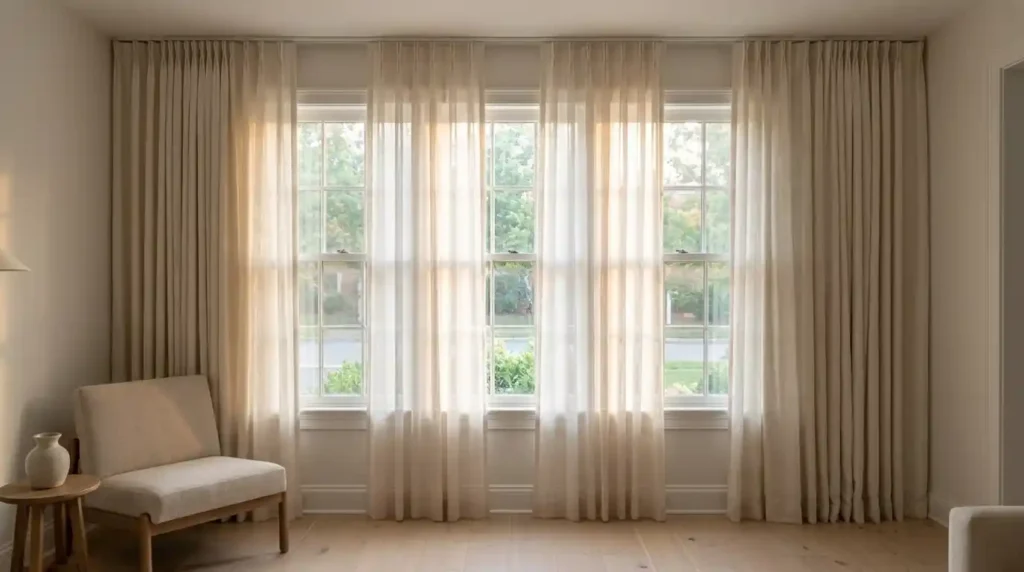
While most curtains guides consider the selection of fabric as an aesthetic choice of deciding whether to use linen or velvet or sheer or solid fabric according to one’s taste. It is not the complete picture. A curtain should be seen as a layer in the process of managing the amount of light, heat. And noise entering a room and failing to achieve this would result in having to live in a room. Which is either too bright at 6 AM or too hot throughout summer afternoons. The very essence of this guide is to select fabrics. And lining according to what the room needs in the first place.
What Curtains Actually Need to Do Before They Look Good:
Every curtain choice starts with a functional question that gets skipped too often in favor of picking a color first. What does this specific room actually need from its window treatment?
Do You Need Blackout or Just Light-Filtering Curtains?
Blackout draperies block nearly 100% of all light entering. Whereas light-filtering or sheers allow a considerable amount of light to pass. Around 80 to 95% depending upon the weave and backing. Something that must be verified from the manufacturer’s information before purchase as to how much light is blocked. Blackout drapes should be used in the bedroom and nursery. Especially in households with employees working on the night shift. And those with children who take their naps during the daytime. Light blocking drapes are suitable for the living room and the kitchen. Because blackout drapes give the living room an appearance of a cave.
How Do You Know If You Need Thermal Lining?
Thermal lining delivers the most immediate benefits. When you have an old house with single paned windows or rooms facing the extreme sun during winters and summers. The thermal lining of the curtains gives a good insulating value to reduce heat loss during winters. And heat gains during summers this way, you get to minimize the fluctuation in the temperature of the room. Without adjusting the thermostat. If you have got new windows with double glazing, then the effect will not be as much.
Fabric Choices and What They’re Actually Good At
Fabric is where most of the buying decisions actually happen. And each material genuinely performs differently rather than just looking different. Picking based on appearance alone is how people end up disappointed a season later.
Linen vs Velvet: Which Fabric Fits Which Room?
Linen is appropriate for a living room or dining room setting. That requires something cozy and has no need for much light obstruction as it is breathable. And naturally not opaque, requiring a lining for this purpose. Velvet is a better choice in a bedroom or a formal setting where not only aesthetics. But also sound absorption, matters. It is more dense than linen and thus absorbs more environmental noise. When a room is exposed to a busy street, this advantage of velvet becomes truly practical. And not simply aesthetic.
What’s the Difference Between Voile, Organza, and Sheer Cotton?
Voile is similar to organza because both materials are sheer fabrics. However, the difference lies in their drapes. Whereby voile has a softer and more matte texture compared to organza which is crispier and reflective. Sheer cotton stands out in between the other two sheer fabrics, being somewhat natural and textured. To create a layered look which is one of the most effective techniques. Combine a sheer fabric with a blackout fabric so that you are able to regulate light through the day.
Getting the Fit and Hardware Right:
A great fabric choice still looks wrong if the length, width. Or hardware is off and this is where a lot of otherwise good curtain purchases fall apart visually.
How Wide Should Curtains Be for a Full, Layered Look?
The sum of the lengths of the curtains. Should be about 1.5 to 2 times the width of the window opening itself. Which is the correct ratio that gives the curtains just enough material for proper draping. One small curtain hanging from one large window will usually always look inadequate regardless of the quality of the curtain material. It would be a wiser investment if there is a limited budget and you need one curtain on each side of the window, to purchase wider curtains than needed.
Should Curtains Touch the Floor?
Indeed, in the majority of cases, curtains which graze the floor or even have an inch or two break like dress pants do make a stronger impression than those which don’t reach all the way to the floor. The little puddle of an inch or two excess fabric creates a more luxurious impression in living rooms and bedrooms. The only exception is kitchen and bathroom curtains, which can be shorter and end at the windowsill level.
Hardware, Tracks, and Rod Choices:
Hardware is easy to treat as an afterthought. But the wrong rod or track can undercut an otherwise good curtain choice, both visually and functionally.
The use of warm metal finishes has prevailed as far as hardware goes. With brass and aged bronze leading the pack in the case of both linen and velvet furnishings within contemporary interiors. Instead of brushed nickel and chrome finishes. Which were popular a decade ago, warm metals have gained popularity in this regard. While wall-mounted rods serve well for most windows, ceiling-mounted or recessed track systems are the better choices if you want a more modern and clean look, since the track system does not involve any visible rod.
Curtains as More Than Window Coverings:
Curtains are increasingly used for jobs that have nothing to do with an actual window. And this is one of the more useful, underused ideas in the whole category.
A floor-to-ceiling curtain could be utilized as a soft room partition in an open plan setting where privacy is required but without having to spend on building a wall. If curtains are hung from one end to the other at the opening of a wardrobe, it can serve the function of doors without costing money for their installation. The use of curtains behind a desk in a home office or anywhere else where video conferencing is held would not only serve to block sound but also make for a more professional appearance.
Conclusion:
The ideal curtains begin with a practical choice and then become a work of aesthetics. Choose the blackout or thermal liner only if necessary; choose fabric according to its performance rather than according to how it looks in a picture; and measure well so that even the simplest of curtains will have function written all over them. Once this difficult task has been achieved. choosing color and pattern will be easy.
FAQs About Curtains:
How would I be able to know whether or not I should go for blackout curtains or light-filtering ones? This is because the function of blackout curtains is ideal in areas like bedroom, nursery or other areas where darkness is crucial as they filter out almost 100 percent of light that comes into the room.
How wide should curtains be to appear full instead of sparse? They must have a combined width of 1.5 to 2 times that of the closed window; that is the normal proportion for a truly full appearance. One panel that is too narrow and is stretched tight across a window almost never appears right regardless of how nice the material is.
Is there more sound absorption from velvet curtains than linen curtains? Yes, since the weave in velvet is much denser, it does indeed have more sound absorbing properties than the lighter material of linen curtains. While the latter can also be used to help decrease the noise, it is used primarily due to its casual feel.