
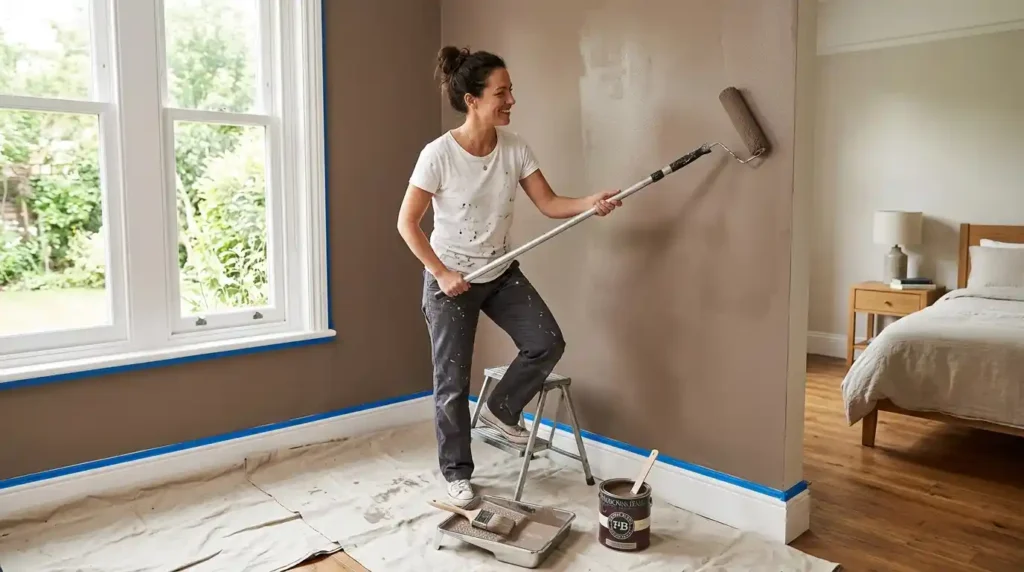
Most people underestimate room painting until they’re standing in a half finished bedroom at 11pm with roller marks across the wall and paint on the skirting board they spent forty minutes taping. I’ve been there. And what I learned the hard way is that interior painting isn’t difficult, but it is sequential. Do the steps in the wrong order and you spend twice the time fixing what you rushed. Do them in the right order with the right materials and a 12×12 room goes from bare walls to two finished coats in a weekend without drama.
The single most important thing the Family Handyman, Benjamin Moore, and Behr all agree on and that most DIY painting guides bury in paragraph six is that surface preparation is the project. The painting itself is almost mechanical once the prep is right. Get the prep wrong and no amount of premium paint corrects it.
Wall Preparation: The Step That Determines Whether Your Paint Job Lasts Four Years or Ten
Room painting preparation starts before a brush touches a wall. Remove all furniture you can move and cover the rest with drop cloths. Take down outlet covers, vent grilles, switch plates, blinds, and any wall fixtures. This sounds obvious but it’s where most DIYers cut corners and it’s where paint splatters land that you spend an hour cleaning later.
Wall Preparation
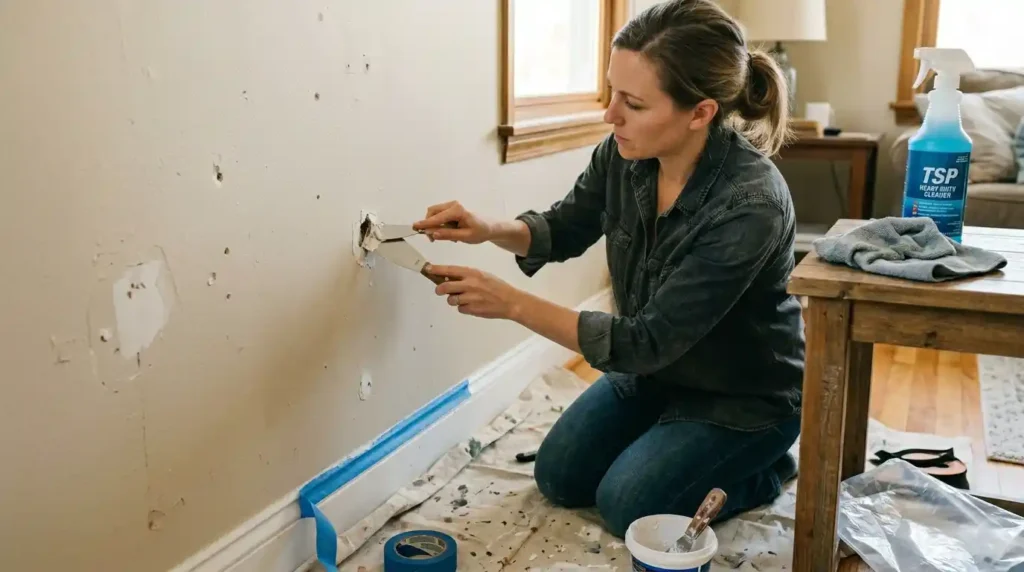
Wall preparation for painting means inspecting every surface for cracks, holes, dents, and imperfections before anything else. Fill holes and dents with spackling compound or joint compound using a putty knife, feathering the edges flat. For larger cracks, use a skim coat of joint compound, allow it to dry fully, then sand smooth with 220 grit sandpaper or a sanding sponge.
A sanding block or sanding pole works well for broader wall areas. After sanding, wipe every surface with a damp cloth to remove dust any dust left on the wall will show through your paint finish like texture you didn’t choose.
Wall Washing
Wall washing is a step that gets skipped more often than any other and causes more adhesion failures than any other. Clean all walls with a soft cloth and a mixture of warm water and trisodium phosphate TSP particularly in kitchens where grease builds on surfaces invisibly, and in bathrooms where soap residue accumulates. Once walls are clean and dry, wall priming before painting matters more than the brand of topcoat paint you chose.
A primer creates the mechanical bond between the wall surface and the paint. Skip it on patched areas and you’ll see the patches through two coats of premium paint. Fresh Start High-Hiding All-Purpose Primer from Benjamin Moore is worth the extra step on heavily patched walls or when transitioning from a dark color to a light one.
If your property was built before 1978, lead paint safety is not optional. Follow EPA renovation repair and painting program guidelines before sanding or disturbing existing paint. Test first, ventilate properly, and use a respirator mask and appropriate safety gear throughout.
Paint Selection: Sheen, Grade and Color In That Order
The choice of color comes first and the choice of sheen comes second although that should not be the case since professional painters always consider the latter before moving to choose colors. The paint sheen by room type is easy to comprehend since you just need to know what each paint finishes do. For instance, flat paint/ mat paint absorbs light and therefore perfect for hiding imperfections hence good for ceilings and low-traffic bedroom walls.
Eggshell finish paint is midway between flat and semi gloss paints making it an excellent option for living rooms and bedrooms because it has just enough sheen to be cleanable but not to highlight every little flaw on the wall surface. Choosing whether to use eggshell or satin paint is based entirely on the traffic since the latter should be used in corridors, kids’ rooms and in dining areas since such areas have more traffic. The use of semi-gloss and glossy paints in various rooms is also explained above.
Choosing Paint Grades
In choosing paint grades is where the cost-benefit analysis comes in. The budget paint ranging from $25-$35 per gallon of builder-grade paint needs three coats for complete coverage and can last four to six years before showing signs of wear. The premium paint that costs around $50-$70 per gallon of paint and can be as expensive as $85 to $95 per gallon of Benjamin Moore Aura in 2026 can have complete coverage with two coats and can last eight to ten years.
Within the professional realm of interior painting, choosing premium paint which can cover in two coats ends up saving money on labor compared to budget paint which needs a third coat.
Paint Color Selection
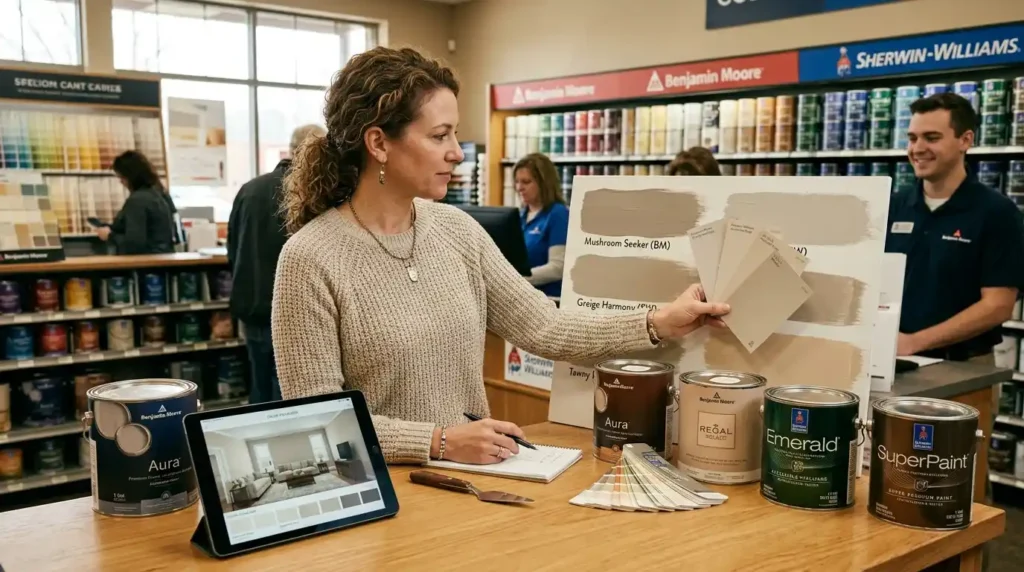
Paint Color Selection After Sheen and Grade, Not Before! An awareness of the paint undertone whether your color is warm, cool, or neutral in relation to the lighting of your space ensures you won’t fall victim to the one true color crime: choosing the right paint that looks totally wrong when applied to the wall. Light Reflectance Value, or LRV, is what determines the reflective quality of your paint color. Paints with low LRV values absorb light making your room feel smaller and moodier, ideal for rooms with northern exposure, an office space, or by design choice.
High LRV paints will reflect light and make a small room appear large. When considering resale, neutral paint colors such as white, light gray, greige, and this year’s trending 2026 mushroom paint with its neutral undertones that change with the light increase home value perception over bold colored paint selections.
Use a digital paint visualizer, room visualizer, or paint app before committing to any color. Paint sampling strategy matters: a large sample swatch applied directly to the wall and observed across morning light, afternoon light, and artificial evening light tells you more than ten small swatches taped to the wall.
The Right Painting Order and Technique That Eliminates 90% of Common Mistakes
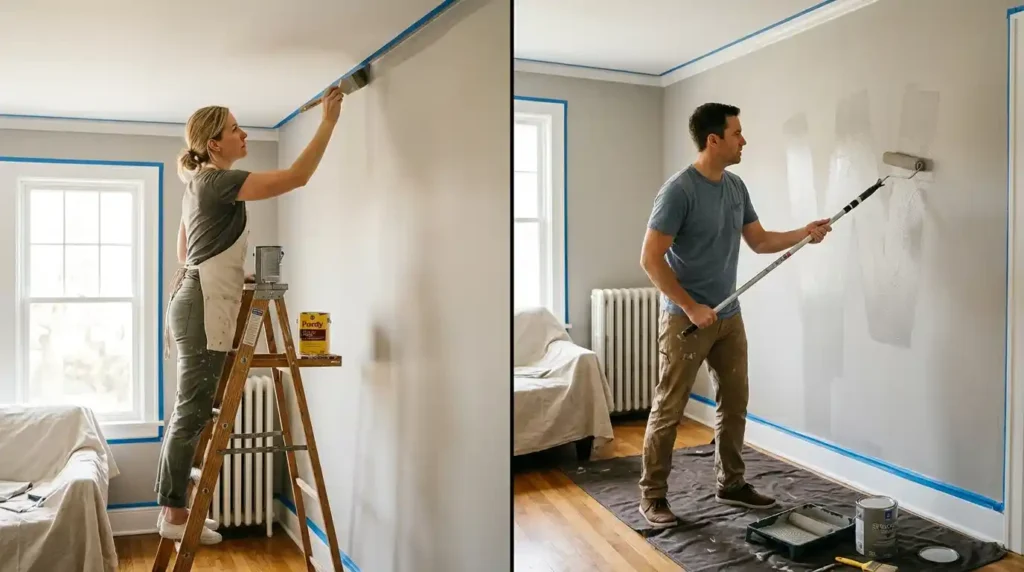
The correct order of painting rooms determines whether it is done by a professional or an amateur. Always start with ceiling painting. Drips of paint can land on walls during ceiling painting, so by doing walls first, you are redoing your work unnecessarily.
A good ceiling should be painted using a 3/8 inch nap roller starting from one direction. In case of another layer, it should be rolled in a different direction from the initial one. Ceiling paints require drying for approximately one hour.
Before Painting Walls
Before painting walls in the room, the first task is to paint the trim of the room. This technique may be confusing but by doing this way, one can have some mistakes while painting as the wall paint will conceal them effectively.
Trim painting uses the 2.5 inch angled sash brush. You must paint from top to bottom where door trim should come first followed by window trim and finally the baseboards. After finishing trimming, painter’s tape must be placed before painting walls.
Cutting In Technique
The cutting in technique is where DIY results most commonly diverge from professional results. Using an angled sash brush a cutting-in brush load paint into the brush and draw a clean line along the ceiling wall junction, corners, around windows, and along tape lines, extending approximately six inches down from the edge.
Cutting in creates the border that your roller cannot reach without creating visible overlap lines. Work in sections of roughly six feet so the cut in edge stays wet when the roller follows this is the wet edge technique that prevents lap marks from forming where a dried edge meets fresh roller paint.
Roll The Walls With The W Pattern Rolling Method
Roll the walls with the W pattern rolling method: Draw a big W on the wall using the roller, but do not remove the roller from the wall; just fill up the remaining parts inside the W. Do not make the W too wide keep the width to around one arm span, that is, 24-32 inches. Roll the walls starting from the top to the bottom, ensuring to maintain a wet edge. One gallon of paint covers 250-300 square feet of wall area.
You can estimate your wall areas and multiply by the ceiling height and deduct the window and door areas. If you want to change from a dark color to a light one, expect to have at least a third coating, which costs an extra $50-70 per 300 to 400 square feet.
For interior latex, acrylic, and water-based paints, allow at least one hour to two hours between paint applications. For oil based paint, give at least six to eight hours between paint layers. Low VOC paint and zero VOC paint are increasingly becoming the preferred type of paint for interiors in the US, UK, and Australia due to their low off-gassing levels compared to conventional interior paint.
Tape Removal Process
Tape removal process is often overlooked in many guides. Take off painter’s tape while paint is wet, not after it is dry. Paint removal from the surface by pulling the tape is inevitable when the paint is already dry, resulting in a torn, bumpy appearance. Pull off at a 45-degree angle on itself.
DIY vs Professional Painting: The Real Cost Calculation for 2026
A DIY interior painting job will cost between $200 and $600 per room in 2026, with regard to material costs such as paint, primer, drop cloths, painter’s tape, sanding sponges, roller covers, and brushes. Painting by professionals is priced at $700 to $1,800 per room, with an average price of $624 per room for a 12×12 room at $2 to $6 per square foot nationwide.
A DIY interior job for a 2,000-square-foot house comprising of 8 to 10 rooms is priced between $1,500 and $3,500, compared to $4,200 and $11,500 by a painting contractor. A two member painting contractor will take 3 to 5 days to paint an interior of 1,500 square feet.
Skilled Painters
Skilled painters in major US metros charge $32 to $48 per hour in 2026, with labor representing 70% to 85% of the total professional painting invoice. Painting costs increased 5% to 8% in 2026 versus 2025, driven by labor rate increases, workers compensation increases of 12% year over year, and elevated TiO2 pigment costs that pushed premium paint lines including Benjamin Moore Aura to $85 to $95 per gallon.
The painter vetting process should include a written painter contract, clear painter timeline, detailed painter prep work scope, and an explicit painter cleanup agreement before any work commences.
ROI Rationale For Resale Value
ROI rationale for resale value through painting is clear: while it costs between $4,000 and $8,000 to get a whole-house repaint job done by a professional, it will boost home value perception by $8,000 and up to $15,000, claim real estate experts.
The most advised neutral paint colors when prepping a house for sale include white, light gray, greige, and earthy neutral paint due to the widened scope of possible buyers. Interior painting job is always number one in terms of home improvement and its ROI.
Conclusion
How to paint a room correctly is one of the best transferable skills when it comes to renovating your house and probably one of the best return on investment skills too. There will be a noticeable difference in the end product between a do it yourself effort that will make your room look amateurish or one that will make it look professionally done.
Proper sanding, priming only in certain areas, painting in a specific order, keeping a wet edge, and taking off any tape while the paint is still wet are all factors that can affect the outcome. If you follow these steps, the color you picked whether it be mushroom paint or a greige color ends up the way it was supposed to look on the visualizer tool.
FAQs
Always start with the ceiling, then move to trim, and paint the walls last, since drips from ceiling work can land on walls and get covered up by the wall paint anyway. Doing it in the reverse order means redoing work unnecessarily, which is one of the most common mistakes that separates an amateur paint job from a professional-looking one.
Budget paint costs $25 to $35 a gallon but typically needs three coats and lasts four to six years, while premium paint runs $50 to $95 a gallon, covers in just two coats, and lasts eight to ten years. Once you factor in the labor time saved by not needing a third coat, premium paint often ends up being the more cost-effective choice overall, not just the nicer-looking one.
Cutting in means using an angled brush to paint a clean line along the ceiling-wall junction, corners, and window edges before rolling the rest of the wall, since a roller can’t reach cleanly into those spots. Working in roughly six-foot sections and keeping that cut-in edge wet while the roller follows right behind it is what prevents visible lap marks from forming where dried paint meets fresh paint.
DIY painting runs $200 to $600 per room in materials, compared to $700 to $1,800 for a professional, with the national average landing around $624 for a standard 12-by-12 room. For a full 2,000-square-foot house with 8 to 10 rooms, that gap widens considerably, with DIY running $1,500 to $3,500 versus $4,200 to $11,500 for a contractor.
Tape should come off while the paint is still wet, not after it’s fully dried. Pulling tape once the paint has dried risks peeling paint away with it, leaving a torn, bumpy edge, so removing it at a 45-degree angle while everything is still fresh gives you a clean line instead.
Flat or matte paint absorbs light and hides imperfections well, making it a good fit for ceilings and low-traffic bedroom walls. Eggshell works well in living rooms and bedrooms since it’s cleanable without highlighting flaws, while satin or semi-gloss holds up better in higher-traffic spots like hallways, kids’ rooms, and dining areas where walls get touched or wiped down more often.
4 thoughts on “How to Paint a Room: The Complete Guide That Actually Gets You Professional Results”