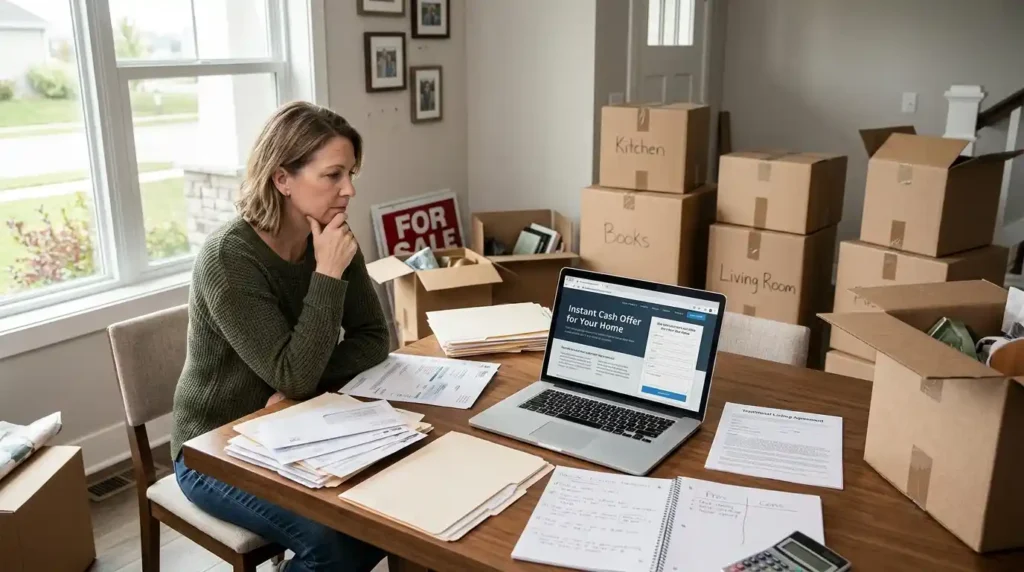
Most people searching “buy my house” are not browsing casually. They are in a specific situation a job loss, a divorce sale, an inherited property they do not know what to do with, a financial emergency that has turned the family home from an asset into a source of stress. I have spoken with enough homeowners in exactly these circumstances to know that the decision of how to sell is rarely straightforward, and the information available online tends to either oversell cash buyers or dismiss them entirely. Neither perspective is particularly helpful for someone who needs to make a fast and informed decision.
The real question is not whether to sell my house fast it is which method of selling fits your actual situation, your timeline, and the financial outcome you need.
What It Actually Means to Sell My House for Cash
When homeowners search sell my house for cash or companies that buy houses, they are typically encountering two distinct types of buyer that the industry often lumps together.
iBuyer Technology
The first is the iBuyer technology driven house buying companies like Opendoor, Offerpad, and formerly Redfin Now that use automated valuation models to generate an instant cash offer online. Opendoor operates across dozens of markets including Atlanta, Dallas, Charlotte, Las Vegas, Nashville, Orlando, Tampa, Miami, Raleigh, and Southern California. Offerpad covers similar geography. Both companies allow a seller to submit a home address, answer questions online, and receive an estimated home value and no-obligation offer within 24 hours Opendoor’s form takes roughly 5 minutes to complete and the company receives an offer request every 2 minutes nationally.
Local Cash Buyer
The second type is the local cash buyer a sell to investor or sell to flipper model operated by companies like We Buy Houses, We Buy Ugly Houses, SoCal Home Buyers, or independent house flipper networks. These are not technology platforms. They are investors who buy distressed property, problem property, and hard-to-sell homes including water damage homes, cracked foundation homes, fire damage homes, code violation homes, hoarder homes, and tenant-occupied homes that iBuyers will typically decline entirely.
Understanding this difference before requesting a cash offer saves significant time and prevents the frustration of submitting to an iBuyer only to receive a declined response because the property condition falls outside their buying criteria.
The Cash Offer Process: What Happens After You Request a Quote
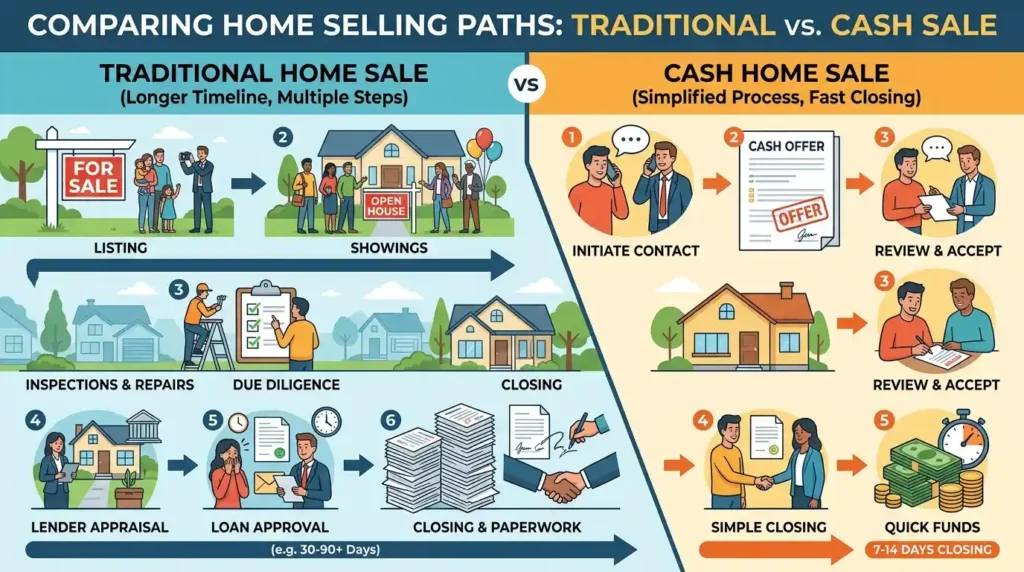
The cash home sale closing process follows a more compressed version of a traditional sale. After you submit your home address and complete the online assessment, the company conducts a property evaluation either virtually or through a home assessment visit and delivers an all-cash offer. Opendoor’s closing range runs 14 to 60 days with a minimum 14-day close. Offerpad closes in as few as 8 days. Some local cash buyers and We Buy Houses companies can close in 7 days for straightforward transactions.
What happens between offer and closing matters. The offer adjustment process is where most sellers feel the gap between the initial number and the final figure. Itemized adjustments for repairs, condition issues, and carrying costs are applied after the property evaluation. This is standard practice not a bait and switch but it is worth understanding before you accept the offer. No repairs required, no staging required, no cleaning required, and no showings required are genuine benefits, but they are priced into the offer itself rather than provided at no cost.
Opendoor
Opendoor allows a 17-day late checkout option post closing. Offerpad allows sellers to stay in the home for up to three days after closing and even includes a complimentary move within a 50-mile radius as part of its service. Seller chosen closing date and move out date flexibility are two of the most practically valuable features for sellers managing a simultaneous purchase or relocation for work.
Funds are disbursed at closing via wire transfer or check payment. There is no lender appraisal, no financing contingency, no mortgage approval process, and no loan fallthrough risk which is the single biggest structural advantage of a cash sale over a traditional listing in a volatile interest rate environment.
What Cash Buyers Actually Pay And What That Costs You
The 70 percent of market value figure circulates widely as the standard cash offer benchmark and it is a reasonable starting point for understanding local cash investor pricing. The reality for iBuyers is more nuanced. The average cash offer on a typical US home value of $368,198 has averaged around $230,124 in recent data though iBuyer offers tend to come in closer to market value than local investors, with the gap reflected in their service fee model rather than a direct price reduction.
Opendoor Service Fee
Opendoor service fee runs competitively against traditional agent commission. Agent commission of 5 to 6 percent on a traditional listing, combined with 9 to 10 percent total seller closing costs, staging cost, repair cost averaging $27,615, and carrying costs covering utilities during sale, taxes during sale, and insurance during sale across an 87-day national average listing to closing timeline the net proceeds calculation often narrows the gap between a cash sale and a traditional listing considerably. The 30 percent value reduction that headlines cash buyer criticism rarely reflects the true net proceeds comparison once all seller costs are factored in.
A 66 percent majority of sellers believe a cash offer will be under-market, and 44 percent consider a cash sale the least profitable option but this perception does not always match the net proceeds reality, particularly for sellers with a problem property, major repair needed home, negative equity, underwater mortgage, or a tight deadline that makes carrying costs a significant factor.
When Selling to a Cash Buyer Actually Makes Sense
Real estate professionals with 15 years of experience like Mark Biggins and investors like Doug Van Soest and Chris Doss have consistently identified the same seller profiles that benefit most from a cash sale: homeowners facing foreclosure or pre-foreclosure, sellers managing a divorce home sale, families dealing with a death in family home sale and inherited property, landlords with a tenant-occupied home or rental property they want to exit quickly, homeowners with a fixer-upper or sell as-is property they cannot or do not want to fund repairs on, and anyone facing a military PCS move or relocating for work on a timeline incompatible with a traditional listing.
The probate sale, estate sale, and sell inherited house fast situations are particularly well-suited to cash buyers because inherited property often carries deferred maintenance, title complexity, and emotional difficulty that makes the fast home sale model genuinely valuable beyond just speed.
Sell House
Homeowners trying to sell house in bad condition including sell my house with water damage, sell my house with foundation issues, or sell problem house situations have limited options on the open market. A Showcase listing on Zillow or a premium MLS listing will not overcome structural disclosure requirements. A cash buyer who specializes in distressed property pricing absorbs those issues into their offer rather than making them a transaction-killing obstacle.
The Traditional Sale vs Cash Sale Decision Framework
The 87-day national average listing to close figure is the honest starting point for any sell fast vs sell for more comparison. That 87 days breaks down as approximately 30 to 45 days closing period after a contract is accepted, plus the days on market period before an offer arrives. In a seller’s market with low inventory and buyer competition, days on market compresses and the financial case for a traditional listing strengthens significantly. In a buyer’s market with rising inventory, price reduction pressure, and loan fallthrough risk, the cash sale case strengthens in equal measure.
Las Vegas
Las Vegas market data illustrates this directly. With 19 percent inventory increase in Las Vegas 2026, 63 percent of Las Vegas homes selling below asking in 2026, and 5.3 percent Nevada unemployment as of January 2026, the Las Vegas Realtors LVR data shows 51 days to go under contract in early 2026 significantly slower than peak conditions. Neighborhood-level pricing shows $715K average in Summerlin South, $522K in Green Valley Ranch Henderson, and $448K in Centennial Hills meaningful variation that affects whether a quick cash sale or a fully-marketed MLS listing optimizes net proceeds in each specific submarket.
Nationally, 27 percent of all purchases were cash buyers as of March 2026, up from the 39.1 percent cash purchases peak of 2025. Mortgage rates 2026 hovering in the low 6 percent range have maintained financing risk as a real consideration for sellers whose buyers require mortgage approval.
Tools
Tools like HomeLight Simple Sale, Clever Offers, and iBuyer.com allow homeowners to request multiple cash offers simultaneously and compare them against an agent’s estimate of market value the most practical way to answer the question of how much will a cash buyer pay for my house in your specific market before committing to either path.
Where the seller wants the middle way, the Showcase listing of Redfin and Zillow’s premium listing with its $9K higher cost and 2 percent higher selling price data suggest that even in good market conditions, the better advertised and professionally staged traditional listing is better than the cash deal. For everybody else, the seller with an unappealing house, one with a pressing need for change, or who just prefers to have a concrete deal rather than to maximize it, there is always the possibility of buying a house in cash from a private party, which gives the following advantages, which the market cannot provide.
Conclusion
Your choice of sell my house is one of finance and life, but no two individuals have a single right answer to their own particular dilemma. It could mean accepting an iBuyer offer from Opendoor or Offerpad, shopping for competing cash offers with Clever Real Estate or HomeLight, or ending up listing your home through the MLS with a traditional listing agent. What matters is not buying into the iBuyer or listing agent narrative without doing your own numbers based on your own unique circumstances, but actually calculating your net proceeds on your own terms.
FAQs
An iBuyer like Opendoor or Offerpad uses automated valuation technology to generate an instant online offer within about 24 hours, typically for homes in reasonably sellable condition. A local cash buyer is an investor, not a tech platform, and specifically targets distressed or hard-to-sell property, like homes with water damage, foundation issues, or code violations, that an iBuyer will usually decline outright.
It depends heavily on market conditions and your specific costs, since the traditional route carries agent commission of 5 to 6 percent, total seller closing costs around 9 to 10 percent, and an average repair cost of $27,615, all stacked against an 87-day national average listing-to-close timeline. Once carrying costs like utilities, taxes, and insurance during that period are factored in, the net proceeds gap between a cash sale and a traditional listing often narrows considerably from what the headline offer numbers suggest
After submitting your address and completing an online assessment, the company evaluates the property, either virtually or through an in-person visit, then delivers an all-cash offer. From there, itemized adjustments for repairs and condition issues get applied before closing, which is standard practice rather than a bait-and-switch, but it’s exactly why the final number can differ from the initial estimate
The 70 percent of market value figure is a commonly cited benchmark for local investor pricing, though iBuyer offers tend to land closer to actual market value, with their cost showing up in service fees instead of a direct price cut. It’s worth noting that a majority of sellers assume a cash offer will land under market value, but that perception doesn’t always match the real net proceeds once traditional selling costs are subtracted from a comparable MLS sale.