There’s a particular kind of garden advice that looks impressive in a photo and falls apart by the second season. The plants were chosen for color, not climate. The patio furniture looked striking in the showroom and started fading by July. Nobody asked what the soil actually needed before they asked what would look good against it. Robert mygardenandpatio exists, in large part, as a correction to that pattern not by rejecting beauty, but by insisting it has to be built on something that survives contact with actual weather.
I’ve spent enough time reading through the philosophy behind mygardenandpatio to recognise a voice that didn’t come from a horticulture lecture hall. It came from years of trial and error, the kind of hands-in-the-soil experience that teaches you things no textbook covers what happens when you plant something a zone too ambitious, what a patio layout looks like after eighteen months of actual family use rather than the day it was photographed for the listing. That’s the foundation robert mygardenandpatio is built on, and it’s the reason the advice reads less like content and more like something a knowledgeable neighbour would tell you over the fence.
The Background That Shapes Every Recommendation
Robert isn’t a landscape architect with a framed credential on the wall, and that absence is worth sitting with rather than glossing over. His background is in environmental science and small-scale agriculture, which means the lens he applies to a backyard isn’t primarily aesthetic it’s ecological first, decorative second. A yard, in his framing, isn’t just for looks. It has to match the climate, support the soil, and last through the seasons without demanding constant intervention to stay alive.
That distinction matters more than it sounds like it should. A landscape architect trained in formal design principles tends to start with form sightlines, proportion, the visual composition of a space. Someone trained in environmental science starts with conditions what the soil is actually capable of supporting, what the regional climate will do to a planting scheme over a five-year horizon, which materials will hold up against freeze-thaw cycles or summer humidity without requiring replacement every other year. Robert mygardenandpatio sits at the intersection of those two instincts, and the content reflects it: practical advice that happens to look good, rather than good-looking advice that happens to be practical.
He started, by his own account, the way most homeowners do frustrated by cheap outdoor products, poor landscaping advice, and designs that read beautifully on paper but didn’t survive real-life use. That frustration turned into years of hands-on work building not just his own backyard but a body of knowledge worth sharing. The reputation that followed wasn’t manufactured through marketing. It accumulated the slow way, through readers who tried his recommendations and found they actually held up.
What Sets the Design Philosophy Apart From Generic Outdoor Content
Most gardening and patio content recycles the same handful of ideas across a thousand near-identical articles — add some string lights, get a fire pit, plant something colourful near the door. Robert mygardenandpatio’s design philosophy starts from a different premise entirely: that outdoor design isn’t about decoration. It’s about structure, flow, lighting, comfort, and nature working together as a system rather than a collection of separate purchases.
A plain garden is just land with plants. A thoughtfully designed garden becomes an experience somewhere families gather, somewhere friends relax, somewhere an individual finds a measure of peace after a difficult day. That reframing changes the entire decision-making process. Instead of asking “what looks good here,” the question becomes “what does this space need to function the way the people using it actually live.” A thoughtfully designed patio, in this framing, acts like an additional room of the house rather than an afterthought tacked onto the edge of the lawn.
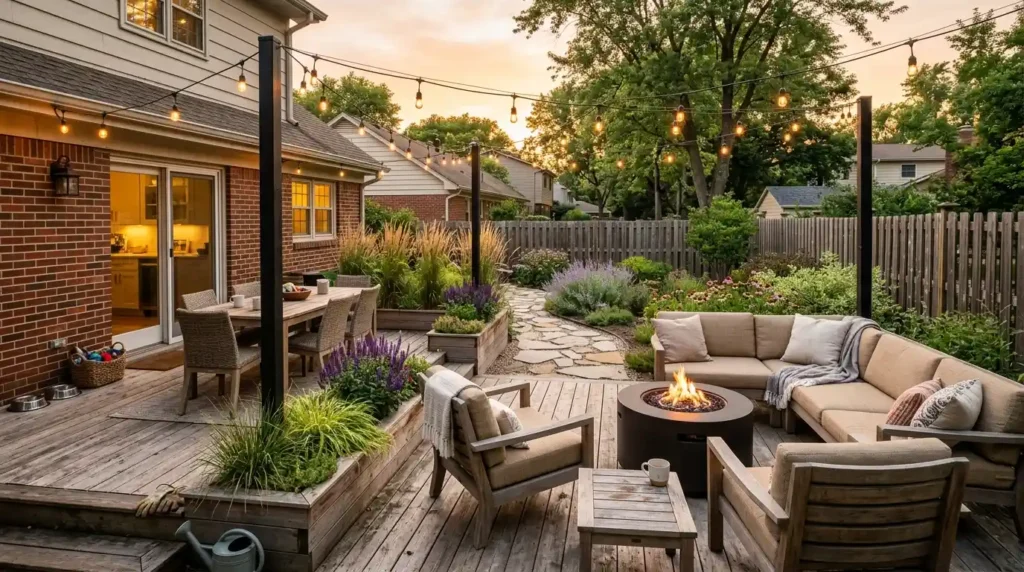
The multi-functional patio layout is one of the clearest expressions of this philosophy in practice combining seating, dining, and entertainment spaces within compact areas rather than assuming a backyard needs to be large to be genuinely useful. That approach matters considerably for homeowners working with a small balcony or a modest patio rather than a sprawling lot, and it’s part of why the advice connected with robert mygardenandpatio resonates with people who don’t have unlimited square footage to work with. Even small gardens can look luxurious when the layout is considered rather than improvised.
Sustainable Choices That Hold Up Past the First Season
Sustainable gardening techniques run consistently through the recommendations associated with mygardenandpatio, and they’re approached as practical decisions rather than ideological ones. Drought-resistant plants like Black Adder Agastache appear frequently in the planting recommendations not because drought tolerance is fashionable, but because a plant that survives a dry summer without constant watering is simply a better investment than one that needs daily attention to avoid dying. Eco-friendly materials follow the same logic: durability and reduced environmental impact aren’t separate goals here, they’re the same goal viewed from two angles.
This is where the environmental science background becomes most visible in the actual recommendations. Plant selection gets matched to regional climate and soil conditions rather than treated as a universal list that works identically in Phoenix and Portland. Regional gardening guidance acknowledges that what thrives in one part of the United States can struggle or fail entirely in another, and the advice connected to robert mygardenandpatio consistently steers readers toward understanding their own conditions before committing to a planting scheme that photographed well on someone else’s property in a different climate zone entirely.
Creative lighting solutions extend this same considered approach into the evening hours. Rather than scattering string lights for ambience alone, the lighting recommendations tend to highlight architectural and natural features deliberately while improving the actual usability of the space after dark lighting a pathway so it’s safe to walk, illuminating a dining area so it functions past sunset, rather than lighting purely for the sake of a warm glow in a photograph.
Seasonal Strategy and the Long View on Outdoor Spaces
Seasonal décor strategies are where a lot of outdoor content gets reduced to surface-level suggestions swap the cushions, add some pumpkins, done. The approach connected with robert mygardenandpatio takes a longer view: keeping outdoor spaces inviting throughout the year requires planning that accounts for what each season actually does to a space structurally, not just decoratively. A patio that looks inviting in June needs a different strategy to remain functional and welcoming in November, and that requires thinking ahead about materials, plant dormancy, and how the space gets used differently across the calendar rather than treating every season as an excuse for a fresh round of purchases.
This is consistent with the broader thesis running through mygardenandpatio: that outdoor living has changed from being a simple empty space outside the house into a genuine extension of the home. Families increasingly use patios for relaxing, entertaining guests, and even working remotely, which raises the practical bar for what these spaces need to deliver. A backyard that only works in perfect weather on a Saturday afternoon isn’t really doing its job. The growing popularity of outdoor living content reflects homeowners recognising this shift and wanting practical advice that works in actual daily life, not just in a staged photograph taken on the one perfect day of spring.
DIY Versus Professional Help — An Honest Assessment Rather Than a Sales Pitch
One of the more genuinely useful aspects of the guidance connected with robert mygardenandpatio is the willingness to be honest about when a project is a reasonable DIY undertaking and when it genuinely calls for professional help. That’s a distinction a lot of outdoor content avoids entirely, either because oversimplifying makes for cleaner content or because steering everyone toward DIY generates more engagement regardless of whether it’s the right call for the specific project.
The honest version of that advice acknowledges that some projects — basic planting, furniture arrangement, lighting installation, seasonal maintenance are well within reach for a motivated homeowner with reasonable patience. Others significant grading work, structural patio installation, anything involving drainage at scale genuinely benefit from professional involvement, and pretending otherwise to keep content “empowering” does readers a disservice. That honesty is part of what builds genuine trust rather than the performed kind: readers consistently note that the content feels tailored to their actual situation rather than recycling the same generic advice found on dozens of other outdoor living sites with interchangeable stock photography and indistinguishable recommendations.
What ultimately distinguishes robert mygardenandpatio from the broader field of outdoor living content isn’t a single dramatic idea. It’s the consistency of an approach grounded in real conditions soil, climate, durability, actual daily use applied patiently across furniture selection, garden layout, lighting design, and seasonal planning, rather than chasing whatever trend happens to be circulating that month.
Conclusion
Robert mygardenandpatio represents something fairly simple at its core: outdoor advice built on conditions rather than trends. Soil, climate, durability, and how a space actually gets used across an entire year matter more here than whatever looked good in last month’s feed. That’s not a flashy proposition, but it’s the reason the recommendations tend to hold up well past the first season rather than fading along with whatever trend inspired them.
The honesty about when to DIY and when to call in professional help, the consistent push toward drought-resistant and regionally appropriate planting, the insistence that a patio should function as genuinely as any room inside the house these aren’t separate ideas. They’re the same philosophy applied across different parts of outdoor living. For homeowners tired of advice that photographs well and performs poorly, robert mygardenandpatio offers something closer to what a knowledgeable neighbour would actually tell you: practical, regionally aware, and built to last through more than one season.
FAQs
It means starting with conditions rather than aesthetics — what the soil can actually support, how the regional climate will treat a planting scheme over several years, and which materials hold up against local weather cycles like freeze-thaw or summer humidity. Only after those questions are answered does the visual side of the design come into play, which is the reverse order most outdoor content follows.
A landscape architect trained in formal design principles typically starts with form, things like sightlines, proportion, and visual composition. The approach connected with Robert mygardenandpatio comes from an environmental science and small-scale agriculture background instead, so it starts with ecological conditions first and treats the decorative outcome as something that follows from getting those conditions right, not the other way around.
The core idea is a multi-functional layout that combines seating, dining, and entertainment areas within a compact footprint rather than assuming a space needs to be large to be genuinely useful. This matters most for homeowners without a sprawling backyard, since a considered layout can make even a modest patio feel purposeful rather than cramped.
Basic planting, furniture arrangement, lighting installation, and seasonal maintenance are described as well within reach for a motivated homeowner with reasonable patience. Significant grading work, structural patio installation, or anything involving drainage at scale is flagged as genuinely benefiting from professional involvement, rather than being oversimplified into a universal DIY recommendation.
Lighting recommendations focus on highlighting architectural and natural features deliberately while improving actual usability after dark, like lighting a pathway so it’s safe to walk or illuminating a dining area so it stays functional past sunset. That’s a different goal than scattering string lights purely for a warm glow that photographs well but doesn’t add real function to the space.
Plant selection gets matched to regional climate and soil conditions rather than treated as a universal list that works the same everywhere, since what thrives in one part of the country can struggle or fail entirely in another. Drought-resistant options like Black Adder Agastache are recommended frequently, not because drought tolerance is trendy, but because a plant that survives a dry summer without constant watering is simply a better long-term investment than one that needs daily attention.