A friend of mine had her house broken into through the front door while she was at work. The door itself wasn’t damaged. The frame wasn’t kicked in. The lock simply got bumped a technique where a specially cut bump key opens a standard pin tumbler lock in seconds and whoever did it walked straight in. The whole thing took less than thirty seconds. Her deadbolt was a standard grade 3 residential lock, and it offered about as much resistance as a screen door.
That story changed how I think about how to improve home security with better locks. It’s not about buying the most expensive lock on the shelf. It’s about understanding exactly where your current setup is vulnerable and making targeted decisions that close those gaps. The question of how to improve home security with better locks always starts with honest assessment before any spending.
This guide covers the full picture from lock grades and cylinder types through to smart lock features and the physical reinforcements that make a lock upgrade actually work.
Understanding How to Improve Home Security With Better Locks — Starting With What You Already Have
Before spending anything, it’s worth understanding what your current locks actually offer. Most homes have standard pin tumbler locks with no particular resistance to the main attack methods burglars use. That’s not an emergency. It’s a starting point for making informed decisions about where improvements will matter most.
The first question worth answering: what grade is your current deadbolt? ANSI BHMA Grade 1 is the highest residential performance rating, Grade 2 sits mid-range, and Grade 3 is basic residential use. Most stock locks installed by builders land at Grade 2 or Grade 3. Upgrading the deadbolt to a Grade 1 lock is frequently the highest-return improvement you can make on how to improve home security with better locks before considering any smart features at all.
Lock Grades and Why ANSI Grade 1 Matters More Than Price
The Testing Standards Most Homeowners Never Check Before Buying
ANSI BHMA Grade 1 locks pass rigorous testing that Grade 2 and Grade 3 locks don’t. They withstand more door cycles, higher bolt strength requirements, and stronger strike force tests. Schlage and Kwikset both produce Grade 1 deadbolts at accessible price points. Medeco and Mul-T-Lock sit at the premium end with additional resistance to drilling, picking, and bumping built into the cylinder design itself.
The BHMA grade system matters specifically because it gives you an objective measure of performance separate from a brand’s own marketing. Kitemark certification in the UK and TS007 star ratings serve a comparable function the TS007 three-star rating indicates a lock and cylinder combination tested against picking, drilling, and snap attacks. British Standard lock designation, specifically BS3621, sets the minimum standard most UK insurers require for valid coverage. Checking these ratings before purchasing takes two minutes and saves the mistake of buying an attractive-looking lock that fails under attack.
The Cylinder Snapping Problem That Most Lock Guides Skip
Why uPVC Door Cylinders Need Specific Anti-Snap Protection
Cylinder snapping is the UK’s most common forced-entry method. Most euro profile cylinders the type found in virtually every uPVC door can be snapped in seconds using basic tools. Once snapped, the lock opens regardless of its quality rating. A standard cylinder that scores well against picking and bumping offers zero resistance to a snap attack.
The fix is specific: upgrade to an anti-snap euro profile cylinder. Look for TS007 three-star rated cylinders, Sold Secure Diamond certification, or products explicitly listed as anti-snap. These cylinders incorporate a sacrificial snap point and internal mechanism design that prevents the snap from compromising the lock. Upgrading the cylinder on a uPVC door is a DIY cylinder replacement job on most standard door preparations. The cylinder itself costs significantly less than replacing the entire lock and delivers targeted protection against the attack method most likely to be attempted.
How to Improve Home Security With Better Locks Against Picking and Bumping
Lock bumping attacks multiple times per minute across US homes every day, according to data cited by security researchers and picking, while requiring more skill, is within reach of any motivated intruder with basic practice. Both methods exploit the physics of the standard pin tumbler design. Understanding this helps explain why certain lock features actually matter and which ones are marketing noise.
The core principle: locks with additional internal mechanisms beyond a standard pin stack resist bumping and picking more effectively. Security pins spool pins, serrated pins, mushroom pins create false set positions during picking attempts and increase the bump resistance of the cylinder significantly. A restricted keyway adds mechanical complexity that slows picking and prevents casual key duplication.
High-Security Cylinders That Actually Resist These Attacks
Medeco, Mul-T-Lock, Evva, and BiLock — What Makes Them Different
Medeco locks use rotating pins alongside the standard pin tumbler design. This means a picked pin must rotate to the correct angle as well as reach the correct height attacking two variables simultaneously instead of one. Mul-T-Lock uses a telescoping pin system with anti-pick sidebar. BiLock uses 12 pins in two rows with a U-shaped key and an anti-pick sidebar, making picking attacks genuinely difficult for all but the most skilled practitioners.
The Evva 3KS Plus cylinder uses sliders and sidebars with no springs at all, which makes it bump-proof by design rather than by reinforcement. Kwikset’s BumpGuard technology and side locking bar mechanism takes a different approach it’s designed specifically for the mid-market, offering meaningful bump resistance at a price point accessible to most homeowners rather than only those willing to pay premium cylinder prices. Key control is another feature these cylinders provide: restricted keyways mean key duplication requires authorised dealers, preventing the casual hardware-store copy problem that undermines standard lock security.
Rekeying vs Replacing — When Each Option Makes Sense
The Smart Move After Moving Into a New Property
Rekeying changes the internal pin configuration so existing keys no longer work. It costs a fraction of full lock replacement and delivers equivalent security against anyone who had a previous key. If you’ve moved into a property where someone else previously lived, rekeying is the single most cost-effective security improvement available. Change locks after moving or rekey after moving house is advice that consistently ranks among the most impactful things you can do for home security without any hardware change whatsoever.
Kwikset SmartKey allows DIY rekeying in three steps without a locksmith. Insert the existing key, rotate to 3 o’clock, insert the SmartKey tool, remove both simultaneously, insert the new key, rotate back. Done. A professional locksmith charges $50–$150 for the same job on standard cylinders, which still compares favourably to full lock replacement. Lost key protocol rekeying immediately when a key is lost or unaccounted for should be standard practice rather than an optional precaution.
Smart Locks and How to Improve Home Security With Better Locks Using Technology
Smart locks offer a set of genuine security improvements that standard mechanical locks don’t and a set of limitations that honest guides tend to understate. Understanding both sides helps you make a decision that actually improves your security rather than just adding expense and complexity.
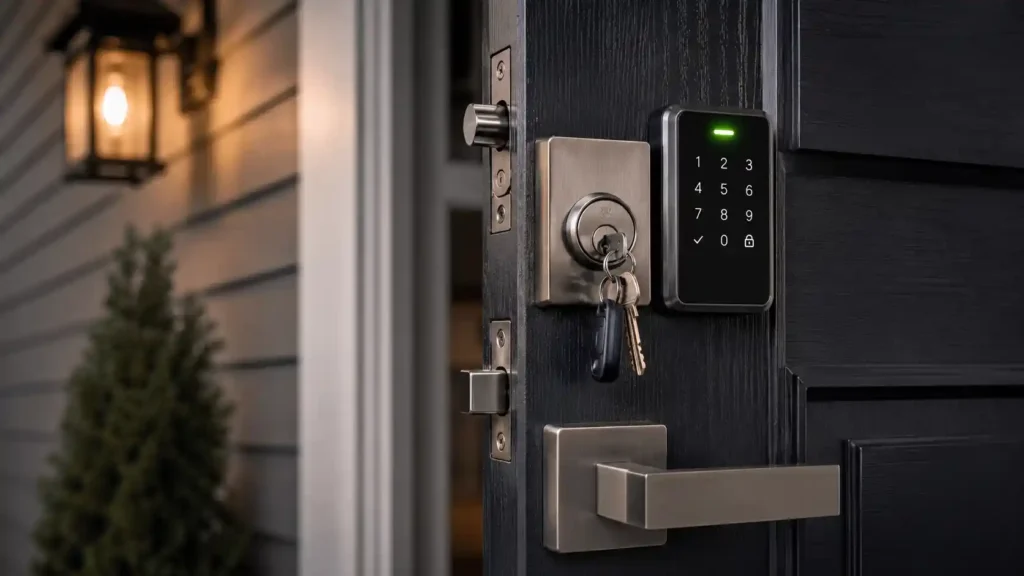
The genuine improvements: smart locks eliminate key duplication risk entirely, provide activity logs of every lock and unlock event, enable temporary access codes and one-time access codes for contractors and guests, and send real-time alerts when the lock is tampered with. The auto-lock feature ensures the door locks without relying on human memory. Guest access management lets you revoke access remotely without a locksmith visit or hardware change.
Schlage, Yale, and the Features Worth Paying For
What to Prioritise When Choosing a Smart Lock
The Schlage Encode Plus combines Apple Home Key support with built-in Wi-Fi, eliminating the need for a separate hub. Its advanced encryption addresses the most common concern about smart lock vulnerability. The Yale Assure Lock 2 offers PIN code entry, smartphone control, biometric verification, and Matter compatibility — useful if you’re building toward a broader smart home integration and want the lock to work across multiple platforms without vendor lock-in.
Eufy’s FamiLock S3 Max uses palm-vein recognition alongside a 2K video camera with wide-angle coverage. The Lockly Vision Prestige adds 3D facial recognition and Apple Home Key in a single unit. At the more accessible end, the Abode Smart Lock works with an existing deadbolt rather than replacing it preserving the Grade 1 mechanical lock while adding smart features. The SwitchBot Lock Ultra Vision Combo at $249.99 fits 99.9% of single deadbolts, including jimmy proof and mortise locks, and incorporates triple battery backup alongside 3D face recognition.
Do Smart Locks Get Hacked — The Security Concerns Worth Taking Seriously
Encryption, Firmware Updates, and Avoiding Cheap Alternatives
Smart lock privacy concerns and data security matter more than most marketing materials acknowledge. Cheap alternatives without end-to-end encryption create vulnerabilities that a motivated attacker with Bluetooth or Wi-Fi sniffing tools can exploit. The counter to this is specific: choose locks with documented encryption standards, keep firmware updated, use strong unique passwords for associated apps, and enable two-factor authentication on the accounts controlling the lock.
Z-Wave and Zigbee protocol locks typically pass communication through a hub with established security standards. Wi-Fi locks connect directly but must implement their own encryption reliably. Bluetooth locks have limited range but face proximity-based attack risks. The safest smart lock decision is choosing an established brand Schlage, Yale, August that publishes security documentation, has an established firmware update track record, and operates under consumer protection frameworks with clear accountability.
Physical Reinforcement — The Step Most Lock Upgrades Miss Entirely
Knowing how to improve home security with better locks also means knowing that a lock alone doesn’t secure a door. A Grade 1 deadbolt on a weak door frame fails when the frame gives before the lock does. This is the most common failure mode in kick-in attacks: the bolt holds, the door jamb splinters, and the door opens anyway.
Door frame reinforcement addresses this directly. A reinforced door jamb with a reinforced strike plate, secured with 3-inch screws reaching the structural framing rather than just the trim, dramatically increases resistance to kick-in attacks. Strike plate upgrade is one of the highest-value improvements in this category. It costs under $30 and installs in under an hour.
Door Hinge Security, Letterbox Guards, and Overlooked Entry Points
Completing the Security Picture Beyond the Main Lock
Door hinge security matters on outward-opening doors where exposed hinges allow the door to be lifted off. Hinge bolts pins that interlock the door and frame when closed prevent this attack. A door chain or door bar provides secondary resistance even when the main lock is compromised. For letterbox guard or mail slot security, a letterbox guard prevents the hook-and-key technique where a wire inserted through the mail slot manipulates the lock or latch from inside.
Sliding door security requires specific attention, since standard patio door locks offer limited resistance. A window bar or door barricade bar in the track prevents forced opening regardless of the lock status. French door security benefits from multi-point locking systems with an espagnolette bolt that engages top, middle, and bottom simultaneously. A long throw bolt on a French door is significantly harder to force than a standard single-point latch. Window lock upgrades sash locks with security ratings complete the entry point picture alongside the main door improvements.
Conclusion
Knowing how to improve home security with better locks means thinking in layers rather than looking for a single solution. Upgrade to a Grade 1 deadbolt or equivalent British Standard lock. Replace the cylinder on uPVC doors with an anti-snap, Sold Secure rated alternative. Rekey after any move or key loss. Add reinforcement to the strike plate and door frame. Then consider smart lock features on top of not instead of strong mechanical fundamentals. How to improve home security with better locks comes down to this sequence every time: fix the physical vulnerabilities first, add technology as a layer on top, and maintain good security habits that technology can’t substitute for.
Frequently Asked Questions
Start with the grade and attack resistance of your existing deadbolt. An ANSI Grade 1 lock or British Standard BS3621 equivalent is the baseline. Combine it with a reinforced strike plate and a bump-resistant or anti-snap cylinder based on your door type.
Yes, in most cases. Rekeying changes the pin configuration so previous keys no longer work. If the lock itself is in good condition and meets current security standards, rekeying is equivalent to replacement for the purpose of controlling who has key access.
They add genuine improvements activity logs, temporary access codes, auto-lock, real-time alerts that mechanical locks don’t provide. But they should layer on top of a mechanically strong lock rather than replace it. A smart lock on a weak cylinder or a compromised door frame is still vulnerable.
After moving into any property someone else occupied, immediately. After any key is lost or unaccounted for. When contractor access keys are no longer needed. Smart locks eliminate some of this by using codes rather than physical keys temporary access codes and guest access management mean rekeying is less frequently necessary.