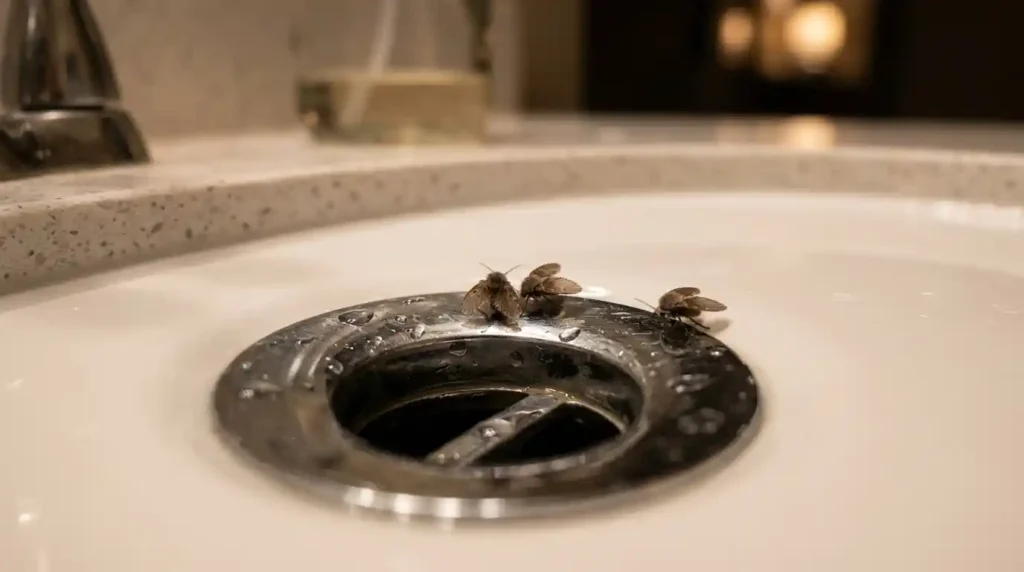
The bathroom light flicks on and suddenly there’s a small cluster of fuzzy insects scattering away from the sink drain. The instinct is to write it off as a moth that snuck in through a cracked window, or maybe just a gnat that’s wandered in from outside somewhere.
I’ve dealt with enough plumbing call outs involving these insects to know that almost every homeowner makes the same first move: a generous pour of bleach down the offending drain, followed a few days later by confusion when the flies are right back where they started. Bleach is the wrong tool for this particular job, and understanding why gets to the heart of what drain flies actually are and where they’re genuinely coming from.
What You’re Actually Looking At
People call these things half a dozen different names without ever realizing it’s one insect. Moth flies, sink flies, sewer gnats, sewer flies, filter flies, pick whichever your plumber used. Scientifically they fall under the Psychodidae family, and the variety most commonly found indoors goes by Clogmia albipunctata. They’re part of the order Diptera, the same broader group that includes houseflies and mosquitoes, but get one under decent light for even a few seconds and the resemblance stops there.
Size wise, you’re dealing with something genuinely small, somewhere in the 1/16 to 1/4 inch range, though if you average out what most people actually report seeing, roughly 1/8 inch or 4 to 10 millimeters is a fair benchmark for the typical specimen hovering near your sink. Colour wise you’re looking at something in the gray to dark brown range, sometimes nearly black. What actually clinches identification, more than colour, is the texture, a soft coating of tiny hairs across the wings and body that produces the fuzzy, moth-like look the name is built on. Six legs, two wings, standard fly anatomy in that respect, but it’s really the wing shape paired with all that fuzz that tells you immediately this isn’t an ordinary housefly.
On the health side, there isn’t much to worry about here. No biting, no disease transmission, so a sudden cluster appearing near a drain isn’t cause for genuine concern. What they’re actually telling you matters more than any direct threat they pose. Think of them less as a pest in the traditional sense and more as an early warning light, a visible clue that organic buildup somewhere inside your plumbing has reached the point where it’s started supporting life.
Distinguishing Drain Flies From the Insects They Get Confused With
Mixing these up with fruit flies is probably the single most common identification error people make, and honestly, it’s an easy mistake to fall into. Both are small. Both seem to materialise out of thin air around damp or food-adjacent areas of the house. Source is the actual difference, not looks. Fruit flies turn up wherever something sweet has started breaking down, an overripe banana, a forgotten spill, anything sugary, which is why a fruit bowl or kitchen bin tends to be where you’ll spot them. Drain flies operate on a completely different logic. They’re tied to the slick organic film building up inside pipework itself, which is exactly why their territory is the sink, the shower, the floor drain, never the counter.
Worth knowing too: there’s a separate cluster of similarly named pests, restaurant flies and garbage flies among them, that key in on food waste, spills, and bins that aren’t being sealed properly, again, nothing to do with plumbing. Spot flies congregating near your trash can rather than your sink, and you’re looking at an entirely different problem with an entirely different solution. Throwing drain cleaning tactics at a garbage fly issue accomplishes nothing.
Pinning down exactly where an infestation is originating matters more than people tend to assume going in. A swarm tracing back to a busy kitchen sink calls for a different response than one coming from a guest bathroom that barely gets used, or a basement floor drain nobody’s thought about in months, even though biologically, you’re looking at the exact same insect in every scenario.
How They Get There in the First Place
Strip the life cycle down to its essentials and it really only needs one thing to get going: organic matter sitting undisturbed in a damp, dark spot. Females deposit their eggs straight onto the biofilm lining the inside of drainpipes, that slick, gel-like residue built from a mix of soap scum, hair, dead skin, grease, and bacteria that any pipe will accumulate over time if it isn’t cleaned with any regularity. From there, the larvae spend somewhere between nine and fifteen days working through that decaying material, developing entirely out of sight inside the pipe itself. This larval window is really where the whole battle gets won or lost, since it’s the stage where the insect is at its most vulnerable, long before it ever takes flight as an adult.
A pupal phase follows, lasting roughly a day or two, and once an adult emerges the whole process can start producing new generations within a week or so under good conditions. That quick turnaround is the reason an infestation that seems to clear up for a few days so often returns. Without removing the breeding material itself, one generation just gets swapped for the next still developing inside the pipe.
It always comes back to moisture sitting where it shouldn’t. A dripping faucet, a pipe leaking somewhere behind a wall, grout slowly weeping moisture near a shower base, a connection under the sink that’s not quite sealed, any of these create precisely the damp, undisturbed conditions drain fly larvae thrive in. Sinks and bathrooms that don’t see regular use are especially vulnerable here too, since the water sitting in the trap eventually evaporates, breaking the seal that normally keeps both sewer gas and insects from making their way up through the pipe. And for what it’s worth, homes running hard water tend to build up biofilm noticeably faster than homes with softer water, which goes a long way toward explaining why some households seem to battle this repeatedly while others rarely see it at all.
Why Bleach and Surface Cleaning Consistently Fail
A pour of bleach down the drain takes out some visible adults and masks the odour briefly, but it does little against the actual issue sitting below, the biofilm where eggs and larvae are established. That layer is thick, firmly attached to the pipe interior, and mostly unaffected by liquid moving through too quickly to scrub anything loose.
Physical removal is what actually works, scrubbing the drain opening and any reachable section of pipe with a stiff brush to break apart the slime directly. A drain snake handles buildup sitting further down than a brush can reach. Disassembling the sink pivot, stopper, shower cover, or drain trap and cleaning each part on its own, with plain water or a biodegradable cleaner, often shows just how much has accumulated in spots a normal wipe-down never touches.
Enzymatic and foaming drain treatments offer a gentler but still effective route. Rather than scrubbing, they rely on bacteria or enzymes that break the organic matter down biologically, reaching sections of pipe a brush physically can’t get to. For infestations that won’t quit, particularly in commercial spaces or homes carrying years of buildup, professional hydro jetting blasts high pressure water through the full interior of the pipe, clearing out material in a way that no household tool can replicate.
There are also situations where the breeding source simply can’t be located or physically reached. In those cases, insect growth regulators like hydroprene or methoprene can be applied directly to the suspected larval habitat. These are low toxicity treatments designed to disrupt development before the insect reaches adulthood, though getting good results means coating the pipe interior thoroughly and reapplying roughly every two to four weeks. And if the flies seem to be coming in from outside rather than breeding indoors at all, a residual insecticide applied around windows and vents can offer some temporary relief while you work on tracking down the actual indoor source.
Keeping Them From Coming Back
Making an enzymatic cleaner part of a monthly routine, instead of something reached for only once flies have already appeared, keeps buildup from forming in the first place without needing anything harsh.
Addressing leaky faucets, weeping grout, and damp under-sink connections removes the standing water larvae depend on. Running water through sinks, guest bathrooms, and seldom-used floor drains weekly keeps the trap sealed and stops the stagnant conditions that invite both breeding and lingering odours. Closing off gaps around doors and windows deals with any flies arriving from outside, and households with hard water often find that softening it slows how fast biofilm reforms after a clean.
If you’ve kept up with all of this and an infestation still won’t budge, or you genuinely can’t trace where it’s coming from, that’s the point where calling in licensed pest control earns its cost. A professional often spots what a homeowner wouldn’t think to check, a cracked pipe tucked behind drywall, a long forgotten floor drain in a basement corner, or buildup sitting deep enough in a sewer line that nothing in a household toolkit could ever reach it.
Conclusion
Drain flies aren’t dangerous, but they’re persistent for a reason. They breed in biofilm that bleach can’t touch and surface cleaning can’t reach, which is exactly why so many infestations seem to clear up for a few days before showing up again. The fix isn’t a stronger chemical, it’s physically removing the organic buildup feeding them, whether that means a stiff brush, a drain snake, an enzymatic treatment, or professional hydro jetting for buildup that’s gone too deep.
Once the breeding source is actually gone rather than just disturbed, prevention is straightforward: regular drain cleaning, fixing leaks promptly, and running water through fixtures that don’t get used often. Skip those habits and the same cycle starts over within a week or two, no matter how much bleach goes down the drain in between.
FAQs
Drain flies, also called moth flies, sink flies, or sewer gnats, are small fuzzy insects, typically around 1/8 inch, that belong to the Psychodidae family, with Clogmia albipunctata being the variety most commonly found indoors. They don’t bite or transmit disease, so a sudden cluster near a drain isn’t a health threat, but it is a reliable sign that organic buildup somewhere in your plumbing has reached the point of actively supporting life.
The real difference is source rather than looks, since both are small and tend to appear seemingly out of nowhere. Fruit flies show up wherever something sweet is breaking down, like an overripe banana or a forgotten spill, which is why you’ll spot them around a fruit bowl or kitchen bin, while drain flies are tied specifically to the organic film building up inside pipework, which is why their territory is always the sink, shower, or floor drain rather than the counter.
Bleach kills some visible adults and masks the smell temporarily, but it does almost nothing to the actual problem, the biofilm coating the inside of the pipe where eggs and larvae are established. That layer is thick and firmly attached to the pipe interior, and liquid moving through too quickly simply can’t scrub it loose, which is exactly why an infestation that seems to clear up for a few days keeps coming right back..
Larvae spend roughly nine to fifteen days developing inside the biofilm before entering a pupal phase that lasts about a day or two. Once an adult emerges, the whole cycle can start producing new generations within about a week under good conditions, which is why removing the actual breeding material matters more than just killing the flies you can see at any given moment.
If you’ve kept up with regular cleaning, fixed any leaks, and run water through seldom-used drains but the infestation still won’t budge, or you genuinely can’t trace where it’s coming from, that’s the point where licensed pest control is worth the cost. A professional can often spot what a homeowner wouldn’t think to check, like a cracked pipe hidden behind drywall or buildup sitting deep enough in a sewer line that no household tool could ever reach it.