
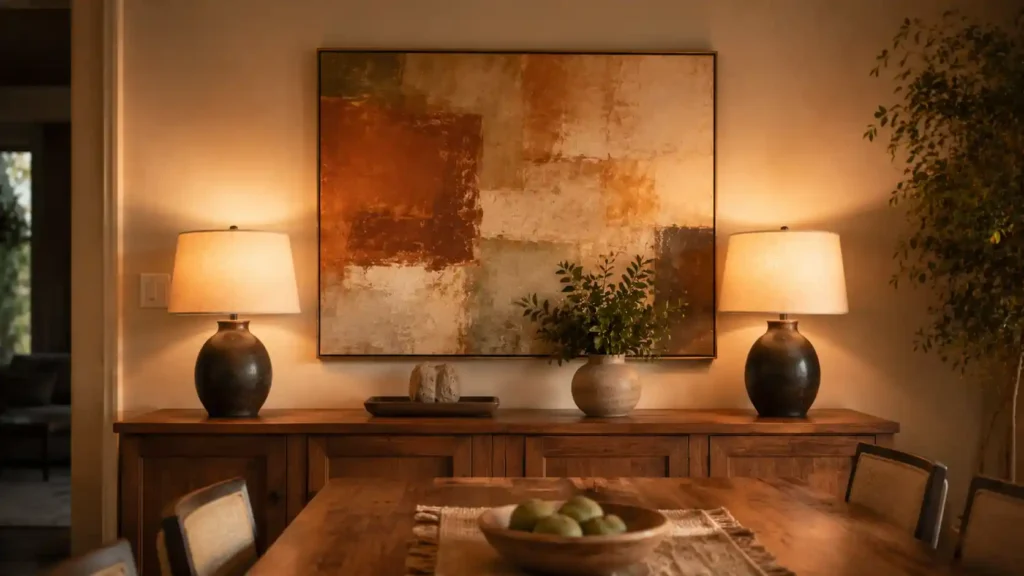
Spent three years ignoring the walls in my dining room. The table was right, the lighting was decent, the chairs were comfortable and every single time someone came over for dinner, the first thing they’d notice was the bare wall above the sideboard. Not in a good way. Just a blank expanse that made the whole room feel slightly unfinished, like a sentence that trails off without a period. Eventually a friend pointed at it directly and said “what are you going to do with that?” and I finally started thinking about dining room wall decor seriously instead of treating it as an afterthought.
What I found was that the wall is actually doing more work than any other surface in the room it’s what sets the mood before anyone sits down, and it’s what people look at between bites during an actual meal. The dining room gathering space deserves the same attention as the table itself. According to the USDA, the average person spends about 67 minutes a day eating without simultaneously doing something else that’s a lot of time spent in a room most people half-decorate and then forget about.
Dining Room Wall Decor Starts With Understanding What the Wall Actually Needs to Do
Focal Point, Atmosphere, or Both — Deciding Before You Buy Anything
Before buying a single piece of dining room wall decor, it’s worth deciding what the wall actually needs to achieve. A large blank dining room wall behind a buffet or sideboard is a different problem from a narrow strip of wall between two windows, and both require different thinking. The focal point wall usually the one visible from the main seating position should anchor the eye and establish the room’s mood from the moment someone walks in. A welcoming dining room doesn’t happen by accident; it happens because someone made deliberate, thoughtful choices about what to put on the walls.
The 60-30-10 colour rule is genuinely useful here. Sixty percent of the wall visual should echo the room’s dominant colour, thirty percent introduces a secondary tone, and the remaining ten percent is where accent colour or bold pattern earns its place. This framework prevents dining room wall decor from feeling random or disconnected from the room’s overall vibe, which is the most common mistake in this category.
Wall Art Choices — From a Single Statement Piece to a Full Gallery Wall
Canvas Art, Framed Artwork, and Knowing When One Is Enough
Canvas wall art remains the most straightforward dining room wall decor choice for most people, and for good reason it’s versatile, available at essentially every price point, and a single oversized canvas above a sideboard or buffet genuinely does most of the heavy lifting a wall needs to do. Abstract art works particularly well in modern dining rooms because it introduces colour and movement without dictating a specific mood; abstract pieces flex around the rest of the room rather than competing with it. Contemporary art and botanical prints serve the same versatile purpose across different style contexts the former in minimalist or mid-century modern dining rooms, the latter in farmhouse, French country, or eclectic dining room settings.
For anyone with a genuinely long or large dining room wall, a single-panel panoramic canvas solves the proportional challenge elegantly the horizontal format mirrors the wall’s own shape and fills the space without requiring multiple pieces to be hung in alignment. A triptych tri-panel canvas or a symmetrical five-panel canvas adds dimension and a more structured visual rhythm for spaces wanting something with more internal movement. The four-panel wave canvas and the 7-piece hexagonal canvas set sit at the more adventurous end both introduce genuine contemporary energy and work particularly well in maximalist or glam dining room settings where the wall is meant to be the room’s primary statement.
Creating a Gallery Wall That Feels Curated, Not Chaotic
Mixed Media, Personal Elements, and Getting the Layout Right
A gallery wall is the dining room wall decor option that most people find intimidating and most interior designers genuinely love, largely because it introduces genuine personality into a space that store-bought single pieces never quite manage. The key is in the gallery wall layout specifically, the spacing. Pieces hung too far apart read as a scattered collection rather than a coherent composition; pieces hung too close lose the breathing room each individual item needs to register visually.
Mixed media gallery walls work best in eclectic dining rooms: framed artwork alongside framed photos, a relief sculpture or two, a theatre poster from somewhere meaningful, framed stationery or framed postcards or framed book pages that actually mean something to the household rather than existing purely as decoration. This is where dining room wall decor stops being interior design and starts being autobiography the pieces spark actual conversation across the dining table, which is exactly what a room built around shared meals should be doing.
The art ledge wall approach a long shelf running along a wall at picture-rail height, layered with framed art of different sizes leaning at slight angles is one of the smarter dining room wall decor ideas for renters specifically, since nothing goes into the wall permanently and the arrangement can be shifted freely.
Mirrors as Dining Room Wall Decor — More Than Just Making the Room Look Bigger
Choosing the Right Mirror Style and Placement for Maximum Effect
Mirrors earn their place in dining room wall decor for two reasons that almost nobody argues with: they genuinely make smaller dining spaces feel larger by creating an illusion of depth, and they amplify whatever light source is nearby studies suggest a well-placed mirror can boost usable light in a room by over 100%. But the style of mirror matters as much as its presence. An ornate gilded mirror above a sideboard transforms a traditional or French country dining room into something genuinely elegant; a black framed mirror or slim brass mirror suits modern and mid-century modern dining rooms respectively.
An antique mirror adds historical depth and a slightly warm, imperfect reflection that flat modern glass never delivers good for rooms wanting age and character rather than sharp contemporary edges. Placing a large wall mirror or oversized mirror directly opposite a window multiplies natural light dramatically, which is particularly valuable in small dining spaces or north-facing rooms that never seem to get quite enough brightness. A mirror above a buffet or mirror above sideboard creates a natural vignette especially when two matching table lamps flank the piece, creating a formal, deliberate arrangement that looks genuinely considered.
Wallpaper and Paint as Dining Room Wall Decor in Their Own Right
Feature Walls, Colour Drenching, and the Peel-and-Stick Option
Paint and wallpaper aren’t typically framed as dining room wall decor, but they absolutely should be the right wall colour or pattern does more for a dining room’s atmosphere than any artwork hung on top of it. Dark paint in particular transforms a dining room from a functional eating space into something that feels genuinely intimate, the kind of moody wall colour that turns an ordinary weeknight dinner into something slightly more special. Jewel tones deep emerald, sapphire blue, rich terracotta work especially well in dining rooms precisely because the room is primarily a nighttime space; warmer light sources make jewel-toned walls glow in a way that cooler neutrals simply don’t.
Feature wall wallpaper has staged a genuine comeback. Grasscloth wallpaper adds textural warmth, nature-inspired wallpaper or mural wallpaper brings the outdoors in, and geometric wallpaper introduces pattern without committing to a full floral scheme. For renters needing renter-friendly dining room wall decor solutions, peel-and-stick wallpaper is now genuinely high-quality enough to be indistinguishable from traditional paste options in most applications bold visual impact, full reversibility.
Lighting as a Wall Decor Decision — Sconces, Chandeliers, and Accent Light
When Fixtures Double as the Room’s Most Important Decorative Layer
Dining room wall decor that generates its own light is the category most people forget entirely until the room is already furnished and they realise the walls look flat at night. Wall sconces flanking a mirror or a piece of statement art add both illumination and architectural definition they make the wall feel three-dimensional in a way that even the best artwork alone can’t replicate. A crystal chandelier hanging above the dining table isn’t just a light source; at the right scale it becomes the room’s most visible design statement, visible from every seated position and casting the kind of warm ambient light that makes every dinner feel slightly more celebratory.
A brass picture light mounted directly above a single oversized painting one of the quiet luxury aesthetic’s signature moves transforms a framed piece from a daytime feature into an evening centrepiece. LED acrylic wall sculptures introduce a genuinely unexpected element for eclectic or contemporary dining rooms wanting something more distinctive than a standard canvas. The principle across all of these options is the same: lighting that also decorates earns twice the square footage.
Functional Dining Room Wall Decor That Earns Its Keep
Shelves, Baskets, Plants, and Displays That Work While Looking Good
Not every piece of dining room wall decor has to be purely decorative. Floating shelves or art ledge shelves along a dining room wall create a display surface for framed photos, small sculptures, and favourite objects while also handling practical storage for items the room genuinely uses. A tall display cabinet deliberately styled art books stacked horizontally alongside decorative objects and a few pieces of statement china functions simultaneously as storage and as a piece of wall art in its own right.
Woven wall baskets and basket wall displays have circled back into genuine popularity as a dining room wall decor choice, particularly in farmhouse, bohemian, and rustic dining room contexts they add texture and warmth in a way that flat canvas art simply doesn’t, and they’re available at genuinely accessible price points (around $10 per piece at Etsy, compared to $798 for branded retail equivalents that deliver a nearly identical effect).
A vertical garden or grouping of potted plants fixed to a dining room wall brings biophilic dining room energy into a room that typically has very little organic material fiddle leaf figs, trailing vines, and faux plant decor all work here, depending on how much maintenance you’re willing to commit to.
Macramé wall hanging and woven wall hanging pieces suit bohemian and eclectic dining room aesthetics specifically, adding tactile depth that painted walls and flat art never deliver. Wall tapestry works similarly for larger expanses a single large-scale textile can cover an entire wall section, introducing colour, pattern, and texture simultaneously.
Conclusion
Dining room wall decor is genuinely the most underestimated element in the room easier to ignore than the table or the chairs, but ultimately more responsible for the mood that settles over everyone sitting down for a meal.
Whether you’re hanging a single oversized canvas to anchor a large blank dining room wall, building a mixed-media gallery wall that tells your household’s actual story, choosing a gilded mirror to double the light in a small dining space, or using feature wall wallpaper to transform the room’s entire atmosphere, the principle stays the same: deliberate choices outperform accumulated impulse buys every time. Spend the same attention on your dining room wall decor as you did on the table beneath it, and the room will finally feel finished.
FAQs
It’s a color-balance framework where 60% of the wall visual echoes the room’s dominant color, 30% introduces a secondary tone, and the remaining 10% is where accent color or bold pattern gets to stand out. Applying this ratio before buying anything is what keeps dining room wall decor from feeling random or disconnected from the rest of the room’s palette.
A single oversized canvas, like an abstract piece or a panoramic panel, does most of the heavy lifting on its own and suits a wall that just needs one clear focal point, especially above a sideboard or buffet. A gallery wall takes more effort to get the spacing right, but it introduces genuine personality by mixing framed art, photos, and personal objects, making it the better choice if you want the wall itself to spark conversation rather than just anchor the room.
Spacing is the single biggest factor — pieces hung too far apart read as a scattered collection, while pieces hung too close crowd out the breathing room each item needs to actually register visually. Mixing media, like framed photos alongside a small sculpture or a meaningful postcard, also helps a gallery wall feel like genuine autobiography rather than a generic store-bought arrangement.
Positioning a large or oversized mirror directly opposite a window multiplies natural light dramatically, since a well-placed mirror can boost usable light in a room by over 100%. Mirrors above a buffet or sideboard also create a natural, formal vignette, especially when flanked by two matching table lamps for a deliberate, considered look.
Yes — peel-and-stick wallpaper has reached a quality level genuinely indistinguishable from traditional paste options in most applications, delivering real visual impact while staying fully reversible when you move out. It’s a strong renter-friendly alternative to a permanent feature wall for anyone wanting texture or pattern without a long-term commitment to the surface underneath.
Wall sconces flanking a mirror or statement art piece add architectural definition that makes the wall feel three-dimensional in a way flat artwork alone can’t achieve. A brass picture light mounted above a single oversized painting transforms it from a daytime feature into an evening centerpiece, and even a well-scaled chandelier over the table becomes a visible design statement from every seated position, not just a light source.


1 thought on “12 Brilliant Dining Room Wall Decor Ideas That Instantly Transform a Bland Room Into a Stunning Space”