Most kitchen remodeling ideas floating around Pinterest look great in a photo and terrible in real life, six months after move-in. I learned that the hard way with an open shelving phase that lasted about four months before the dust got to be too much. So this guide skips the fantasy and sticks to what’s actually driving kitchens in 2026, backed by real survey data from homeowners who’ve done the work. You’ll get real numbers on what people are prioritizing, what’s worth paying for, and what tends to look dated fast.
What’s Actually Driving Kitchen Remodeling Ideas Right Now:
Here’s the thing nobody expects. Most people aren’t renovating because they saw something pretty online. They’re staying put because moving costs too much and there just aren’t enough homes on the market anyway, so they’re pouring money into the kitchen they already have instead. That single shift changes almost everything about what actually gets built.
Why More Homeowners Are Renovating Instead of Moving:
Aging housing stock plus a tight market means longer homeowner tenure, and that combination is quietly reshaping kitchen remodeling ideas across the board. People aren’t chasing trends anymore so much as fixing what genuinely bothers them. Tapping into home equity for a kitchen upgrade has become the default move when relocating just isn’t realistic, and honestly, it makes sense. Why move when you can fix the one room that actually annoys you daily?
Function Over Fads:
Two motivators show up again and again in homeowner surveys, dissatisfaction with the old style and outright deterioration or dysfunction of the space. Roughly four in ten renovating homeowners cite each one. That’s a meaningful shift away from pure aesthetics. AI rendering tools have made this easier too, letting people visualize a finished kitchen before committing real money to it, which cuts down on decision paralysis more than you’d think.
Cabinets, Countertops, and Backsplash Choices:
This is where most of the visual impact lives, and also where budgets tend to run away from people fastest. Get these three decisions right and the rest of the kitchen follows naturally.
Cabinet Colors and Two-Tone Looks:
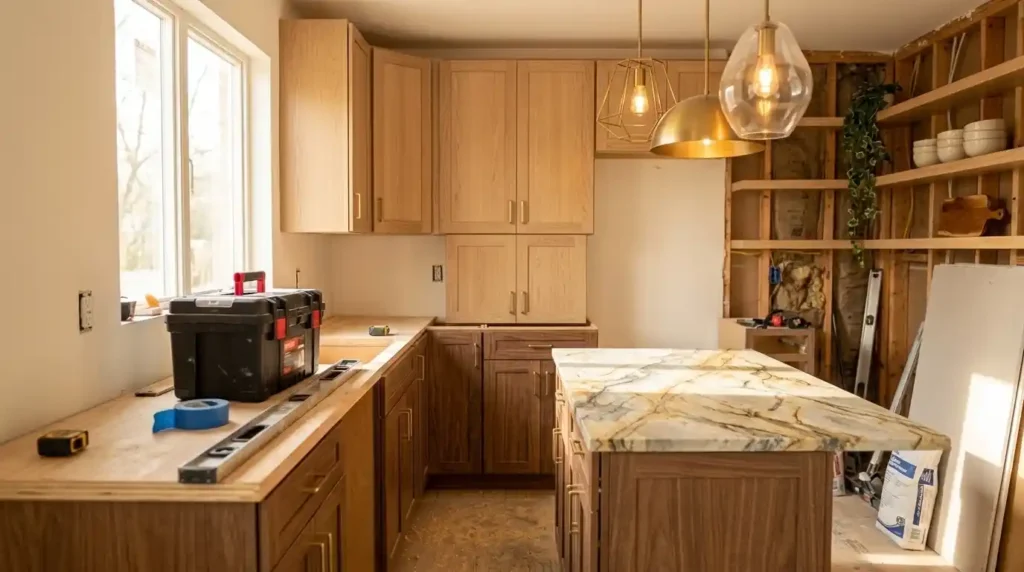
Wood tone cabinets have overtaken white as the top pick, a real reversal after roughly a decade of all-white dominance. Two-tone setups, one shade up top and a different one on the lower cabinets, keep gaining ground too. It’s a low-risk way to add contrast without committing to a fully bold palette. If you’re nervous about color, this is the safer entry point.
Countertop Materials Worth the Investment:
Quartz remains the practical default, durable and low-maintenance, but statement countertops made from natural stone with real movement and character are pulling ahead in popularity. Quartzite and granite both get compared constantly on cost, and the price gap is worth understanding before you fall in love with a slab at the showroom. Tile backsplashes, usually white or off-white in a rectangular shape, remain the safest resale choice. Slab backsplashes in engineered quartz are trending upward for people who want a cleaner, more seamless look instead.
Storage and Layout Ideas That Actually Work:
Storage complaints show up constantly in homeowner surveys, nearly half say they don’t have enough of it. That single stat probably explains more kitchen remodeling ideas than any single style trend does.
Built-Ins People Actually Use:
Built-in features now appear in the majority of kitchen renovations, and pantry cabinets lead the pack by a wide margin. Beverage stations come in second, and butler’s pantries, walk-in pantries, and breakfast bars round out the list. These aren’t flashy additions. They’re the boring, practical stuff that actually gets used every single day, which is exactly why they keep showing up in survey after survey.
Bigger Islands, Same Footprint:
Here’s a stat that surprised me. Most kitchens keep roughly the same footprint after renovation, even though more than half of homeowners change the layout somehow. Islands are getting bigger within that same space, with rectangular shapes far outpacing L-shaped designs, and about half now stretch past seven feet long. Expansion is genuinely the exception, not the rule, so don’t assume you need to knock out a wall to get more usable space.
Smart Technology Worth Considering:
Smart kitchen tech has moved past novelty appliances into something that actually solves problems, mostly around storage and monitoring. Voice-controlled systems tied into lighting and temperature settings are becoming standard rather than a splurge. Embedded pantry sensors can track what’s running low and alert your phone before you’re stuck without an ingredient mid-recipe, which sounds gimmicky until you’ve actually used one. Refrigerators now come with adjustable temperature zones, water filter alerts, and remote monitoring built in as a baseline feature rather than a premium upsell. None of this replaces good cabinetry or a solid layout, but it’s worth budgeting a small slice for if convenience matters to you.
Lighting That Does More Than Illuminate:
Kitchen lighting has quietly become one of the more design-forward categories in the whole remodel. Oversized pendants over the island aren’t new, but how they’re arranged has changed. Asymmetrical groupings, multiple fixtures at different heights along the same island, are showing up in a lot of recent projects, treating the fixture as a sculptural piece rather than just a light source. If your kitchen still has one flat overhead fixture doing all the work, this is genuinely one of the cheapest upgrades with the biggest visual payoff.
What It Actually Costs by Region:
Cost is where kitchen remodeling ideas either stay realistic or spiral out of control, and the regional gap is bigger than most people expect. A small kitchen remodel on the West Coast typically runs $75,000 to $100,000, while the East Coast lands even higher at $80,000 to $120,000. The Midwest sits considerably lower at $30,000 to $50,000, and the Southeast comes in leanest at $15,000 to $30,000. Mid-range to large renovations can climb past $150,000 in any region once custom cabinetry and premium appliances enter the picture. The smart move, regardless of budget, is spending heavily on the things you touch daily: countertops, appliances, fixtures, and skimping where you can on the parts nobody actually notices.
Choosing the Right Professional for the Job:
Nearly all homeowners spending real money on a kitchen bring in at least one professional, and general contractors lead that list by a wide margin. Kitchen designers, design-build firms, interior designers, and architects all show up too, usually depending on how much the layout itself is changing. A straightforward cabinet and countertop swap rarely needs an architect. A full layout overhaul that touches plumbing or load-bearing walls almost always does. Matching the right professional to the actual scope of the work is what keeps a project on budget and on schedule.
Kitchen Remodeling Ideas Conclusion:
The best kitchen remodeling ideas right now aren’t really about chasing a look. They’re about fixing what’s actually broken, storage, layout, outdated finishes, and spending money where it gets used every day. Pick materials that age well, budget honestly by region, and bring in the right professional for the actual scope of your project. Do that, and the kitchen you end up with will still feel right five years from now, not just in the first few photos.
FAQs About Kitchen Remodeling Ideas:
Wood tone cabinets have overtaken white as the top choice, marking a real shift after roughly a decade of all-white dominance. Two-tone cabinet combinations are also gaining popularity as a lower-risk way to add contrast.
No, most kitchens stay roughly the same size after renovation, even when the layout changes significantly. Expansion happens in a minority of projects, so a smart reconfiguration often achieves more than adding square footage would.
Costs vary widely, with West Coast and East Coast projects often running $75,000 to $120,000 for a small remodel, while Midwest and Southeast projects can come in well under $50,000. Larger renovations with custom finishes can exceed $150,000 in any region.