The rug that gets cleaned wrong once rarely looks quite right again. I learned this the hard way with an oriental rug not antique, but hand-knotted, wool pile, bought at some expense that I hit with a diluted vinegar spray because a general cleaning guide said it was safe for most rugs. The colors in one corner shifted visibly. Not dramatically, but enough to notice every time light hit the floor at a certain angle. That was the moment I started taking fiber type seriously before reaching for any solution, homemade or otherwise.
Most diy rug cleaner solution guides treat every rug as interchangeable. They’re not. A synthetic fiber rug and a wool rug don’t just need different cleaning strengths they need fundamentally different chemistry, different moisture levels, and different drying approaches. Get that wrong and you’re not cleaning the rug. You’re shortening its life.The same principle applies to carpets the DIY carpet cleaning solution guide covers how fiber type changes the approach there too
Why Fiber Type Is the Decision That Comes Before Every Recipe
Synthetic rugs nylon, polyester, polypropylene are the most forgiving category. Machine-made, stain-resistant by design, tolerant of water-based solutions and mild acidity. A homemade rug cleaner that works beautifully on a braided polyester area rug in the living room can strip natural lanolin from a wool rug in the same application, leaving the fibers dry and brittle in a way that only becomes obvious months later when the pile starts to mat.
Wool rugs hold moisture differently from synthetic fiber rugs. The cellular structure of wool felts under heat and excess water meaning a steam cleaner that refreshes a synthetic rug will distort and shrink a wool rug. Wool also dries slowly, which is where mold and mildew risk come from when people over-wet the pile and move on. A natural fiber rug wool, cotton, jute, sisal needs cool water, minimal moisture, and air circulation during drying that synthetic rugs don’t require at the same level.
Oriental rugs and Persian rugs sit in their own category. Hand-knotted construction, natural dyes in many cases, fibers that react to pH in ways machine-made rugs simply don’t. Dye migration where one colour bleeds into an adjacent area when wet — is the specific risk that catches people out with antique rugs and heirloom pieces. Any diy rug cleaning solution that’s acidic or alkaline enough to strip a stain is also acidic or alkaline enough to shift a natural dye. Silk rugs are the category where I’d say honestly: unless the stain is minor and fresh, professional rug cleaning is the right answer. Silk fibers fray under any real cleaning pressure, and dye bleeding on silk is irreversible.
Pour a little water on a jute or sisal rug and watch what happens the fibers brown almost immediately and the backing holds that moisture for far longer than anything sitting on top of it suggests. These rugs don’t dry quickly and the gap between surface-dry and actually-dry is where mold quietly takes hold. The only thing that belongs on jute or sisal is a barely-damp cloth carrying the mildest possible solution, wiped off fast and followed immediately by a fan.
Before any solution touches any rug, try a small amount of it on a corner nobody looks at. Leave it to dry completely, then check it run a white cloth over the area, hold the rug up to light at an angle, look for any shift in colour or texture. Two minutes of patch testing has saved me from at least three cleaning disasters on rugs I wasn’t certain about. The people who skip it are usually the ones who skip it because they’re already stressed about the stain which is exactly when slowing down by two minutes matters most.
The Ingredients That Do the Real Work — and the Ones That Don’t
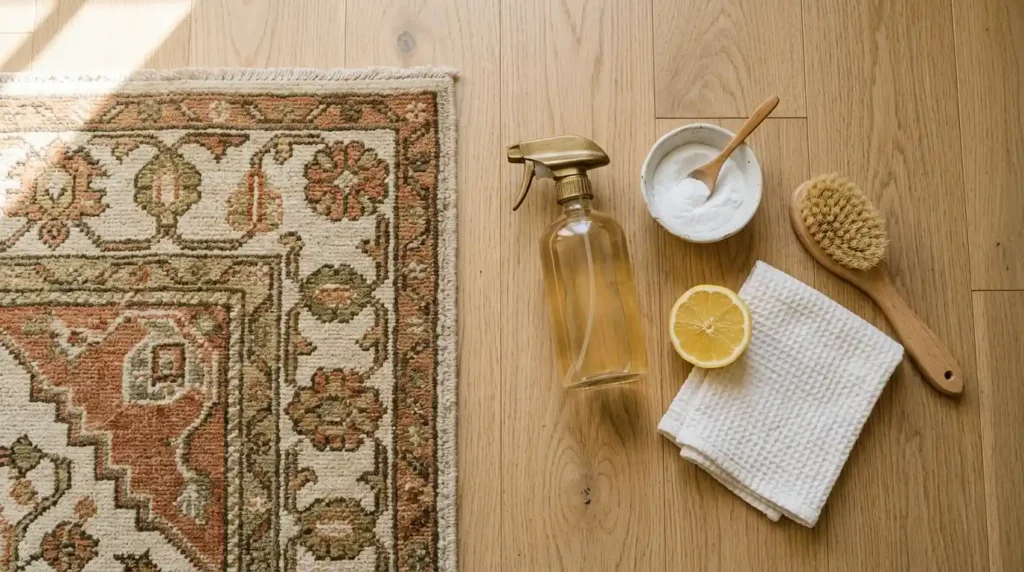
White vinegar is in nearly every diy rug cleaner solution recipe online because it works on synthetic rugs and it’s cheap. Most of these ingredients cross over if you’ve already mixed a DIY floor cleaning solution at home, the same pantry staples apply here with adjusted ratios for rug fibers. Mild acidity, cuts through grime, dries without leaving residue on non-porous synthetic fibers, neutralizes some odors on contact. On natural fiber rugs wool specifically it needs heavy dilution and minimal application.
Most guides suggest equal parts white vinegar and water as the standard starting ratio, which is fine for a one-off spot treatment on a robust synthetic but harsh enough to degrade wool pile with repeated use. Apple cider vinegar pulls the same cleaning weight with a smell that hangs around a bit longer before it clears out.
Baking soda is the odor absorber. Sprinkled dry onto a pet urine stain, left overnight, vacuumed off in the morning that’s its most effective use case for rugs. Mixed into a cleaning paste with water, it becomes a mild abrasive that works on tile and hard surfaces but is too gritty for regular use on rug fibers. Combining baking soda and white vinegar produces a fizzing reaction that does help lift embedded dirt from synthetic pile, but the combination needs rinsing out completely residue left in rug fibers attracts more dirt.
Hydrogen peroxide at standard 3% concentration is a low-level bleaching agent as well as a disinfectant. On synthetic rugs in light or neutral colors, a hydrogen peroxide and dish soap combination is one of the more effective spot cleaners for blood stains, pet stains, and stubborn food spills. On colored rugs and on any natural fiber rug it needs a patch test first and careful application second. The colour fading risk is real and it’s not reversible.
Dish soap in small amounts liquid dish soap or washing-up liquid, a teaspoon to a tablespoon depending on the volume of water adds degreasing power to any water-based diy rug cleaning solution without building up residue if rinsed properly. Castile soap works the same way and is gentler on natural fibers. Sal Suds is a better choice than straight castile soap in recipes that combine it with vinegar because castile and vinegar together reduce each other’s cleaning effectiveness. A wool-safe detergent is the appropriate choice for wool rugs where you want some soap action beyond water alone.
Enzyme cleaner the same chemistry used in commercial pet stain removers is what actually breaks down urine at a molecular level rather than masking it. Making your own properly takes weeks of fermenting citrus peels and sugar, and the honest truth is most people have a stain to deal with now, not in a month.
What actually works in the meantime: cool water and white vinegar applied to the fresh stain to lift the bulk of it, then baking soda sprinkled dry on top once you’ve blotted the liquid out. Leave that overnight. It won’t replicate a commercial enzyme formula but it handles most cat urine and dog urine stains well enough if you’re on the stain before it sets.
Cornstarch and milk mixed into a paste handles ink stains and grease stains in a way that liquids don’t the paste absorbs the oil or ink rather than spreading it. Apply the paste, let it dry for several hours, brush off the dried residue, vacuum. Shaving cream works on oil stains similarly, applied directly, left for ten minutes, blotted off with a clean white cloth. Club soda poured generously onto a fresh food or beverage spill, blotted immediately, lifts the stain before it sets in a way that most liquid spray solutions don’t match on timing.
Salt — coarse table salt applied dry to a fresh red wine or beverage spill is the one I reach for first when something spills and I need to buy a few seconds before proper treatment. Dump it on, let it pull the liquid out of the fibers for a few minutes, vacuum it up, then go in with a vinegar-water solution. Nobody mentions salt much in natural rug cleaner guides because it doesn’t sound impressive enough, which is exactly why it keeps getting overlooked.
Lemon juice brings natural antibacterial properties and leaves cotton and synthetic rugs smelling clean without synthetic fragrance. Lemon essential oil, lavender essential oil, peppermint essential oil, wild orange essential oil added in small amounts to any water-based homemade rug cleaning solution, these contribute real antimicrobial properties alongside the scent. Tea tree essential oil is the one to avoid in any home with cats, at any concentration.
Surface-by-Surface Recipes That Hold Up in Practice
Synthetic rugs — all-purpose homemade rug cleaner: Two cups warm water, two tablespoons white vinegar, one teaspoon liquid dish soap, five to six drops lemon essential oil mix in a spray bottle, not a bowl, so you control exactly how much goes on. Mist the area, give it five to ten minutes to work into the fibers, then blot from the outside edge of the stain moving inward. Using a clean white cloth matters here colour transfer from a patterned cloth into a light-coloured rug is a real problem. Rinse with a damp clean cloth, blot dry, point a fan at it.
Wool rugs — minimal moisture approach: The guiding principle with wool is less is more, applied slowly. Cool water, a small amount of wool-safe detergent on a soft-bristled brush, worked gently in the direction of the pile not against it, not in circles. No white vinegar at standard strength, no hot water, nothing that generates heat or introduces significant moisture. Blot, don’t scrub. Once you’ve treated the area, lay the rug flat somewhere with moving air, keep it out of direct sunlight which pulls natural dyes, and flip it partway through so the backing dries as thoroughly as the face.
Pet urine on synthetic rugs: Two cups white vinegar to two cups cool water in a spray bottle. Saturate the stained area, let it sit five minutes, blot firmly with a clean rag. Then take the spray bottle away and reach for the baking soda dry, sprinkled generously over the damp spot, left until morning. Vacuum it off the next day.
The sequence matters: vinegar addresses the stain itself, baking soda addresses the odor that remains in the fiber after the stain is gone. For older set-in pet stains, a quarter cup hydrogen peroxide mixed with one teaspoon dish soap applied and left ten minutes before blotting works on light-colored synthetic rugs but always patch test first on colored ones.
Oriental rugs — careful spot treatment only: A few drops of mild liquid soap in cool distilled water is the whole recipe. Applied with a white cotton cloth, dabbing motion only, starting from the outer edge. Before that cloth touches the stain, test the same solution on a corner of the rug and let it dry fully.
What you’re checking for is whether the dyes hold or shift some natural dyes are stable when wet and some aren’t, and there’s no way to know which you’re dealing with without testing. If colour bleed shows up in the patch test, put the cloth down and call someone who cleans oriental rugs professionally. A diy rug cleaner applied to unstable dyes turns a spot into a smear.
Homemade carpet shampoo for carpet cleaning machines: Quarter cup white vinegar, one tablespoon washing-up liquid, filled to capacity with hot water in the machine tank. One important note before using any vinegar-based solution in a carpet cleaning machine check the manufacturer’s guidance first. Vinegar corrodes internal components in some Bissell machine models and voids the warranty. Baking soda should never go into a carpet cleaning machine regardless of the recipe; it settles into internal filters and blocks them.
For machine-safe DIY cleaning, one scoop of Oxiclean dissolved in the recommended water volume is a cleaner choice that won’t damage internal parts and costs about a dollar per gallon versus the $19.59 the Rug Doctor formula runs for a half gallon.
The Mistakes That Undo Good Technique
Rubbing a stain is the one that comes up in every guide and gets ignored anyway because rubbing feels productive. What it actually does: spreads the stain sideways into clean fibers while pushing it further down into the pile at the same time. You end up with a bigger stain sitting deeper in the rug than when you started. A clean white cloth, pressed down firmly and lifted straight up that’s the motion. Do it repeatedly on fresh cloth sections until nothing more transfers.
Over-wetting is quieter damage. You finish cleaning, the surface of the rug feels mostly dry, you roll it back up or put the furniture back. What you didn’t account for is the backing, which held onto moisture the pile released and is now sitting damp against the floor with no airflow. By the time a musty smell shows up, the mold is already established underneath. Flat drying with air moving underneath and over the rug flipped at the halfway point is the only way to know the whole thing is actually dry.
Using a beater bar vacuum attachment on a wool rug or oriental rug pulls and distorts the pile over time. Suction only, in the direction of the pile, is how these rugs should be vacuumed. Every clean starts with a thorough vacuum to lift surface dust and debris before any wet treatment goes on.
Soap residue is the slow problem nobody notices until a rug that used to look clean starts looking dingy faster and faster between cleans. What’s happening is that detergent left in the fibers after inadequate rinsing grabs onto airborne dust and foot traffic particles and holds them. The rug becomes its own dirt trap. After any soap-based homemade rug cleaner application, rinse with plain cool water on a clean cloth until the cloth comes away without any suds, then blot dry. Run a dry hand across the fibers when it’s done if anything feels tacky or slightly stiff, it needs another rinse pass.
Annual deep cleaning either a thorough at-home wash for synthetic rugs and cotton rugs where the label allows it, or professional rug cleaning for wool, silk, oriental, and heirloom pieces — is what maintains rug fiber integrity and allergen control over time. Prompt stain treatment, regular vacuuming, and occasional at-home spot cleaning handle the rest between proper deep cleaning sessions.
Conclusion
A diy rug cleaner solution works best when the fiber type drives the recipe choice not the other way around. The ingredients that refresh a synthetic rug in twenty minutes can quietly ruin a wool pile or shift a natural dye on an oriental rug over the same timeframe. Get the fiber right first, patch test before committing, blot instead of rub, and dry the whole thing not just the surface. Do those four things consistently and a pantry-based cleaning routine outlasts most commercial products while costing a fraction of what they charge for the same result.
FAQs
No — fiber type should drive the recipe choice, not the other way around, since what refreshes a synthetic rug in minutes can strip natural lanolin from wool or shift dyes on an oriental rug. A solution safe for a polyester area rug can leave wool fibers dry and brittle, or worse, cause visible dye migration on a hand-knotted piece, so checking fiber type before mixing anything is the step most generic guides skip.
Synthetic rugs like nylon, polyester, and polypropylene are machine-made, stain-resistant, and tolerant of water-based solutions with mild acidity. Wool holds moisture completely differently, since its cellular structure felts under heat and excess water, meaning the same steam or vinegar treatment that’s fine on synthetic pile can distort, shrink, or slowly rot wool fibers over time.
Mix two cups of white vinegar with two cups of cool water in a spray bottle, saturate the stained area, let it sit five minutes, then blot firmly with a clean rag. Follow that up with dry baking soda sprinkled generously over the damp spot and left overnight, since the vinegar addresses the stain itself while the baking soda handles the lingering odor left in the fibers.
It depends entirely on the patch test results — a few drops of mild liquid soap in cool distilled water, applied gently with a white cloth to a hidden corner, tells you whether the natural dyes are stable or will bleed. If any color shift shows up during that test, it’s time to stop and call a professional rug cleaner, since a DIY solution applied to unstable dyes can turn a small stain into a permanent smear.
It depends on the machine and the ingredient — vinegar-based solutions can corrode internal components in some machine models and void the warranty, so it’s worth checking manufacturer guidance first. Baking soda should never go into a carpet cleaning machine regardless of the recipe, since it settles into internal filters and blocks them; a scoop of OxiClean dissolved in water is generally the safer machine-friendly alternative.
An annual deep clean, either a thorough at-home wash for synthetic and cotton rugs or professional cleaning for wool, silk, oriental, and heirloom pieces, is what maintains fiber integrity and controls allergens over time. In between those sessions, prompt spot treatment on fresh stains, regular vacuuming, and occasional light cleaning handle everyday maintenance without needing a full deep clean each time.