
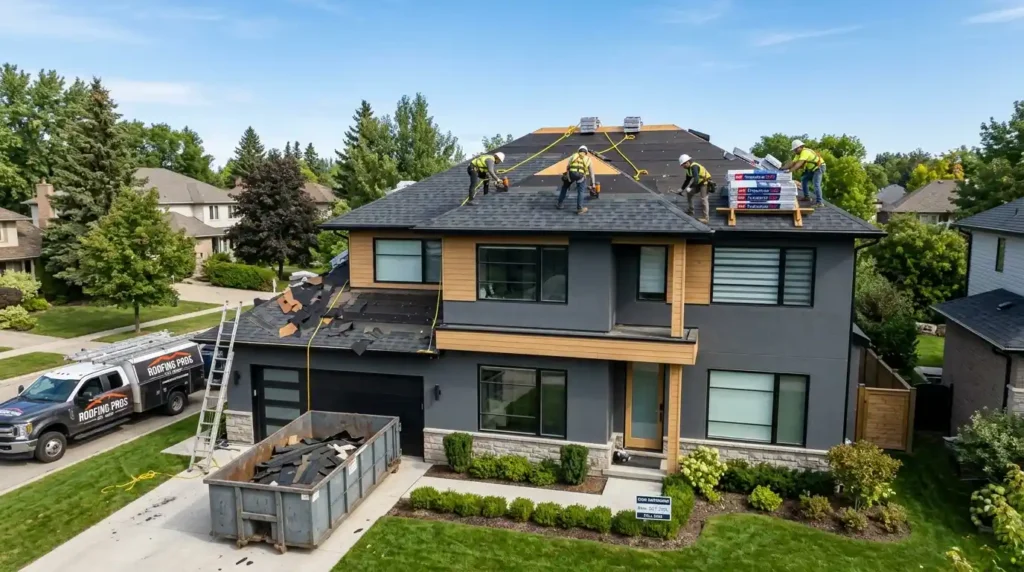
It’s no surprise that the first time I got a new roof quote, it was nearly double what I had budgeted for. And my gut response was that he padded the price. But he didn’t. What I was unaware of was that there is no single “cost of a new roof.” There are individual costs for everything from material to labor to tear off to structural components that all come together to make one lump sum. When you understand that, it all makes sense. The truthful answer on how much does a new roof cost in 2026 is that homeowners in the United States pay anywhere from $10,000 to $30,000 on new roofs, with some opting for roofing systems costing over $50,000.
According to This Old House, a good estimate would be around $5,117 for 1,000 square feet worth of asphalt shingles, so a roof of 1,500 square feet would fall in the range of $5,202 to $18,059 while a 2,000-square-foot roof could cost between $6,885 to $23,993. Based on FoxHaven Roofing’s statistics in 2026, a homeowner will pay an average amount of between $9,800 and $41,800 on replacing the roofing on their 2,000-square-foot home, with most paying around $15,000 to $20,000 for asphalt shingles. The variation is caused by factors like roof size, pitch, structure, complexity, and roofing materials, all which affect the price individually, but most online calculators allow you to change only one or two variables at once.
Roof Replacement Cost Per Square Foot: What the Numbers Actually Mean for Your Home
Roofers use “squares” as their unit of measure in which each square is equal to 100 square feet; thus a roof that measures 1,200 square feet would require 12 squares of roofing while a 1,800 square foot roof needs 18 squares. Most domestic roofs range between 1,500 and 3,000 square feet with an average single-story home requiring around 1,775 square feet and two stories needing 3,500 square feet of roof area.
Average Price Per Square Foot Of The Roof In 2026
The average price per square foot of the roof in 2026, shown by most estimates, is actually broad due to how many things can be covered within it. For example, according to data compiled by Modernize, based on 3,000+ homeowner projects, 3-tab shingles can be anywhere between $4.50 and $7.50 per square foot installed while architectural shingles will range from $6.00 to $9.00 with high-quality asphalt simulating wood or slate prices going as high as $16.00 per square foot.
At Apex Roofs, 3 tab shingles are estimated to cost between $3.43 and $4.65 per square foot, while architectural shingles go for between $4.11 and $5.57 per square foot. In 2026, according to Cobex Construction Group’s estimates, asphalt shingle roofs can cost $3.40 to $8.75 per square foot while overall new roofs cost $6 to $35 per square foot. According to CostFlowAI, the average installed cost of a re-roofing project is somewhere between $5 and $12 per square foot.
What accounts for this range for seemingly identical roof construction?
Roof complexity holds the explanation. In terms of price per square foot, a straightforward gable roof is significantly cheaper than a roof with dormers, valleys, hips, steeply pitched sections, or a roof requiring unique methods and added safety considerations during installation. A low slope roof is easier to install than a steep slope roof, with time decreasing and additional risk premium factored into the cost of labor as the roof pitch increases with each extra degree.
An estimate for a full roof replacement job on a 2,000-square-foot house using architectural shingles at less than $6,000 should give cause for alarm either the tear off is not happening, materials are inferior, or work is missing.
Roofing Material Cost Comparison: From Asphalt Shingles to Slate
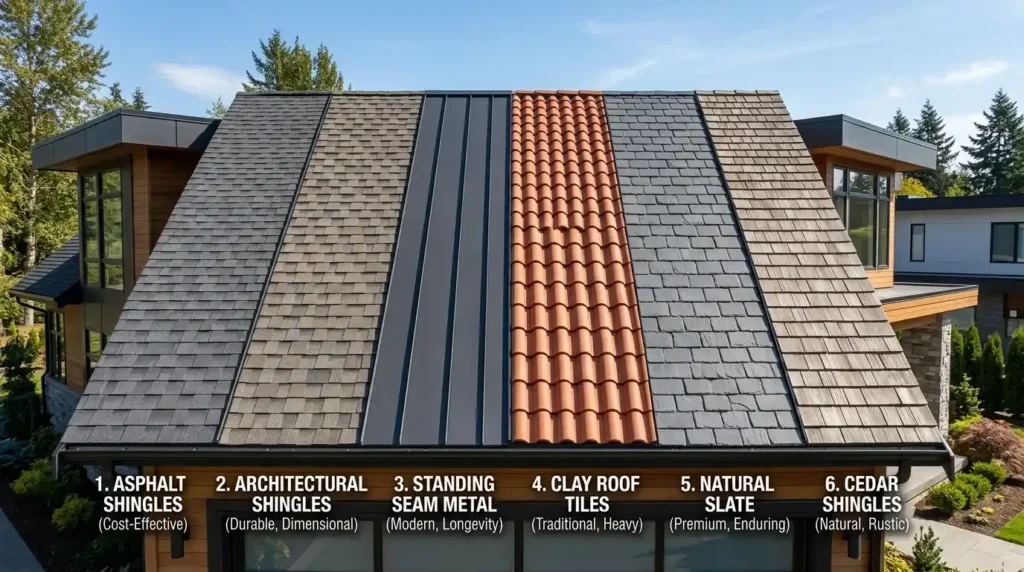
Asphalt shingles still reign supreme, with 47% choosing asphalt as their new roofing material in 2026. This is due to its combination of cost-effectiveness, easy installation, and reasonable longevity. The least expensive and the least complicated asphalt shingles are called 3-tab, and they can last for 15 to 25 years.
Next are architectural shingles, which are pricier per square foot compared to their counterparts, yet have superior durability and aesthetics.
Standing Seam Metal And Metal Roof
Standing seam metal and metal roof in general is one of the most expensive options available at $8.00 to $18.00 per square foot. However, according to Cobex, the wide range of metal roofs estimated by the firm starts at $6 per square foot and ends at $35 per square foot, considering material costs and other expenses.
The benefits of installing such an expensive product lie in the longevity; standing seam metal and concrete tile roofs can last 50 to 70 years.
Two Main Advantages Of Clay And Concrete Tile Roofing
The two main advantages of clay and concrete tile roofing include their fire-resistant qualities and lifespan, but they are usually used in those buildings that have Mediterranean and Spanish Colonial architecture. Slate roofing is the most expensive roofing system, since the installation of new slate tiles may cost between $19,000 and $52,000 or more, as well as require the reinforcement of the building structure because of slate’s extremely heavy weight. Nevertheless, in return, it will guarantee you more than one hundred years without any problems with your roof, thus making it an ideal choice for luxurious homes or even historic houses, since slate is also one of the historic house roofing materials.
Another example of high-end materials is cedar shingles and copper, both being very expensive and having special maintenance, but also long-lasting and beautiful. The cost of installation of flat roof systems based on EPDM, PVC, or TPO is approximately $14 per square foot, which makes it relatively effective for such structures as additions or garages, and sometimes other homes too.
Labor, Tear-Off, Permits and the Hidden Line Items That Inflate Every Quote
Labor is consistently the largest single cost factor in any roof replacement 2026 survey data puts labor’s share at 65% of total project cost, while other estimates place it at 50% to 60%. Roofing professionals charge $40 to $90 per hour per worker depending on complexity, location, and whether you’re working with an experienced, reputable roofing contractor with a large team or a smaller, newer roofing company.
Experienced crews with established reputations often charge more and in my experience, that premium is usually worth it, because the hidden costs of a poorly executed tear-off show up months later as leaks you can’t easily trace back to the install.
Tear off Labor
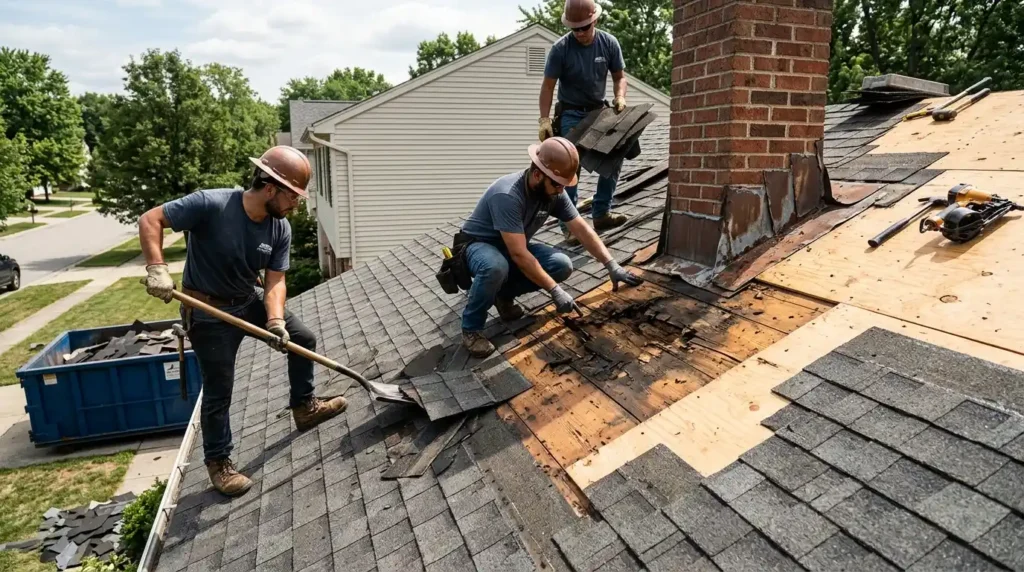
Tear-off labor adds $1 to $5 per square foot on top of the base installation cost, and it’s not optional if your existing roof has multiple layers many older homes do, and full removal of all layers is required before new materials go down. This is often the stage where hidden expenses emerge. Problems such as moisture damage, wood rot, or structural deterioration in the roof decking may only become visible after the old roofing is removed.
If repairs like roof decking replacement, flashing replacement, or structural reinforcement are required, they will be added to the overall project cost. A roofing inspection before the project starts helps set realistic expectations, but it can’t catch everything that’s hidden under existing layers.
Permit Fees
Permit fees typically run $100 to $500 depending on your municipality, and roof disposal cost and cleanup cost are usually itemized separately from the core installation. When you’re comparing quotes, read the line items rather than just the bottom number a quote that’s missing tear-off, disposal, permits, or flashing replacement isn’t actually cheaper, it’s incomplete.
For minor issues, the cost calculus is completely different: average roof repairs in 2026 run around $1,150, typically ranging from $400 to $1,900, with minor repairs like patching a leak or replacing a handful of shingles often staying under $1,000. Roof repair vs replacement is worth evaluating honestly before committing to either a $1,147 average basic roof repair (per Liberty Mutual) can buy years of additional life from a roof that isn’t yet at the end of its 15 to 30 year average lifespan.
Repair vs Replacement, Insurance Claims and Financing Options
The question of whether or not roof coverage is included under homeowner’s insurance depends almost completely on the cause of the damage, and here much confusion arises. Homeowners’ insurance covers sudden events that happen unexpectedly: storms, fallen trees, fire, vandalism, and others. But they will not cover roof damage caused by any kind of wear-and-tear, deterioration, neglect, moss growth, or simply because the roof has reached the end of its natural lifespan. In particular, if the roof is older than 20 years, your insurance company may put some age limitations into play.
ACV Vs RCV Roof Insurance
The ACV vs RCV roof insurance distinction matters financially. Under Actual Cash Value, depreciation is factored in a $50,000 replacement cost on a 10-year-old roof might see $23,000 in depreciation deducted, plus a $2,000 deductible, leaving a $25,000 payout. Under Replacement Cost Value, the same scenario nets $48,000 after just the deductible. In Australia, roof insurance deductibles in Melbourne typically range from $500 to $2,000, and notably, 47% of all homeowner insurance claims in Australia relate to roofing making it one of the most common claim categories nationally.
Documenting your roof’s condition annually, keeping records of professional inspections, and maintaining detailed maintenance records all strengthen a future claim and can reduce the chance of denial over preventable issues.
Roof Replacement Projects
For roof replacement projects that aren’t insurance covered, roof financing has become a standard part of the conversation.
Home equity loans are among the most common options, allowing homeowners to borrow against built up equity at competitive interest rates. Roofing payment plans and contractor arranged financing are increasingly common too, spreading a $5,000 to $12,000 typical asphalt shingle project or a much larger premium material project into manageable monthly payments rather than a single upfront cost.
Choosing a Roofing Contractor, Warranties and Getting the Timing Right
There are two factors which will continue to influence an increase in the cost of roofing through the remaining period of 2026. Firstly, tariffs on steel and aluminum were imposed under Section 232 of 50%, in mid-2025, and they have not been reduced, impacting roofing materials that are made from these metals, while other roofing materials have increased in price in line with rising labor rates.
There is a tendency for coastal areas and metropolitan cities to be quoted higher prices than those in rural areas when it comes to the same roofing material. Even within a single state, costs differ according to location.
Credibility Of A Contractor
In assessing the credibility of a contractor, the warranty discussion should not be overlooked because there is usually a huge difference between the warranties offered by different contractors for both types of warranty manufacturer warranty and workmanship warranty and the workmanship warranty is even more important in terms of longevity than the manufacturer warranty, and a longer workmanship warranty is a better indicator of confidence than a slightly reduced cost.
Quality installation should always take precedence over quality material since an average asphalt shingle roof that is installed well will last much longer than a premium material roof that was installed poorly.
Final Roofing Bill
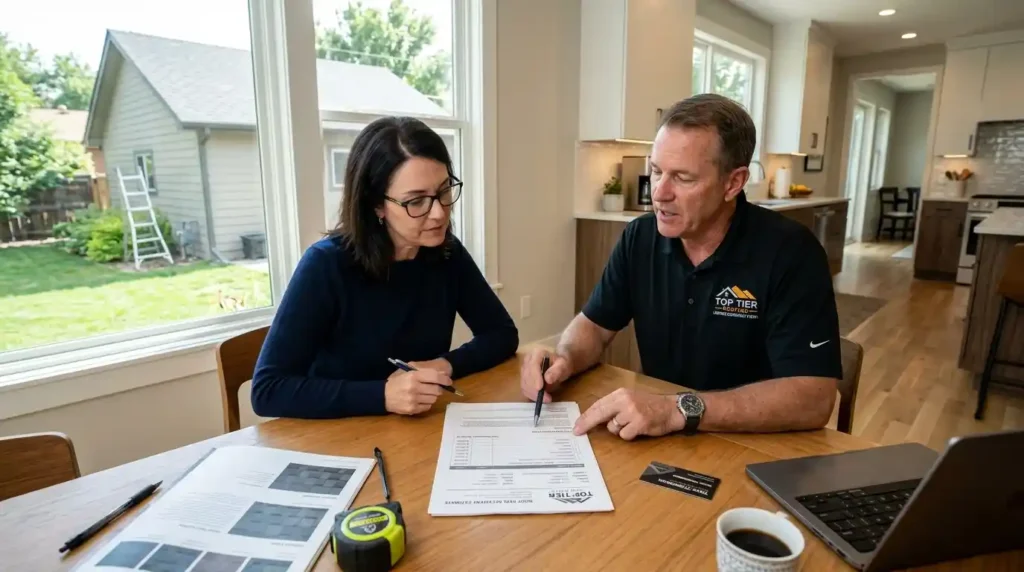
According to a 2026 homeowner survey, nearly 79% of homeowners reported that their final roofing bill aligned closely with their initial estimates. While roofing costs can vary widely, the pricing typically becomes far more predictable after a professional inspection that accounts for roof size, slope, design complexity, materials, and labor requirements.
The goal isn’t finding the lowest number. It’s understanding what’s inside the number you’re given, and making sure nothing critical tear off, decking repair, flashing, disposal, permits has been quietly left off the page.
Conclusion
In all honesty, it doesn’t matter so much about getting a precise figure as it does knowing precisely what will be measured, taken away, fixed, and installed on top of your very own roof. These ranges that seem so broad in every guide you’ve ever seen don’t mean that no one truly understands what they’re saying because it reflects the sheer number of factors that actually impact the bottom line in your own backyard.
The best possible way to avoid any kind of shock is by going beyond just finding the most economical quote. Instead, consider getting an itemized quote, determine whether you are repairing or replacing your roof, understand exactly what coverage you have from your insurance before you assume it will help, and make sure that your roofer stands behind their work for a lifetime.
FAQs
A roofing square is simply the industry’s unit of measurement, equal to 100 square feet, so a 1,800-square-foot roof requires 18 squares of material. Understanding this helps when comparing quotes, since contractors often price per square rather than per square foot, and knowing the conversion lets you sanity-check whether a quote’s math actually adds up for your roof’s size.
Actual Cash Value (ACV) factors in depreciation, so a $50,000 replacement on a 10-year-old roof might see $23,000 deducted for wear before the deductible is even applied, leaving a much smaller payout. Replacement Cost Value (RCV) skips that depreciation deduction entirely, netting a payout much closer to the full replacement cost minus just the deductible, which makes it the more valuable coverage type if you have a choice between policies.
Read the line items rather than just the bottom number, since a quote that leaves out tear-off, disposal, permits, or flashing replacement looks cheaper but is actually incomplete. As a rough sanity check, an estimate under $6,000 for a full architectural shingle replacement on a 2,000-square-foot house should raise a flag, since that price likely means the tear-off isn’t happening or inferior materials are being used.
Most homeowners in the US pay between $10,000 and $30,000 for a new roof, with some premium material systems running past $50,000. Material choice drives a lot of that range — asphalt shingles, the most common choice at 47% of installs, typically run $3.40 to $9.00 per square foot installed, while metal roofing runs $6 to $35 per square foot and slate can run $19,000 to $52,000 or more for the full installation.
It depends on where the roof sits in its lifespan and how extensive the damage is — average roof repairs run around $1,150, and a repair like patching a leak or replacing a handful of shingles can buy years of extra life if the roof isn’t yet near the end of its typical 15 to 30 year lifespan. Full replacement makes more sense once the roof is old enough that repairs are becoming frequent or the underlying decking and structure show signs of deterioration.
It depends entirely on the cause of the damage — insurance generally covers sudden, unexpected events like storms, fallen trees, fire, or vandalism, but it won’t cover damage from wear-and-tear, gradual deterioration, moss growth, or a roof simply reaching the end of its natural lifespan. Insurers may also apply age-based limitations if your roof is older than 20 years, so it’s worth checking your specific policy rather than assuming coverage applies.

3 thoughts on “How Much Does a New Roof Cost: A Realistic 2026 Breakdown Before You Sign Anything”