Most people discover ACRIS the hard way mid-negotiation, needing to verify a seller actually owns what they’re selling, with no idea where to start. An ACRIS NYC property search by address is free, doesn’t require a login, and pulls directly from New York City’s own property records, but the interface wasn’t built with first-timers in mind.
This walks through the actual steps, what to do when an address search comes back empty, how to read the results you get, and the borough-specific quirks that trip people up. Real estate attorneys use this daily. You can too, in about the time it takes to read this.
What ACRIS Actually Is
ACRIS stands for the Automated City Register Information System, and it’s run by the NYC Department of Finance. Deeds, mortgages, liens, satisfactions anything recorded against a property in four of the five boroughs lives here, going back to 1966 in most cases. Staten Island runs on a separate system, which catches a surprising number of people off guard when their address search comes back with nothing.
It’s genuinely public. No subscription, no account, no fee to search or view document images. Title companies and attorneys use it constantly for due diligence, but so do reporters chasing an ownership story, landlords checking a building’s history, or just someone curious who actually owns the house next door.
Who actually uses ACRIS and why
Buyers use it to confirm a seller’s ownership before signing anything, attorneys pull title chains for closings, and researchers track ownership transfers over decades. I’d argue anyone about to sign a lease with an individual landlord not a management company should run a quick search too, just to confirm the name on the lease matches the recorded owner.
How to Do an ACRIS NYC Property Search by Address
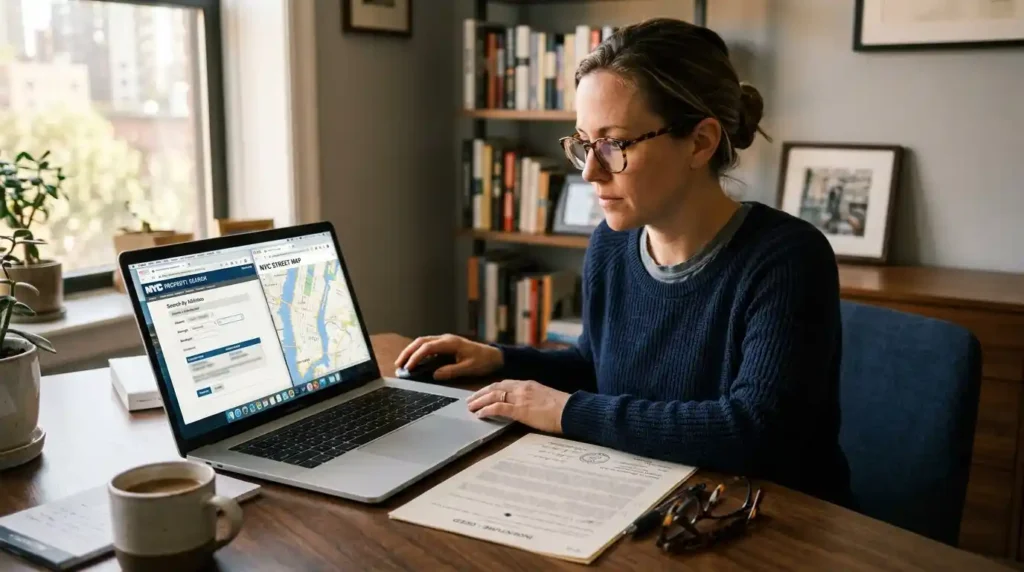
This is the part most readers care about, so let’s get straight to the answer. From the ACRIS main page, choose “Search Property Records,” then “Find Addresses and Parcels” if you’re starting from an address rather than a known block and lot.
What information do you need before starting?
You need the full street address, including house number and street name, plus the correct borough the search won’t work without both. A ZIP code helps confirm you’ve got the right borough if the address sits near a border, since NYC’s boundaries don’t always match what people assume based on the mailing ZIP.
Step-by-step: searching by address
Enter the borough first, then the house number, then the street name exactly as it’s recorded abbreviations sometimes matter more than you’d expect, so try “St” and “Street” separately if one doesn’t return results. The system converts your address into a BBL, that’s Borough-Block-Lot, and that BBL becomes the key that unlocks every document tied to the property. Once you’ve got a match, you’ll see a property page listing recorded documents deeds, mortgages, and anything else filed against that parcel.
If you already know the apartment or unit number for a condo, include it. Co-ops are trickier here, and I’ll get into why in a minute.
When Address Search Comes Back Empty
Address search fails more often than people expect, and it’s rarely because the property doesn’t exist. Street renumbering, merged lots, and vanity addresses (the ones developers use for marketing that don’t match the recorded legal address) all break a straightforward address lookup.
Why did my ACRIS address search return no results?
The most common reason is a mismatch between the address you’re using and the one officially recorded this happens after street renumbering or when a building uses a marketing address different from its legal one. Switching to a BBL search once you’ve identified the parcel through the NYC Property Lookup Tool usually solves it, since BBL is the more stable identifier underneath the address.
How do you find a BBL when the address search fails?
Use the standalone “Find Addresses and Parcels” tool separately from the document search it’s built specifically to convert a rough address into a confirmed BBL even when the main property search stalls. Once you’ve got block and lot numbers, plug those directly into the parcel identifier search instead of retrying the address field.
Reading Borough Codes and Block-Lot Numbers
ACRIS uses a one-digit code for each borough, and getting it wrong is an easy, invisible mistake the system won’t necessarily flag it, it’ll just quietly search the wrong borough.
What are the ACRIS borough codes?
Manhattan is 1, the Bronx is 2, Brooklyn is 3, and Queens is 4. Staten Island doesn’t have a code here because, again, it’s not part of the core ACRIS system you’d need the Richmond County Clerk’s records instead.
Block numbers run up to five digits and lot numbers up to four, and every taxable parcel in the city has one. As an example, a property might sit at block 908, lot 1033 plug both into the parcel search alongside the correct borough code, and you’ll land directly on that property’s document history without needing the address at all.
What You’ll See in Your Search Results
Once you’ve matched an address or BBL, the results page lists every recorded document tied to that parcel document type, recording date, party names, and a City Register File Number, or CRFN, that uniquely identifies each filing.
How do you know if a deed is real or current?
Click into the specific document and you can view the scanned image directly, comparing the actual recorded deed against the index information ACRIS displays. The index is a summary; the scanned document is the legal record, and for anything involving real money, I’d always pull the actual image rather than trusting the index fields alone.
You can filter by document type if a property has a long history separating deeds from mortgages, satisfactions, and lien filings makes a decades-long title chain much easier to follow than scrolling through everything in date order.
Searching Beyond Address When You Need More
Address search is the obvious entry point, but it’s not the only way in, and sometimes it’s not even the best one.
Can you search ACRIS by owner name instead of address?
Yes party name search lets you look up documents by grantor or grantee, which works well if you know an owner’s name (or an LLC name) but not the exact property address. This is particularly useful for landlord research, where a single owner or LLC might hold several properties you wouldn’t otherwise connect through address search alone.
You can also search directly by CRFN or transaction number if you already have a document reference, and by reel and page for older pre-digital filings. UCC and federal lien searches sit as separate options too, worth checking if you’re doing full due diligence rather than a quick ownership check.
Why might a co-op not show up the way you expect?
Co-ops are legally structured differently from condos you’re buying shares in a corporation that owns the building, not a direct real property interest so an individual co-op unit often won’t have its own dedicated ACRIS record the way a condo unit does. You’ll usually need to search the building’s overall address and review corporate-level documents instead of expecting a unit-specific deed.
When ACRIS Is Down or You Need Help
The system does go offline for maintenance, and it’s worth knowing the pattern so you’re not troubleshooting a search that was never going to work in the first place.
Scheduled maintenance windows run roughly 1:00 AM to 2:00 AM daily, plus a longer Sunday window from about 5:00 AM to 10:00 AM. If your search is timing out or behaving oddly during those hours, that’s probably why try again outside the window before assuming you’ve made an error.
For anything the system itself can’t resolve, the ACRIS Contact Center is reachable at (212) 487-6300, and in-person help is available at City Register offices across the boroughs, including locations in the Bronx, Brooklyn, Manhattan, and Queens. Older records predating the digital system sometimes require an in-person visit regardless, since not everything from before 1966 made it into the online index.
Conclusion
An ACRIS NYC property search by address gets you real, recorded property information for free, in minutes, without ever needing an account. Start with the address, fall back to a BBL search through the parcel lookup tool if that stalls, and always pull the actual scanned document rather than trusting the index summary alone. It’s not a perfect system co-ops, Staten Island, and pre-1966 records all have their quirks but for the vast majority of NYC properties, it’s the fastest legitimate way to verify who actually owns what.
FAQs
Yes, ACRIS is a free public database with no login or subscription required to search property records or view scanned document images.
Staten Island, also known as Richmond County, isn’t part of the core ACRIS system, so you’ll need to check with the Richmond County Clerk’s office for those property records instead.
Try the separate “Find Addresses and Parcels” tool to convert the address into a BBL, then search directly by borough, block, and lot instead of retrying the address field.