A surprising number of sites that look official for Broward property search aren’t run by the county at all some even say so themselves, quietly, in the fine print. This guide starts there, because it matters more than any search tip: where the real data actually lives, versus where an independent site has just repackaged it and added its own branding.
From there, we’ll get into how the official search tool actually behaves, why address searches sometimes come back empty for no obvious reason, and the difference between the Property Appraiser’s records and the Clerk’s Official Records, since people mix those up constantly and end up looking in the wrong place entirely.
Which Broward Site Is Actually the Government’s Own Portal?
The real one is bcpa.net, run by the Broward County Property Appraiser’s Office under Marty Kiar. That’s where ownership, assessed value, exemptions, and sales history actually live, maintained directly by the county rather than a third party.
A handful of other sites use very similar names and show up right alongside it in search results one, for instance, explicitly discloses in its own fine print that it’s “an independent informational resource created for educational purposes only and is not affiliated with any government agency.” That’s not necessarily malicious. Plenty of these sites just aggregate public data and present it under their own branding, sometimes charging for a “premium” report built entirely from information the county gives away free. But it does mean you can land on a site that looks official without actually being the source of record, and if you’re doing anything that matters verifying ownership before a purchase, confirming an exemption that distinction is worth checking before you trust what you’re reading.
How Do I Know I’m on the Real Broward County Property Appraiser Website?
Look for bcpa.net specifically, and check for a clear identification of the Broward County Property Appraiser’s Office and Marty Kiar as the office holder. If a site doesn’t clearly state it’s the official government portal, or includes language distancing itself from government affiliation anywhere on the page, treat it as a secondary source and cross-check anything important against bcpa.net directly.
How the Official Broward Property Search Actually Works
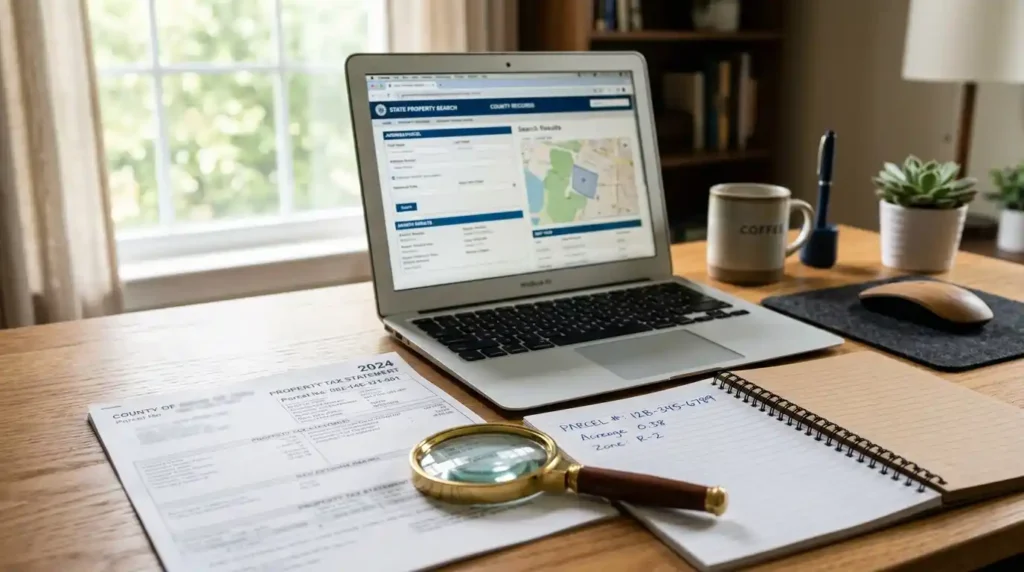
BCPA’s search tool takes three main entry points address, owner name, or parcel ID, also called a folio number and each one has its own quirks worth knowing before you assume a search failed because a record doesn’t exist.
For an address search, enter the street number and street name only. Skip the directional prefix (N, S, E, W) and skip the street type too (Ave, St, Blvd) on your first attempt, since the system tends to handle a looser query better than an overly specific one. Owner searches work last-name-first, and using just a partial name is often more effective than typing the full name out, particularly if you’re not certain of the exact spelling on file. The parcel ID, or folio number, is the most precise identifier once you have it you’ll find it printed on a property tax bill or pulled from an earlier search result, and it’s worth saving once you’ve got it, since it makes every follow-up lookup faster than searching by address again.
What’s the Difference Between a Parcel ID and a Folio Number in Broward County?
They’re the same thing Broward County uses “parcel ID” and “folio number” interchangeably to refer to the unique identifier assigned to each property. Once you have it, it’s the fastest and most reliable way to pull up a specific property’s record without dealing with address-formatting quirks.
Why the Property Appraiser Isn’t Who Sends Your Tax Bill
This trips up a genuinely large number of people searching for Broward property records: the Property Appraiser’s office determines your property’s value and processes exemptions, but it doesn’t send tax bills or collect payment. That’s an entirely separate office.
Tax billing and collection runs through the Broward County Tax Collector, a different department with its own contact line, separate from BCPA. If you’re trying to pay a bill or check a current balance, searching bcpa.net alone won’t get you there you need the Tax Collector’s specific portal. This split confuses people constantly, since both offices deal with “your property taxes” from a resident’s perspective, even though they’re handling genuinely different parts of the process behind the scenes.
Where Do I Pay My Broward County Property Tax Bill?
The Broward County Tax Collector’s Office handles billing and payment, not the Property Appraiser. If you’re searching for assessed value or exemption status, bcpa.net is correct; for an actual bill or payment, you need the Tax Collector’s separate site and contact line instead.
Property Appraiser Records vs. Clerk’s Official Records
Beyond the tax-billing confusion, there’s a second, equally common mix-up: the Property Appraiser’s records and the Clerk of Courts’ Official Records cover genuinely different document types, and knowing which one you need saves a search in the wrong system entirely.
BCPA handles ownership data, assessed and market value, exemption status, building characteristics, and sales history essentially a property’s profile. The Clerk of Courts’ Official Records Search, on the other hand, holds the actual recorded legal documents: deeds, mortgages, liens, and judgments, searchable by party name, document type, or book-and-page reference. If you’re doing real title research before a purchase, you’ll likely need both BCPA for the property’s current profile, and Clerk records for the actual chain of title behind it.
Do I Need the Property Appraiser or the Clerk of Courts for a Deed Search?
The Clerk of Courts’ Official Records Search holds actual deed images and recorded documents, while the Property Appraiser’s site shows ownership and value data derived from those records but not the documents themselves. For genuine title research, checking both is the more thorough approach, since each system holds information the other doesn’t.
Homestead Exemption and Why It’s Worth Checking Early
If you own and live in a Broward property as your permanent residence, the homestead exemption is one of the more consequential things to check through this same search system, and it’s easy to miss if you’re only looking at raw property value.
Filing happens directly through BCPA’s own online system, and eligibility generally requires owning and occupying the property as a permanent residence as of January 1 of the relevant tax year. Beyond the base homestead exemption, Broward also administers additional exemptions for seniors, and for property owners with a qualifying disability, each with its own eligibility rules worth checking directly on the official site rather than assuming you don’t qualify. Save Our Homes portability is a related benefit worth knowing about if you’re relocating within Florida, since it can carry forward some of your prior homestead’s tax benefit to a new property rather than starting completely from scratch.
How Do I File for Homestead Exemption in Broward County?
File directly through BCPA’s official online exemption system, generally required by the relevant filing deadline in the year you’re applying. Eligibility depends on owning and occupying the property as your permanent residence as of January 1 of that tax year, so confirm your specific situation against the current requirements on bcpa.net directly rather than assuming standard rules apply to every case.
Conclusion
A smart Broward property search starts with confirming you’re actually on bcpa.net, not a similarly named independent site quietly disclaiming government affiliation somewhere in its footer. From there, loosen your address searches, save your folio number once you find it, and remember that the Property Appraiser and the Tax Collector plus the Clerk of Courts for actual recorded documents are separate offices handling different pieces of the puzzle. Get that structure straight first, and the rest of the search moves considerably faster.
FAQs
Yes the official BCPA property search and the Clerk of Courts’ Official Records Search are both free public tools, with an optional account available for saved searches rather than a requirement to search at all. Be cautious of third-party sites charging for “premium” reports built from the same publicly available data.
Usually a formatting issue rather than a missing record try dropping the street direction and street type from your search, since the system often matches better with just the street number and name alone. If that still doesn’t work, switching to an owner-name or parcel-ID search is generally more reliable than retrying the same address text repeatedly.
Market value reflects what the Property Appraiser estimates the property would sell for, while assessed value is the figure actually used to calculate your tax bill, which can be lower due to caps like Save Our Homes for homesteaded properties. The gap between the two numbers can be substantial for long-term owners, since assessed value increases are capped annually while market value moves with the broader market.
No certified copies of recorded documents come through the Broward County Records Division or the Clerk of Courts, not the Property Appraiser’s office. BCPA can show you ownership and value data, but the actual certified legal document requires going through the Clerk’s Official Records system separately.