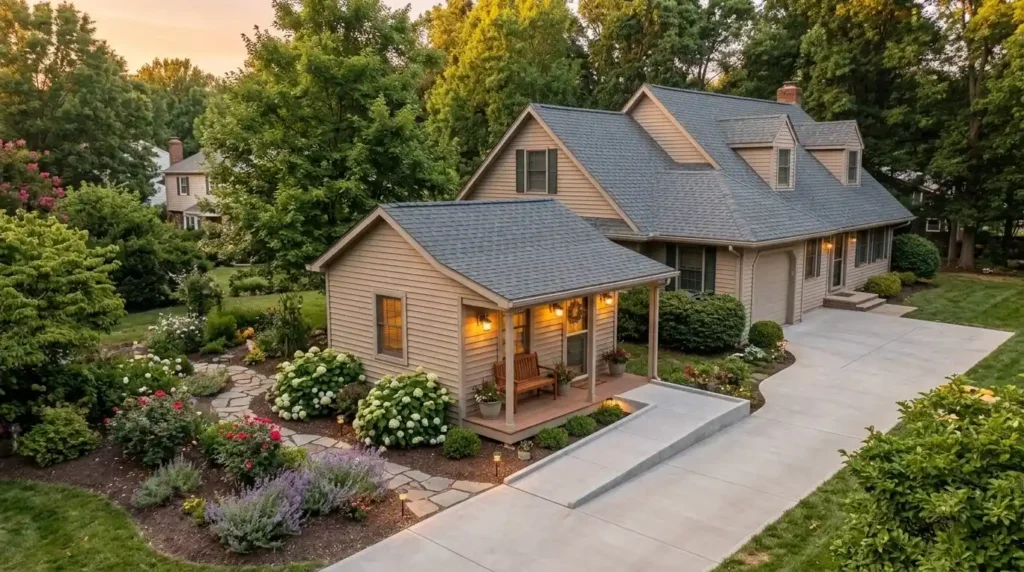
A coworker of mine spent almost a year going back. And forth on whether to put her dad in assisted living or build something in the backyard instead. She went with the backyard option. And honestly, watching her navigate permits was more complicated than she expected going in. Granny pods sound like a simple, tidy solution on paper. Small home, aging parent, done. In practice there’s a legal category, a permitting process, and a real cost range hiding underneath that cute nickname. This piece walks through what a granny pod actually costs, how the ADU rules work. And where families get tripped up before they’ve even broken ground.
What Granny Pods Actually Are, Legally:
Here’s the thing that surprises a lot of people right out of the gate. Granny pods aren’t their own special legal category anywhere. They’re accessory dwelling units, ADUs, wearing a friendlier name. And that distinction changes basically everything about size limits, permitting, and where you’re even allowed to put one.
ADU Rules Drive Everything:
When you come to grips with the idea that the granny pod is simply an accessory dwelling unit. Everything falls into place. States have limitations on detached units that usually range at around 1,200 square feet. Although local zoning ordinances can narrow down that number even more based on lot size and setbacks. The attached units, those that are built next to the main home. Are usually allowed to be approximately half of the size of the main home. This information may not apply to all areas.
Why the Legal Label Matters More Than the Name:
Calling it a granny pod instead of an ADU doesn’t get you out of permits. And treating it like it might is a common mistake. Some families try converting a shed into living space to skip the process entirely. And that approach carries a real risk of denial once an inspector actually looks at it. A park model RV can sometimes bypass full building permits by being classified as a temporary structure instead. Which speeds things up considerably in more restrictive zones. But it’s a different product with different tradeoffs than a permanent build.
What Granny Pods Actually Cost:
This is the number everyone wants, and honestly, most national averages you’ll find online are a little misleading once your specific state and lot enter the picture.
The Real Price Range:
The average range for prefabricated homes is from $40,000 to $125,000. Whereas a completely turnkey one may cost $85,000 to $150,000. More elaborate custom-made prefabs may easily exceed $250,000. The problem with those cheap costs is that they do not account for all the additional expenses associated with setting up on site and linking the utilities, which is why an actual planning budget is likely to be from $100,000 to $300,000.
What Actually Drives the Cost Up:
Size plays the biggest role, a compact 300 to 500 square foot unit costs a lot. Less than something pushing 800 to 1,200 square feet with full amenities. Foundation type matters too. A permanent slab foundation costs more upfront than a wheeled setup but tends to hold value better and avoids the temporary-structure classification headaches. Property taxes and insurance also creep up once the new structure gets added, which is easy to forget when you’re focused on the sticker price of the pod itself.
Granny Pods vs Assisted Living, Financially:
This is really the comparison most families are actually trying to make, even if they start out just asking “how much does a granny pod cost.”
National median costs for assisted living run around $74,400 a year, and a semi-private nursing home room lands even higher. A private nursing home room can clear $129,000 annually in some markets. Against those numbers, even a $150,000 granny pod build can pencil out favorably within just a few years, especially if more than one family member ends up needing the space over time. It’s not automatically cheaper for every family, but the comparison is worth running with real numbers instead of assuming either option is obviously better.
Financial Help That Actually Exists:
Not every family is paying for this entirely out of pocket, and a few programs are worth knowing about before assuming the full cost falls on you alone.
USDA and VA Programs Worth Checking:
USDA Rural Development Section 504 provides loans for up to $40,000 and grants for up to $10,000 for very-low income rural homeowners, in order to make safety repairs, not build from scratch. Some veterans with specific service connected disabilities might qualify for the VA disability housing grant, with maximum limits for the Specially Adapted Housing grant exceeding $126,000 by 2026. However, these funding sources won’t pay for an entire granny pod build-up, but will reduce some expenses related to it.
Permits, Zoning, and Timeline Expectations:
Permitting is where a lot of granny pod timelines quietly fall apart, mostly because people underestimate how long the process actually takes.
What to Expect From Local Approval:
You should plan for a period of 4 to 8 weeks for permit processing in most cases, with costs ranging from $500 to $3,000 based on where you live. However, there are several states that have made this process quite efficient. California, for example, has made it mandatory for ministers to process permits within 60 days for those who abide by regulations – that’s quite speedy when compared with most other states. Always ensure setback criteria, occupancy criteria, and HOA criteria prior to submission.
Regulations Are Still Shifting:
Several states have pending 2026 legislation aimed at standardizing ADU rules statewide. Which would reduce a lot of the redundant county-by-county review that currently slows projects down. That’s genuinely good news for anyone building soon. But it also means checking current rules right before you file is worth doing even if you researched this a year ago. Zoning law in this space moves faster than most people expect.
Granny Pods Conclusion:
However, there is always the practical, usually more economic alternative to assisted living – a granny pod, which is simply an ADU in disguise. Granny pods do have legal implications despite their friendly sounding name, and these legal obligations differ from one state to another and are accompanied by certain expenses. Therefore, budget accordingly not only for the construction itself but make sure you are familiar with all the zoning laws of your area, and make the assisted living vs. granny pod calculations in real numbers.
FAQs About Granny Pods:
Most prefab units run $40,000 to $125,000, with turnkey builds landing between $85,000 and $150,000. Once permits, site work, and utilities are included, many families budget $100,000 to $300,000 for the full project.
They’re legal as accessory dwellings units in most states, but the laws can vary considerably by counties and even by the neighborhoods. Be sure to confirm the legality from your local zoning/planning department
Yes, sometimes it can be less costly, especially when considering the long term because assisted living costs nationally an average of about $74,400 per year. This all comes down to your actual construction cost and usage period.