Nobody thinks about what’s in their floor cleaner until something goes wrong. For me it was a commercial product well-reviewed, not cheap that left a sticky residue across a sealed hardwood floor I’d just spent forty minutes cleaning. Took three passes with plain water to undo it. That was the last time I bought one. I’ve been mixing my own diy floor cleaning solution since, and the floors genuinely look better for it.
It’s not just the cost, though the savings are real a homemade floor cleaner costs almost nothing compared to what commercial brands charge for the same job. It’s more than once you’ve had a dog licking a freshly mopped floor and started reading ingredient labels, chlorine, triclosan, and synthetic odors stop feeling like an acceptable trade-off for convenience. Pantry staples vinegar, baking soda, rubbing alcohol, a drop of dish soap have been doing this work for decades. The part most people miss isn’t the ingredients. It’s matching the ratio to the floor.
Why the Floor Type Changes Everything Before You Mix Anything
Here’s where most homemade floor cleaner recipes fall short: they give you one formula and tell you it works everywhere. It doesn’t.
Sealed hardwood floors you’re cleaning the finish, not the wood. Anything too acidic or applied too wet damages that finish quietly, over time, until the dullness becomes permanent. Unsealed hardwood and waxed floors are worse. Pour vinegar on a waxed floor and you won’t notice the damage immediately the wax just quietly lifts, and by the third or fourth clean the floor looks tired in a way that’s hard to explain. Leave a wet mop sitting on unsealed wood long enough and you’ll hear the boards shift before you see them buckle.
Laminate floors and LVP floors look like hardwood but behave differently they have a wear layer that streaks easily and reacts badly to excess moisture. Push too much water into laminate and nothing happens right away, which is the problem six weeks later a plank edge curls up and you’re looking at a repair job that didn’t have to happen.
Vinyl flooring and linoleum are more forgiving. Durable, water-resistant, tolerant of stronger solutions — but too much essential oil leaves a film that dulls the surface and attracts dust. Tile floors and ceramic tile can handle the most aggressive DIY mixes, though the grout lines between them are a separate problem from the tile itself and need a different approach. Then there’s natural stone marble floors, granite, travertine and this is the category that catches people badly.
Vinegar on marble etches it. Baking soda is gritty enough to leave hairline scratches on polished stone that only show up in certain light until they accumulate and suddenly they’re everywhere. Natural stone floors want one thing: something pH-neutral that cleans without touching the surface chemistry. That’s it.
Patch test a small area first, every time, regardless of what the recipe says. Thirty seconds of caution versus a floor repair bill isn’t a difficult calculation.
The Ingredients Doing the Real Work
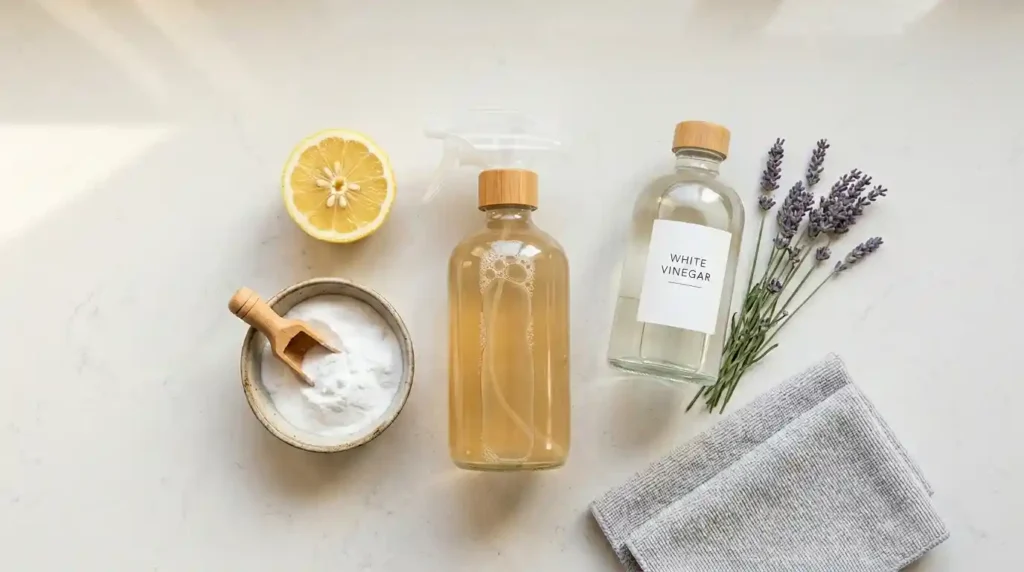
White vinegar is the one I reach for first. It breaks down surface grime, cuts through grease, and on sealed floors tile, vinyl, laminate it dries without leaving anything behind. Apple cider vinegar does the same, just with a smell that hangs on slightly longer before it clears. I dilute both; straight from the bottle is too sharp for regular use and will dull surfaces with repeated application. The 1-1-1 mix one part water, one part white vinegar, one part rubbing alcohol is the combination I’ve settled on for floors that need cleaning without fuss, and it’s held up across more surface types than I expected when I first tried it.
Baking soda isn’t a floor cleaner, it’s a spot treatment. Worked into a paste with a little water and pressed into a grout line or a stubborn tile stain, it does something no liquid solution quite manages it physically lifts the grime rather than just loosening it. The fizz when it meets vinegar is useful, not decorative; it gets into porous surfaces and pushes debris out from underneath. Keep it away from unsealed wood and stone though. The same texture that makes it effective on ceramic will scratch anything softer.
Washing soda not the same thing as baking soda, and worth the distinction handles the kind of old, layered buildup that weekly mopping never quite reaches. Two tablespoons into sixteen ounces of water, applied before the main clean, mopped off. It’s a pre-treatment, not a regular mix.
Dish soap in small amounts one tablespoon per gallon, genuinely no more adds degreasing grunt to a water-vinegar base. The instinct to add more when the floor feels particularly dirty is understandable and wrong. Extra soap doesn’t clean harder, it just leaves residue that grabs the next round of foot traffic and holds it.
Here’s the thing about rubbing alcohol in a floor mix that most recipes either skip or under-explain: it’s not there for cleaning, it’s there for disinfecting. Isopropyl at 70% is what actually deals with pathogens on hard surfaces the stuff that soap and vinegar push around but don’t necessarily kill. It also dries fast, which means no moisture sitting on wood or laminate longer than necessary. The 91% version is slightly more potent but the smell during application is enough to open windows for. Stick with 70% unless you have a specific reason not to.
Sal Suds behaves better in combined solutions than castile soap does. Castile and vinegar together produce a curdled, separated mixture that looks wrong because it is wrong the acid breaks down the soap’s cleaning action. Sal Suds doesn’t have that reaction. For stone or sealed wood where you’re not mixing with vinegar at all, straight castile soap in water is perfectly fine.
Olive oil in hardwood floor recipes specifically a teaspoon per bottle, not more polishes as it cleans. The sealed surface gets a natural sheen and the oil nourishes without making the floor slick, provided you wipe it off properly. I skipped it for years before trying it on an older hardwood floor that had gone dull, and the difference after one clean was obvious enough that I kept it in the rotation.
Essential oils are a personal call, but they’re not purely decorative. Lavender, lemon essential oil, peppermint oil, grapefruit oil, wild orange oil, lemongrass each carries real antimicrobial weight, not just a nice smell. I’ve settled into seasonal blends: something with cinnamon and orange through winter, mint-lime when the weather turns, a straight citrus mix of lemon and grapefruit for proper deep cleaning days in summer. The thing nobody puts prominently enough in these recipes: tea tree oil will harm cats. Even small amounts. If you have cats, it’s off the table entirely.
Most essential oils sit somewhere on the risk scale for dogs too at higher concentrations so in a house with animals, either drop them from the recipe or use one small drop of lavender, diluted well, and keep pets out until the floor is fully dry.
Surface-by-Surface: The Recipes That Hold Up
Sealed hardwood floors — fill a spray bottle with one gallon of warm water, half a cup of white vinegar, a tablespoon of natural dish soap, ten drops of lemon essential oil. Work one section of floor at a time, mist lightly, wipe with a microfiber cloth. Before the mop touches the floor, wring it until almost no moisture transfers to your hand that’s the level of damp you’re after. Any wetter and you’re not cleaning the floor, you’re soaking it.
Laminate floors and LVP — the 1-1-1 ratio in a spray bottle: equal parts water, white vinegar, rubbing alcohol. Light mist, microfiber pad, done. No rinsing needed, dries fast, no residue. It’s the no-rinse floor cleaner that actually works across multiple surface types without having to switch solutions between rooms.
Vinyl flooring and linoleum — two tablespoons of Sal Suds or liquid dish soap into one gallon of warm water. If you’ve had film buildup before, skip essential oils in this mix. Mop, rinse with clean water, dry quickly to stop water spots forming.
Tile floors and grout lines — one cup white vinegar into ten cups of hot water, baking soda dissolved in before anything else goes in. Mop the tile surface first, then switch to a toothbrush on the grout the same solution, just applied with more pressure into the lines. Rinse everything off afterward and dry it; tile that air-dries streaks. If you want a citrus-infused vinegar version, soak citrus peels in white vinegar for five to seven days, strain, dilute with water, same method. Better smell, reuses peel scraps, identical cleaning power.
Marble, granite, travertine — nothing acidic, nothing abrasive. A few drops of castile soap or Sal Suds in warm distilled water is the whole recipe. Mop gently, wipe with a soft towel, done. It sounds too simple for a surface that expensive, but that simplicity is the point stone doesn’t need strong cleaning agents, it needs to not be damaged by them.
The Part That Kills Good Results Even When the Recipe Is Right
A dirty mop head undoes everything. It doesn’t clean floors it moves grime from one section to another while adding moisture the floor didn’t need. Change microfiber pads between rooms. Pull a string or sponge mop out of the bucket and wring it properly every few feet not as a habit but because a mop head that’s been dragging across twenty square feet of floor is carrying whatever was on that floor, and you’re about to spread it further.
Vacuum before you mop not sweep, vacuum. Brooms shift fine grit around without picking it up. Add water to that grit and it becomes a thin slurry sitting between the mop and the floor surface, mild enough not to feel like anything but consistent enough over time to leave micro-scratches on sealed finishes.
Label your spray bottles. An acidic vinegar solution on a marble floor because two unlabelled bottles looked identical is an expensive and completely avoidable mistake.
Don’t put any diy floor cleaning solution into a steam mop. This kind of thing knowing what damages what before it’s too late is what the home maintenance guides here are built around. Those machines are built for water only. Adding solution homemade or otherwise damages the machine and often the floor.
As for frequency: daily vacuuming in heavy traffic areas, weekly mopping with the right homemade floor cleaner recipe for whatever surface it is, monthly attention to tile and grout. That’s the rhythm. Overcleaning hardwood is its own problem too much moisture too often degrades the finish over time just as surely as using the wrong product once.
Conclusion
The floor is one of those surfaces that gets cleaned the most and thought about the least. Most people pick up whatever’s on the shelf, mop in the same direction they always have, and wonder why the finish looks duller every year. A solid diy floor cleaning solution doesn’t fix that on its own — the right ingredient ratio for the right surface, a clean mop head, a vacuum run before the bucket comes out — those are the parts that actually matter.
Get those right and the homemade version outperforms most of what’s sold commercially, costs almost nothing to make, and doesn’t leave anything on the floor you wouldn’t want a child or a dog pressing their face into twenty minutes later.
FAQs
No — this is where most homemade recipes go wrong, since a mix that’s perfectly safe on tile can quietly damage sealed hardwood, laminate, or natural stone over repeated use. Sealed hardwood needs minimal moisture and no harsh acidity, laminate reacts badly to excess water, and natural stone needs something entirely different from vinegar-based recipes, so matching the ratio to the actual surface matters more than the ingredients themselves.
A pH-neutral cleaner is the only safe option for marble, granite, and travertine, since vinegar’s acidity actually etches the polished surface of natural stone. Baking soda is off the table too, since its gritty texture can leave hairline scratches that don’t show up right away but accumulate over time under certain lighting.
The 1-1-1 ratio works well here: equal parts water, white vinegar, and rubbing alcohol in a spray bottle, applied as a light mist and wiped with a microfiber pad. It requires no rinsing and dries fast, which matters since laminate’s wear layer reacts badly to sitting moisture, sometimes showing curled plank edges weeks after the fact rather than right away.
Not always — tea tree oil is harmful to cats even in small amounts and should be left out entirely if you have one in the house. Most other essential oils carry some risk for dogs at higher concentrations too, so in a pet household it’s safer to either drop them from the recipe altogether or use just one small, well-diluted drop of something gentler like lavender, keeping pets off the floor until it’s fully dry.
Steam mops are built to run on water only, and adding any cleaning solution, homemade or store-bought, can damage the machine’s internal components. It can also leave residue on the floor that the steam mop wasn’t designed to handle, so any homemade recipe should stay limited to spray bottles and traditional mopping methods.
Daily vacuuming in heavy-traffic areas, weekly mopping with the surface-appropriate recipe, and monthly attention specifically to tile and grout lines is the general rhythm worth following. It’s also possible to overdo it on hardwood specifically, since too much moisture applied too often degrades the finish over time just as surely as using the wrong product once would.