
However, not all the insects flying around the garden are created equal, and it makes a difference than you may assume in terms of choosing the proper product for the job.
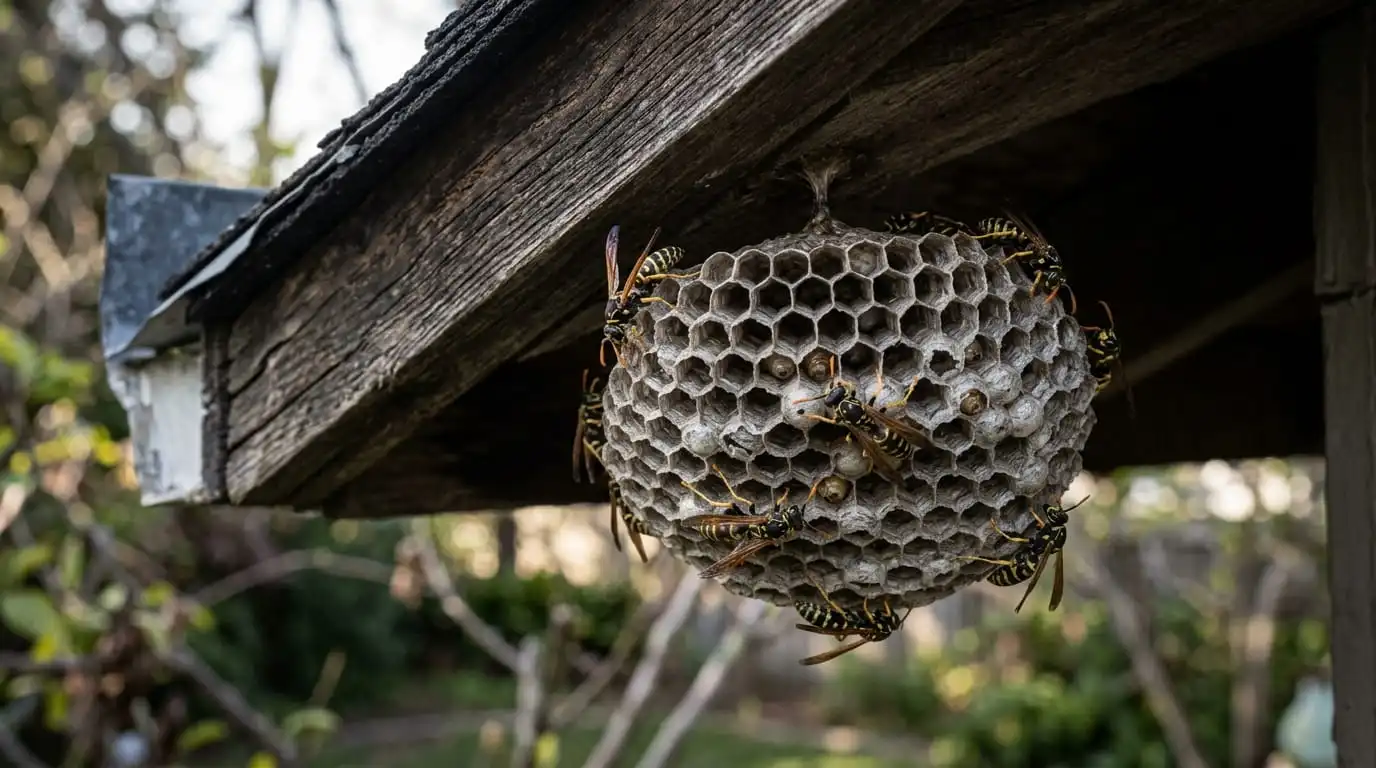
The paper wasp is the one known for creating that honeycomb-like structure of open nest under the eave and on the fence rail. The territorial insect will try to avoid any confrontation with an intruder until he approaches too close to the nest.
On the other hand, the yellowjacket is an aggressive species known for its ability to sting more than once and not die from doing so. It also prefers nesting places that cannot be reached easily and are well-hidden from the outside eye. It can be said that the yellowjackets are the reason why you suddenly face a dozen or so angry wasps while walking along a hole somewhere in the lawn.
The hornet bald-faced hornets, to be more specific likes to make an enclosed, gray papery nest hanging on the tree branch or roof overhang. They could also be considered the most defensive creatures among the three.
In general, being aware of what you deal with allows you to take appropriate measures.
What’s Actually Inside That Can of Wasp Spray?
Take a step into your local hardware store, and you will see rows and rows of wasp and hornet spray. Every one of them looks a little bit different from each other, and every one makes a little bit different claim. This is what really counts.
Your typical Raid, Spectracide, and Ortho brand of wasp spray all contain chemicals known as pyrethroids. Two examples would be cypermethrin and permethrin. What these chemicals do is very simple; they paralyze the wasp’s nervous system and kill it quickly upon contact.
The better products also leave what’s called a residual effect a chemical layer that stays active on the nest surface for days or even weeks after you spray. That is important since you rarely get rid of all the wasps at once. The worker wasps will come back to the nest after their trip outside, and if you have managed to apply your product correctly, they will also come into contact with the insecticide and will perish.
Those chemical sprays are the only choice you have got when facing an active and large-sized nest, mostly hornets and yellowjackets. They are potent and fast, and for such nests, speed is important.
What is negative about those products is that they are extremely toxic. Do not allow children and pets near them until the treated surface has dried completely. Be careful when using them around streams, ponds, and drainage ditches; some formulas containing bifenthrin may be highly toxic to fish and other wildlife species.
Read the label before you spray near water. It takes thirty seconds and could save a lot of headaches.
Natural and Plant-Based Sprays
If the word “pyrethroid” makes you nervous especially if you have young kids or a dog who treats the backyard like his personal kingdom there’s a solid alternative in plant-based sprays.
The star ingredient in most natural wasp sprays is peppermint oil. Its menthol compounds essentially overwhelm the wasp’s ability to navigate and function, acting as both a contact killer and a strong deterrent. Eucalyptus, clove, and lemongrass oils show up frequently in these formulas as well.
Do they work? Yes but with a realistic caveat. Natural sprays are genuinely effective for smaller nests and lighter infestations. They’re also excellent as preventive sprays on areas where you don’t want wasps to start building in the first place. What they typically can’t do is match the knockout power of a chemical formula against a large, mature colony of hornets. For that kind of situation, you need the synthetic stuff.
The other practical reality: natural sprays don’t last as long after application. Rain washes the scent barrier away, and it needs refreshing regularly every couple of weeks through peak season, or after every heavy rain.
Foam Sprays
Foam deserves its own mention because it solves a problem the other formulas simply can’t: hidden nests.
If you’ve traced wasp activity to a gap in your siding, a crack in the foundation, or a hole in the ground where they’re flying in and out, a standard aerosol stream isn’t going to reach the colony deep enough to matter Foam, however, covers all gaps, traps the wasps inside, and inundates their nests from within. It is designed specifically to handle situations like this and performs superbly when applied properly.
The Single Biggest Mistake Homeowners Make
I want to spend some time on this because it’s where most DIY wasp removal goes wrong — and it’s almost never about choosing the wrong product.
The nest is sprayed during mid-afternoon.
This makes perfect sense. After all, that’s when you found it. That’s when it’s bothering you. That’s when you feel like taking action. But there is no worse time to take down a wasp nest than mid-afternoon. There are two very good reasons why.
First, wasps are at their busiest and most aggressive during daylight hours. When you startle a nest at 2 PM on a sunny Saturday, the wasps you will be facing are sharp, quick, and ready to defend themselves. You are walking into the fight on their terms, not yours.
Second and this is the part people don’t think about a big chunk of the colony is out foraging.
However, they will soon be back to their nests. Even though the spray kills all the wasps currently at the nest, you will have to deal with many more once they get back and see their partly dead colony, but they’ll definitely pick up from where they left. You may end up getting stung for nothing.
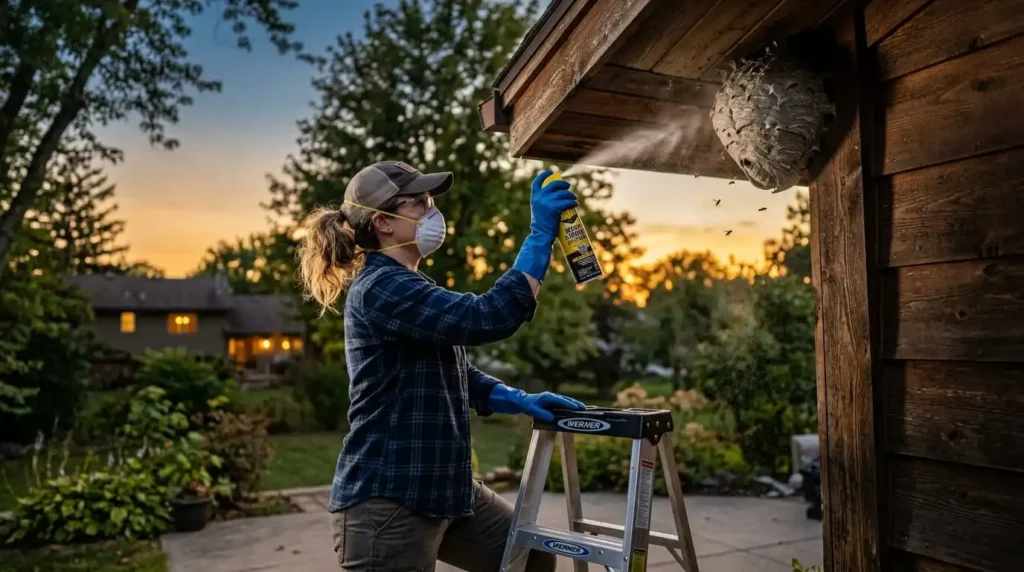
Early mornings, close to the dawn or evening, towards the sunset, are the best times for treatment since the temperature and lighting are relatively favorable. Most importantly, at that moment, most of the colony will be inside the nest. It is better to get rid of an entire population of wasps at once than some small portion of it.
That is more effective than any other factor such as the product used.
How to Actually Do It: A Real Step-by-Step
Okay. You’ve got your spray. It’s dusk. The nest is right there. Here’s exactly what to do.
Get dressed properly first. They’re not home. Therefore, even if your spray eliminates all the wasps currently in the nest, when these field workers come back several hours later, to find only a partly exterminated colony, they would just go back to work. You have failed in your mission; you’ve done more harm than good and you must have gotten stung a couple of times along the way.
The best time to exterminate your wasps is either very early in the morning, right before or immediately after dawn, or very late at night, just before or right after dusk. During these times, the weather is cool, there’s little light, and most importantly, almost all of the wasps in the colony are back inside the nest.
Just this single adjustment makes more sense than which spray you’ll use.
Walk the area before you touch the spray can. Know where you’re going to move after you treat the nest. Identify your exit path and make sure nothing is blocking it. The last thing you need is to spray and then fumble around looking for the gate latch while wasps mobilize behind you. Have a clear, unobstructed path already mapped out.
Position yourself upwind. This is non-negotiable. Spray drift in your face is unpleasant at best and genuinely dangerous at worst. Stand so any breeze carries mist away from your body.
Aim at the nest entrance first. The opening of the nest is where wasps escape. Hit it with a solid, sustained stream to cut off their exit route, then coat the rest of the nest exterior thoroughly.
Walk away don’t run. This is counterintuitive when every instinct says flee, but calm, deliberate movement is far less likely to trigger a chase response. Running signals panic. Move steadily and put some distance between yourself and the nest.
Leave it completely alone for 24 to 48 hours. This is the hardest part for people who want immediate confirmation that it worked. Resist the urge to check every hour. Come back the next morning and look for activity from a safe distance. If wasps are still flying in and out, give it one more treatment the following evening. And never attempt to remove the nest while it’s still active some survivors may still be trapped inside..
Take down the dead nest .Once you are sure there is no activity from the nest for more than a full day, knock it down using a stick or broomstick, while still wearing your gloves, place it into a bag and dispose of it in the trash can outside. Do not leave it hanging around once it is dead because the pheromones found in the nest will lure new queens looking for places to set up colonies.
It is important to treat the area where the nest was. Spraying it with an insecticide or a natural repellent will let the scouts know that the location is no longer suitable. This is also a good moment to address any small issues before they become bigger problems — sealing entry points around your home that wasps may have used to get inside is exactly the kind of preventive maintenance that saves you headaches down the road.
Chemical or Natural? Here’s How to Actually Decide
Forget about thinking too hard here, the answer boils down to two things.
How big the nest is and how much do these wasps defend themselves? In case you have a large, well-functioning wasp nest in an area that is usually occupied by people, whether for walking, eating, and playing use something harsh. You need the swiftest way to get rid of them.
What kind of people usually occupies this place, how often do they come? If your backyard is regularly frequented by kids and pets, and the wasp nest is just a small paper nest hidden away in some corner then peppermint is definitely what you should be going with. It may take two sprays instead of one, but it works perfectly fine.
A lot of experienced home owners and I’d include myself in this use a layered approach: chemical spray to eliminate the active nest decisively, then natural repellent applied to the surrounding area to prevent anything new from moving in. It costs a little more but covers all your bases.
When to Just Call Someone (And Not Feel Bad About It)
There’s no shame in recognizing when a job is beyond DIY territory. Here are the situations where calling a professional is genuinely the smarter move not laziness, not weakness, just good judgment.
Your nest is located within your wall cavities or attic spaces. When wasps are coming in and out of a hole in your siding or door frames but you cannot find out where exactly their nest is, blindly spraying into an empty space will not work and may even cause them to go further inside or push them out from another entry point.
The colony is very large. A nest bigger than a basketball, or activity coming from multiple locations on the same structure, warrants professional-grade products and protective gear.In these situations, even your home renovation service team or a property care professional may need to be involved — especially if the infestation has caused structural damage that requires repair once the colony is removed.
Conclusion
The problem with wasps is that they become an exaggerated concern unless you know how to handle it properly. Using the correct type of wasp spray at the proper time and method ensures that you will be able to manage the situation effectively. It doesn’t matter whether you want to use an aerosol spray that contains chemicals that can neutralize an entire nest of wasps or use a peppermint-based solution to ensure safety among your children and pets, the process is the same you have to prepare, apply, and take action. There are no shortcuts in removing and preventing wasps from coming back into your backyard.
FAQs:
Most drugstore wasp sprays, including brands like Raid, Spectracide, and Ortho, rely on pyrethroid chemicals such as cypermethrin and permethrin that paralyze a wasp’s nervous system on contact. Many of these formulas also leave a residual layer on the nest that stays active for days, so wasps that were out foraging get exposed once they return home.
It mostly comes down to nest size and how much foot traffic the area gets. Chemical sprays are the better choice for a large, aggressive nest like hornets or yellowjackets in a high-traffic spot, while a peppermint-oil spray works well for smaller nests and is a safer pick around kids and pets, even if it sometimes takes a second application.
Early morning or dusk is far better than mid-afternoon, since most of the colony is inside the nest and less aggressive during those cooler, lower-light hours. Spraying in the middle of the day means dealing with wasps at their most active and defensive, plus a chunk of the colony will still be out foraging and returning to a disturbed nest afterward.
A regular aerosol stream often can’t reach far enough into a hidden cavity to hit the actual nest, so foam spray is the better option since it expands to fill gaps and traps wasps inside. If you can’t pinpoint exactly where the nest is behind the wall, that’s a sign to bring in a professional rather than spraying blindly.
It’s worth calling in help once a nest is inside wall cavities or an attic space where you can’t see it directly, since spraying blind can push wasps further inside or out through another entry point. A nest larger than a basketball, or wasp activity coming from multiple spots on the same structure, is also a sign the job calls for professional-grade equipment.
Wait 24 to 48 hours and check for activity from a safe distance before touching it, treating again the next evening if wasps are still flying in and out. Once it’s confirmed dead, knock it down with a stick while wearing gloves, bag it, and remove it from the property promptly, since leftover pheromones can attract new queens looking to build there again.



1 thought on “What’s the Best Wasp Spray? A Homeowner’s Complete Guide”