
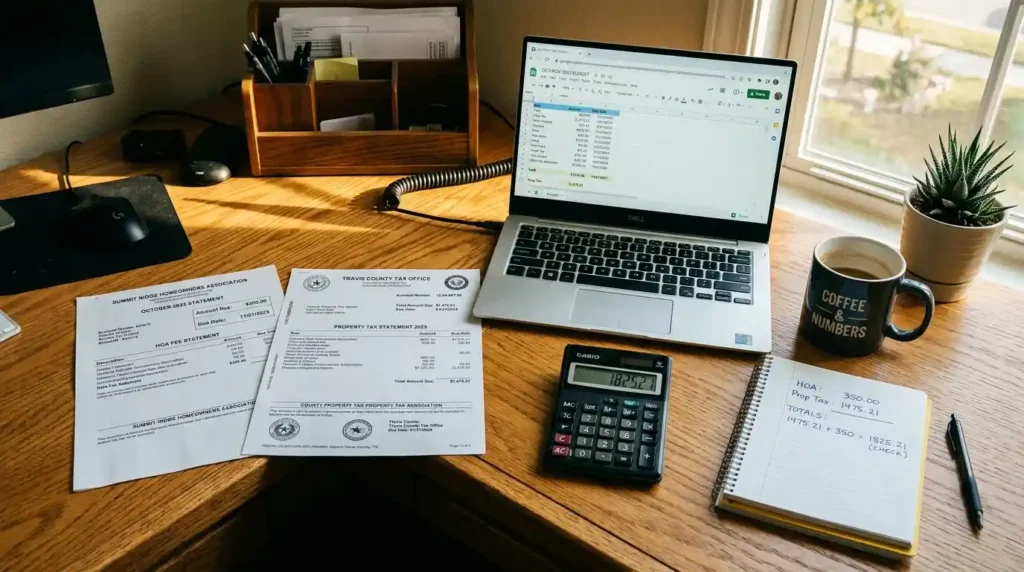
My coworker closed on her first condo last year and budgeted her monthly housing cost using just her mortgage payment plus her HOA fee, assuming that covered everything. Her first property tax bill arrived a few months later completely separate from either number, and she said her stomach actually dropped a little seeing the total. She’d genuinely thought her $380 monthly HOA fee was doing double duty, covering both building upkeep and her share of property taxes. It wasn’t. This piece breaks down whether HOA fees include property tax, what each cost actually pays for, and how to avoid the same budgeting mistake she made.
Does HOA Include Property Tax? Here’s the Direct Answer
No, HOA fees and property taxes are two completely separate costs, billed by different parties for entirely different purposes. My coworker’s confusion is genuinely common though, since both show up as recurring housing costs and both get paid regularly, which makes them feel like they might overlap somehow even though they don’t.
The association collects HOA dues to run the building itself, maintenance, insurance on shared spaces, reserve funds. Local government collects property taxes separately, going toward schools, roads, public services that have nothing to do with the building’s HOA at all. My coworker’s mortgage lender should’ve flagged this distinction clearly during closing, she said in hindsight, but the paperwork moved fast enough that the difference just didn’t register until that separate tax bill showed up months later.
Do Condo Fees Cover Property Taxes?
No, condo or HOA fees never cover property taxes, these are two entirely separate bills paid to different entities. My coworker’s specific mistake was assuming her $380 monthly fee was somehow bundling both costs together. It wasn’t, it covered only the building itself, and her property tax bill arrived on its own timeline from an entirely different office months later.
What HOA Fees Actually Pay For
My coworker’s condo fee landed right around $450 a month, which she thought was on the higher side until she compared notes with a friend in a single-family HOA paying closer to $250. Condo associations generally handle more shared infrastructure, roofing, elevators, exterior walls, things a single-family HOA rarely touches, which explains a lot of that gap.
She eventually got an itemized breakdown from her management company after calling to ask what she was actually paying for. Administration costs took one slice. Ongoing maintenance took another. The last piece went toward a reserve fund, money set aside now for a roof replacement or elevator overhaul that might not happen for another decade. That reserve piece genuinely surprised her most, she’d assumed her whole fee covered things she could immediately see, landscaping, the pool, hallway lighting, not something years off in the future.
What Does an HOA Fee Typically Cover?
My coworker’s own breakdown ended up covering three main buckets once she finally saw it laid out. Day-to-day maintenance, administration, and reserve contributions for bigger repairs down the line. None of it touched her individual property tax bill at all. That arrived from her county assessor entirely separately, on its own schedule. Calculated off her unit’s assessed value rather than anything her HOA collected.
Who Actually Pays Property Taxes on a Condo
Individual unit owners pay their own property taxes directly. Based on their unit’s assessed value, not the HOA collectively on behalf of everyone. My coworker’s tax bill came straight from her county assessor’s office. Calculated off her specific unit’s value alone, nothing pooled together with her neighbors or paid through the association at all.
Property tax on shared common areas, hallways, the pool, the parking structure, generally gets folded into each owner’s individual assessment. As a proportional share instead of billed separately as one collective amount. She ended up calling her county assessor directly to actually understand this part. Since nothing in her closing paperwork spelled it out clearly enough for her to piece together herself.
Who Pays Property Taxes on Condo Common Elements?
Each unit owner pays a proportional share of the common-area tax burden folded into their own individual property tax bill. My coworker had to call her county assessor’s office to understand exactly how her share got calculated. Since her closing documents never explained it. The exact method varies by state and even by county, so a quick call to local tax authorities. Beats guessing based on what worked for a friend somewhere else entirely.
How to Budget Correctly for Both Costs
Getting an accurate total housing cost means adding three separate numbers, mortgage payment. HOA fee, property tax, treating none of them as overlapping with each other. My coworker’s redone budget, built right after that surprise tax bill landed, finally accounted for all three honestly. The corrected total came out noticeably higher than what she’d originally qualified for based on mortgage payment alone.
Checking a property’s tax history before buying avoids this exact surprise. County assessor websites usually list current and historical tax amounts by parcel number or address. Something she wishes she’d pulled up herself before closing instead of trusting her lender’s estimate had it all figured out already.
How Do I Find Out the HOA Fees and Property Taxes for a Specific Property?
HOA fees show up through the listing agent. A property’s resale certificate, or directly from the HOA management company handling that community. Property tax amounts are public record, searchable through the county assessor or recorder’s website using an address or parcel number. My coworker now checks both sources separately before even touring a property. Having learned firsthand that a single combined number on a listing site can quietly leave one of these costs out entirely.
Conclusion
HOA fees and property taxes are genuinely separate costs, and my coworker’s underestimated budget is a pretty direct example of what happens when someone assumes otherwise. HOA dues fund the building and its shared spaces. Property taxes fund local government, billed by the county based on your unit’s individual assessed value. Budget for both as distinct line items from the very start, and check a property’s actual tax history before buying so nobody’s stomach drops the way hers did months after closing.
Frequently Asked Questions
Does HOA include property tax in the monthly fee?
No, HOA fees and property taxes are always separate costs billed by different entities for different purposes. HOA dues fund building maintenance and shared amenities, and property taxes fund local government services, billed directly by the county or city.
Are HOA fees tax deductible?
Generally no for a primary residence, though a portion may be deductible if the property is used as a rental or for business purposes. Consulting a tax professional about your specific situation is worth doing, since deductibility rules can shift depending on how the property is actually used.
How much are typical HOA fees compared to property taxes?
HOA fees for single-family communities typically run $200 to $400 monthly, and condo fees often run $300 to $700, given the additional shared infrastructure condos usually maintain. Property tax amounts vary far more widely by location, since they’re based on assessed home value and local tax rates instead of a standard fee structure.
Can I pay my property taxes through my HOA?
No, property taxes must be paid directly to the local tax authority, usually the county, and cannot be paid through or bundled into an HOA payment. Some mortgage lenders do collect property taxes through an escrow account as part of the monthly mortgage payment, but that’s separate from anything the HOA itself collects or manages.