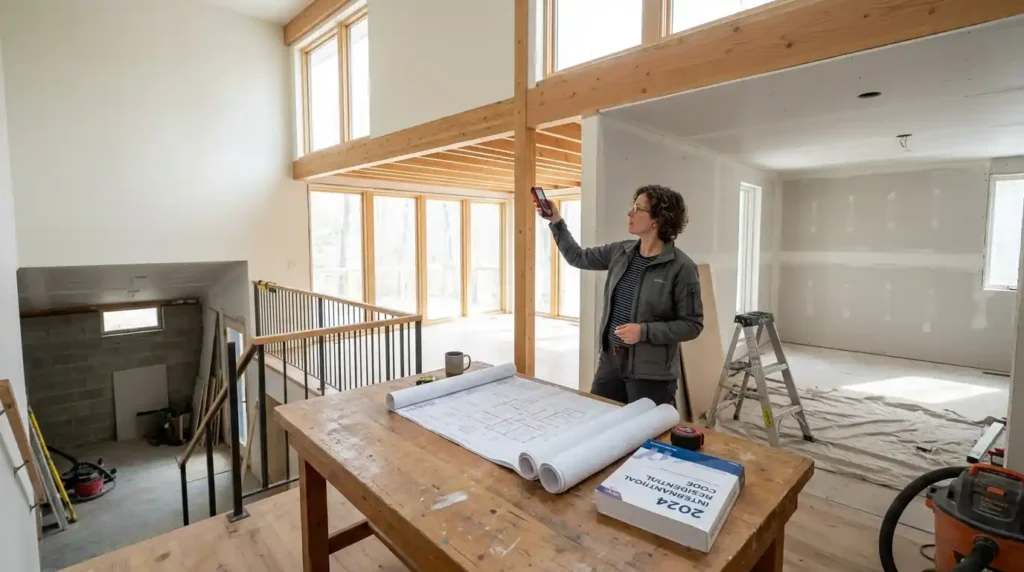
Most discussions about ceiling height requirements usually begin the same way; someone is considering converting their basement into something else or renovating their attic or loft and realizes that they have no idea how the requirements work. I recall being there once, myself, measuring the height in a half-completed basement to determine whether or not 6′ 10″ would be acceptable. As it turns out, it all depends on the location, use of the space, and what version of which building code applies to the particular construction being performed. Mistakes made in this area can be extremely costly when the walls are already framed, not to mention embarrassing.
The minimum ceiling height requirement tends to be among the building code provisions that everyone assumes is simpler than it really is. However, depending on room type, occupant classifications, geographical location, and whether one is doing new construction or altering an existing building, the standards required may differ widely. It will therefore help a lot for one to understand the standard ceiling height requirements and their design implications early enough.
IRC and IBC Minimum Ceiling Height Requirements: What US Building Codes Actually Specify
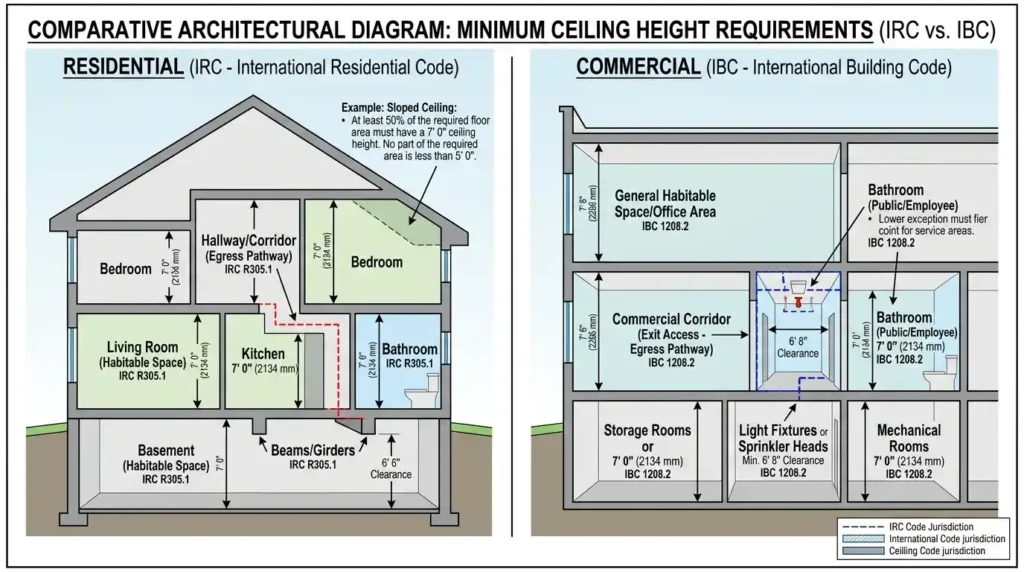
The code that determines the minimum ceiling height is found in the IRC Section R305 which distinguishes ceiling heights based on room types. Spaces considered as habitable such as the bedroom and the living room are required to have ceilings that measure 7 feet according to IRC Section R305. Hallways and basements with habitable spaces are expected to adhere to the same minimum ceiling height of 7 feet. The minimum for bathrooms and laundry spaces is 6 feet and 8 inches while basements without habitable spaces and hallways have a minimum ceiling height of 6 feet and 8 inches.
Where beams and girders project below the ceiling surface within habitable spaces, the IRC permits a minimum projection down to 6 feet 6 inches from the finished floor provided the beams are spaced not less than 4 feet on center, with a maximum beam projection of 6 inches below the required ceiling height. For sloped ceiling design, the 50 percent area rule applies: at least 50 percent of the required floor area must have the full minimum ceiling height, and no portion of the required floor area may have a ceiling height below 5 feet. Any area falling below that 5-foot threshold is excluded from the minimum area calculation entirely.
International Building Code IBC
The International Building Code IBC applies to commercial and institutional occupancies and establishes slightly different thresholds. Under IBC Section 1208.2, occupiable spaces the commercial equivalent of habitable spaces and corridors must achieve a ceiling height of not less than 7 feet 6 inches above the finished floor. Bathrooms, kitchens, storage rooms, and laundry rooms in commercial buildings can drop to 7 feet. A furred ceiling design in commercial occupancies must maintain the minimum ceiling height in at least two-thirds of the area, and in no case may the furred ceiling portion fall below 7 feet. According to IBC Section 1003.2, means of egress must have a minimum ceiling height of 7 feet 6 inches, while any approved projections must maintain at least 80 inches (6 feet 8 inches) of clear headroom in all circulation areas.
California Building Code
The California Building Code adds healthcare-specific minimum ceiling height requirements under OSHPD provisions: hospitals must maintain 8 feet as the minimum ceiling height, with exceptions dropping to 7 feet for closets, toilet rooms, bathrooms, and soffits over fixed cabinets and work surfaces. The Minnesota Residential Code adds specific guidance for existing building alterations: basement renovation ceiling height must reach at least 6 feet 4 inches including beams, girders, ducts, and other obstructions. Minnesota also specifies that bathroom minimum ceiling height of 6 feet 4 inches applies at the center of the front clearance area for water closets, bidets, and sinks with the shower tub area requiring 6 feet 4 inches above a minimum 30 by 30 inch area at the showerhead wall.
2018 IEBC International Existing Building Code
The 2018 IEBC International Existing Building Code provides additional guidance for alteration projects, noting that the minimum ceiling height of newly created habitable and occupiable spaces must meet current code requirements which matters significantly for basement renovation, loft conversion, and attic conversion projects where existing structural conditions may make compliance challenging.
UK Minimum Ceiling Height Standards: What London and the Rest of England Actually Require
The UK minimum ceiling height situation is both simpler and more ambiguous than the US framework. There is no single piece of building legislation that sets a legally mandated minimum ceiling height for habitable rooms in most of England which surprises most homeowners and even some architects encountering this for the first time. Building regulations suggest a minimum floor to ceiling height of 2.1 meters 6 feet 11 inches for habitable spaces including living rooms, bedrooms, and kitchens, though this is technically permissible at a level far below what most people consider comfortable for a habitable room. At the absolute minimum end, 210 centimeters is the resale consideration threshold with 200 centimeters considered an absolute minimum pushing it boundary that most design professionals would advise against.
London Ceiling Height
London, however, follows even more stringent building codes. New buildings in London need to have a minimum ceiling height of 2.5 meters (8 feet 2 inches) due to the updated building laws in consideration of the challenges presented by the high-density nature of London, as well as the understanding of the correlation between the ceiling height and light and ventilation within an urban environment. According to the Royal Institute of British Architects (RIBA), there should be a living room ceiling height of 2.4 meters, which corresponds to the National House Building Council (NHBC) standards followed by reputable home builders throughout the country.
UK Ceiling Height
When it comes to UK ceiling height over staircases, the headroom for the building regulation is a minimum of 2 meters and 6 feet 6 inches. In the case of loft conversions, one needs to be careful as to calculate the ceiling height as the sloping of the ceiling and headroom constraints will decrease the useable area of the room. The RIBA guide of having a ceiling height of about 2.1 meters for at least half the area of the loft conversion room is an excellent guideline.
Ceiling Heights In Victorian And Edwardian
Ceiling heights in Victorian and Edwardian architecture often exceeded modern standards, creating a greater sense of space, light, and elegance. Victorian ceiling height typically ranged from 2.7 meters to 3 meters in standard residential construction, with prestigious period property formal rooms including drawing rooms and entrance halls frequently exceeding 3 meters. Upper floors in period property buildings were more modest at around 2.7 meters. Post-war housing ceiling heights dropped to 2.1 meters to 2.3 meters as materials shortages, budget constraints, and a need for affordable efficient housing reshaped construction priorities. By the 1930s, 2.4 metre ceiling heights became more common in suburban development. Modern UK builder preferred range sits at 2.4 meters to 2.6 meters, with ceiling height trend upward in new builds reflecting both improved construction economics and changing buyer expectations.
UK Commercial Ceiling Height
UK commercial ceiling height standards show a marked variation from residential. Office buildings typically feature ceilings from 2.7 meters to 3 meters, aligned with the IBC commercial occupancy principles despite operating under different regulatory instruments. Hospital minimum ceiling height in the UK follows institutional building guidance that prioritizes both clinical functionality and patient wellbeing.
Australia, Canada and Global Standards: How Minimum Ceiling Height Varies Internationally
Minimum ceilings height specifications for Australia are based on the National Construction Code NCC system. Minimum habitable room requirements in Australia for bedrooms, living rooms, and similar type of rooms are 2.4 meters. For non-habitable rooms such as kitchen, bathrooms, and laundry rooms, the minimum requirement is 2.1 meters. Although there is a minimum specification of 2.4 meters, ceiling heights in newly constructed buildings in Australia are now at an average of 2.7 meters owing to the recognition of the effect of ceiling heights on room feel and natural lighting. It has been proven to be an inexpensive addition at only 2.55 meters instead of 2.4 meters with the difference being just nominal, but can drastically change the feel of the room an advice always given by Australian architects and builders.

National Building Code Of Canada (NBC)
The National Building Code of Canada (NBC) sets the minimum ceiling height for habitable spaces at 6 feet 11 inches, closely matching IRC standards while accounting for Canadian building needs. Typically, new structures erected in Canada are provided with either 8′ or 9′ ceilings, as this helps strike a balance between thermal efficiency and aesthetic appeal, especially in the country’s warm southern areas.
Ceiling Height Psychology, Design, and the Experience Every Designer Should Understand
Ceiling heights and the related psychology are uniform in various studies, with high ceilings making people feel spacious, luxurious, creative, and inspired. Low ceilings make people feel cozy, warm, intimate, and grounded, giving people a sense of safety and protection, which is why low ceilings are preferred in bedrooms, snug rooms, and small apartments when comfort and warmth are sought after rather than luxury and elegance. Neither choice is inherently better the wisdom behind the design is using the right ceiling heights according to their functional features.
Larger Ceilings
In open plan spaces, larger ceilings allow the creation of more spacious and connected rooms with an aesthetic appeal similar to hotel lobbies or galleries. High ceilings provide a specific acoustical performance and sound characteristics that are more suitable for living rooms and studios but less so for dining rooms unless additional sound isolation is used. Lower ceilings, on the other hand, provide a peaceful and intimate atmosphere in spaces due to the way sound moves around in lower ceilings.
Architectural Details
Ceiling height also dictates the way architectural details get expressed. Designing an exposed beam ceiling, designing a vaulted ceiling, and designing a coffered ceiling all rely on ceiling height. It becomes difficult to execute a coffered ceiling successfully in a 2.4-metre room as it comes across as compressed as opposed to elegant. The placement of pendant light and chandeliers is done following the guideline that the bottom of the fixture needs to be about 7 feet off the floor of the room, which means there is little room available for installing pendants in a 2.4-metre room but plenty in a 3-metre room for statement-making chandeliers to make their mark. Proportion of artwork, proportion of shelves, and potential of having a mezzanine are all dictated by ceiling height in much the same way.
Raising Ceiling Height
Raising ceiling height in renovation and existing building projects is possible removing a dropped ceiling design or furred ceiling design layer sometimes reveals meaningful additional height above but structural alteration for genuine ceiling height renovation requires building regulations approval in the UK, building permit applications in the US, and equivalent planning permission processes in Australia and Canada. The ceiling height renovation cost impact and ceiling height structural alteration complexity means this decision deserves careful professional assessment before being committed to rather than discovered as a pleasant possibility mid project.
Conclusion
Ceiling height, as a requirement for buildings, falls into the category of those codes that make things easier to understand before you do them than afterwards. Regardless of whether you are dealing with the US code’s 7 foot minimum habitable space in the basement, the UK’s 2.1 metre minimum recommendation for converting a loft, the 2.4 meter minimum required by the NCC for Australia, or the 7′ 6″ minimum requirement by the IBC for an occupiable space in a commercial setting, the number is significant. But so are the issues beyond code compliance ceiling height psychology, space effectiveness, natural lighting, acoustics, and resale value all hinge upon getting the ceiling height right. The extra inches needed to clear the minimum will not cost you much in terms of construction time or money. Fixing a ceiling height problem, however, will be far more expensive.
FAQs
Under IRC Section R305, habitable spaces like bedrooms and living rooms need a minimum ceiling height of 7 feet, and that same 7-foot minimum applies to hallways and any habitable space created in a basement. Bathrooms and laundry rooms are allowed to drop slightly lower to 6 feet 8 inches, since those spaces don’t carry the same occupancy expectations as a bedroom or living room.
The IRC governs residential construction and sets a 7-foot minimum for habitable spaces, while the IBC applies to commercial and institutional buildings and requires a higher 7 foot 6 inch minimum for occupiable spaces and corridors. Means of egress under IBC rules need that same 7 foot 6 inch clearance, though approved projections are allowed to reduce headroom slightly to 6 feet 8 inches in circulation areas.
For sloped ceiling designs, at least 50 percent of the room’s required floor area needs to meet the full 7-foot minimum, and no portion of that required floor area can measure below 5 feet. Any section of the room below that 5-foot threshold simply gets excluded from the floor area calculation entirely rather than counting against the room.
In the US, a basement space needs to hit the same 7-foot minimum as any other habitable room once it’s being converted into living space, not just used for storage. In the UK, there’s no single legally mandated minimum, but RIBA guidance suggests around 2.1 meters (roughly 6 feet 11 inches) across at least half the area of a loft conversion room as a sensible benchmark.
It can meaningfully change a room’s feel and functionality, sometimes by removing a dropped or furred ceiling layer to reveal existing height underneath, but any structural alteration for genuine height changes requires formal approval, whether that’s building regulations in the UK, a building permit in the US, or planning permission in Australia and Canada. Given that complexity and cost, it’s a decision worth assessing with a professional upfront rather than discovering as a possibility partway through a project
The US IRC sets a 7-foot minimum for habitable rooms, the UK has no strict legal minimum but suggests around 2.1 meters (6 feet 11 inches), and Australia’s National Construction Code requires 2.4 meters for habitable rooms like bedrooms and living rooms. London goes further than the rest of the UK, requiring new buildings to hit 2.5 meters (8 feet 2 inches) specifically due to density and light considerations in the city.