Ruined a rug once. Not badly, not permanently, but enough that for about two years there was a faint yellow patch near the fireplace that I had to strategically cover with a floor lamp. What happened was embarrassingly simple I mixed a homemade carpet cleaner without checking whether the dish soap I grabbed had blue dye in it. It did. Light grey carpet, blue dye, no patch test. Lesson learned the hard way, as most useful lessons are.
That was maybe six or seven years ago. Since then I’ve cleaned up more carpet disasters than I can count pet stains, a full glass of red wine at a house party, my son’s phase where he thought the hallway carpet was an appropriate place to eat tomato soup, mud tracked in from the garden every single winter. You figure things out. You also figure out pretty quickly that spending $25 on a bottle of carpet cleaning formula every couple of months is, as my grandmother used to say, a mug’s game.
Why Household Ingredients Beat the $25 Bottle Every Time
Here’s the thing nobody tells you about commercial carpet cleaning solution: you’re mostly paying for water, fragrance, and branding. The actual cleaning agents surfactants, mild enzyme cleaner base, an oxidising compound are things you either already own or can buy at a dollar store for less than two dollars combined. I’ve done the math. A proper DIY carpet cleaning solution made from household ingredients costs roughly $1 per gallon. A half-gallon of Rug Doctor solution runs about $20. I don’t need a spreadsheet to work out which one wins.
White vinegar is where almost every good homemade carpet cleaner starts. Distilled white vinegar specifically the acetic acid in it is what does the work. It breaks down embedded dirt, cuts through the organic compounds sitting in carpet fibres, neutralises odour-causing molecules rather than covering them up, and handles bacteria reduction without anything harsh touching your carpet pile. The smell, yes, it’s there. It disappears completely once the carpet dries. I’ve had people walk into a room I’d cleaned two hours earlier and compliment how fresh it smelled. The vinegar smell is temporary. The clean is not.
Baking soda is the other half of that pairing. Dry, powdery, completely unimpressive to look at and genuinely useful. It absorbs moisture, pulls organic compounds upward out of carpet texture, and its deodorising properties go after the kind of deep-set smell that comes from pet urine that’s had time to work its way into carpet underlay. When you combine baking soda and white vinegar the fizzing reaction isn’t just visual. The agitation is actually doing mechanical work against stain residue in the carpet pile.
3% hydrogen peroxide is the third ingredient worth keeping around. Natural bleaching agent, brightens synthetic carpet and nylon carpet fibres, breaks down grease stains and blood stains without the nuclear option of chlorine bleach. The 3% is important that’s the standard brown-bottle pharmacy kind. Hair bleach is 6–10% hydrogen peroxide and I promise you do not want that near your carpet. Check the bottle. Most of the time you’re fine, but check.
Castile soap or clear liquid dish soap, a bit of cornstarch for paste recipes, salt for fresh urine deposits, lavender essential oil or tea tree oil for genuine deodorising properties rather than just fragrance these aren’t decoration. Tea tree brings mild antimicrobial action. Lavender handles bacteria reduction alongside the vinegar. Add 10 drops of either to your spray bottle solution and the carpet smells genuinely clean when it dries, not perfumed-over-dirty. There’s a difference and you can tell.
Four Recipes, Each One Earning Its Place
I want to be specific here because “mix vinegar and baking soda” is the kind of vague advice that leads to yellow patches and sad floor lamps.
The machine recipe the one that goes into your Bissell machine, Rug Doctor rental, or upright carpet cleaner needs to be a concentrated solution you then dilute per your machine’s instructions. Mix 2 tablespoons liquid laundry detergent (liquid Tide is reliable, or squeeze the contents out of a Tide pod), 1 tablespoon OxiClean or the dollar-store equivalent, a small pour of Downy fabric softener, into 1 gallon hot water. Hot water matters. It dissolves dirt and residue more effectively and activates the cleaning agents properly. This runs through a SpotBot handheld, an upright Bissell, a Rug Doctor rental I’ve used all three, no machine issues, no damage to carpet fibres. Cost: about $1 per gallon versus $20 for a commercial half-gallon. I’ve made this in batches and kept it in an amber glass bottle under the sink.
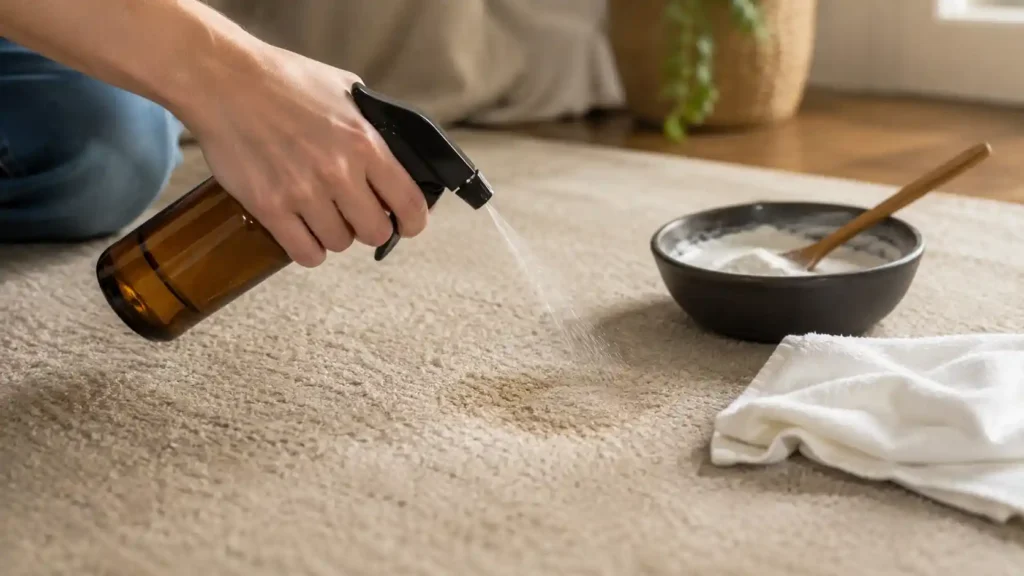
The everyday spray bottle solution handles food spill, beverage spill, coffee stain, most of what daily life throws at carpet. Combine 1 cup distilled white vinegar, 1 cup warm water, 1 tablespoon clear dish soap Blue Dawn works well here because of how it handles grease and a few drops of lavender essential oil. Into a spray bottle. Lightly mist the stain. Don’t soak it. 5–10 minutes dwell time, then blot with a clean microfibre cloth. Blot, don’t scrub scrubbing pushes the stain deeper into carpet fibres and into carpet underlay where set-in stains live. Work from the outside edge of the stain inward. Rinse and repeat as needed. Air dry completely, ideally with a window open or a fan running.
The paste recipe is for the serious ones. Red wine stain. Mud stain after it’s dried in. Blood stain. Vomit stain, which — if you have kids or pets is a matter of when, not if. Mix 3% hydrogen peroxide, a small amount of Castile soap or liquid dish soap, and cornstarch until you get a paste. The 1:2 ratio is what holds: one part dish soap to two parts hydrogen peroxide. Cornstarch in the mix draws moisture upward while the peroxide works through the stain from above. Cover the entire stain with paste. 15–30 minutes dwell time minimum. Then a damp microfibre cloth or old toothbrush gently to work the residue loose. Blot clean.
The dry deodoriser recipe doesn’t involve liquid at all, which is sometimes exactly what a situation needs. Mix ¼ cup baking soda with 10 drops essential oil. Sprinkle it across the carpet really useful for high-traffic zones that have absorbed months of foot traffic smell, or for pet areas. Let it sit 15 minutes minimum then vacuum with a fine particle vacuum. For fresh pet urine, pour salt directly onto the damp area first to absorb the liquid — the salt pulls urine crystals upward before they can travel down into carpet underlay. Let the salt work 10–15 minutes, vacuum, then follow with the spray solution. Urine odour neutralisation only works if you address what’s actually in the carpet, not just what you can smell at the surface.
The Part Most Guides Skip — Matching Your Mix to Your Carpet
Wool carpet is not synthetic carpet. This matters enormously and a lot of DIY carpet shampoo guides write as though all carpet is the same material, which it isn’t.
Wool fibres have a lower pH tolerance than nylon carpet or blended carpet. Straight white vinegar even diluted in the standard 1:1 ratio can damage wool fibre structure if used repeatedly. For wool carpet, the safe version is: 1 teaspoon wool-safe detergent, 1 teaspoon distilled white vinegar, 1 litre warm water. Gentle. Light blotting technique. Dry thoroughly because underlay under wool holds moisture longer than the surface feels. Synthetic carpet and blended carpet tolerate the standard recipes without issue.
Whatever the carpet type patch test first. Always. Press a damp cloth with your solution onto an inconspicuous spot and wait for it to fully dry before touching the main area. Some dyes are not stable. Some colourfast carpets are not as colourfast as labelled. I know it feels like an unnecessary step when you’re staring at a fresh red wine stain and your guests are still in the next room. Do it anyway, or accept the possibility of a floor lamp situation.
Over-saturation ruins more carpet cleans than wrong ingredients do. When carpet fibres, carpet pile, and carpet underlay absorb too much liquid, drying time stretches out, mould risk increases, and residue gets left deep in carpet texture where it attracts more dirt over time. Light, even application damp not wet followed by proper air drying. One or two passes with a carpet cleaning machine. Open windows. Don’t walk on it until it’s dry.
The Real Reason to Make the Switch
The safe carpet cleaner for babies crawling, safe for pets framing gets used a lot in DIY content and it sounds like marketing but it’s actually just chemistry. Commercial products regularly contain ammonia, borax in concentrations that linger in carpet fibres, and fragrance compounds that don’t break down quickly. Residue-free result isn’t cosmetic it’s about what your kids and pets are absorbing through prolonged skin contact with carpet pile they spend hours on daily.
An eco-friendly carpet cleaner made from household ingredients doesn’t affect indoor air quality the way aerosol commercial products do. It costs a fraction of the store-bought alternative. You can make a natural carpet shampoo machine recipe in a large batch, adjust the dilution ratio up for deep cleaning or down for light maintenance, swap the essential oil based on what you have. It’s adaptable in a way that a sealed commercial bottle isn’t.
The maintenance rhythm that actually keeps carpet looking decent: vacuum high-traffic zones regularly, do the dry baking soda deodoriser treatment monthly, hit stains immediately with the spray bottle solution the moment they happen. A fresh food spill is a two-minute job. The same spill after 48 hours is a paste treatment and a 30-minute dwell time and possibly a second round. Same stain, completely different amount of work depending on whether you caught it early.
How to remove old carpet stains naturally which is what most people are actually googling at midnight while staring at something that’s been there three weeks comes down to repetition more than chemistry strength. A second or third application of a diluted homemade carpet cleaner, with proper dwell time and blotting technique between rounds, outperforms a single aggressive treatment with stronger product nearly every time. The carpet cleaning hacks that work aren’t dramatic. They’re patient. That’s almost never what people want to hear, but it’s what the carpet needs.
FAQs
Most effective homemade recipes build around white vinegar, baking soda, 3% hydrogen peroxide, and a clear dish soap or castile soap, each doing a different job. Vinegar breaks down dirt and neutralizes odor at the source, baking soda absorbs moisture and lifts residue upward, and hydrogen peroxide brightens synthetic fibers and handles tougher stains like blood or grease.
Yes, largely because commercial carpet cleaner is mostly water, fragrance, and branding built around the same basic cleaning agents, surfactants, mild enzymes, and an oxidizer, that a homemade mix uses. A DIY solution made from household ingredients costs roughly $1 per gallon compared to about $20 for a half-gallon of commercial solution, without sacrificing cleaning performance for most everyday stains.
Mix 2 tablespoons of liquid laundry detergent, 1 tablespoon of OxiClean or a similar dollar-store equivalent, and a small pour of fabric softener into 1 gallon of hot water, since hot water dissolves residue and activates the cleaning agents more effectively than cold. This concentrated mix works in an upright machine, a handheld spot cleaner, or a rental unit, and can be batch-made and stored in a bottle under the sink between uses.
A paste made from 3% hydrogen peroxide, a small amount of dish soap or castile soap, and cornstarch in a 1:2 ratio of soap to peroxide is built specifically for stubborn set-in stains. Covering the stain completely and letting it sit for 15 to 30 minutes before gently working it loose with a damp cloth or toothbrush gives the peroxide time to actually break the stain down rather than just sitting on the surface.
Not the standard recipe — wool fibers have a lower pH tolerance than synthetic or blended carpet, so straight vinegar used repeatedly, even diluted, can damage the fiber structure over time. A gentler wool-safe version using 1 teaspoon of wool-safe detergent, 1 teaspoon of white vinegar, and 1 liter of warm water, followed by light blotting rather than saturation, is the safer approach.
A homemade solution runs roughly $1 per gallon versus around $20 for a half-gallon of commercial cleaner like Rug Doctor solution, which adds up quickly if you’re cleaning carpets regularly. Beyond the cost difference, most of the ingredients (vinegar, baking soda, dish soap) are things people already have at home or can pick up cheaply, so there’s little upfront investment needed to start making the switch.